
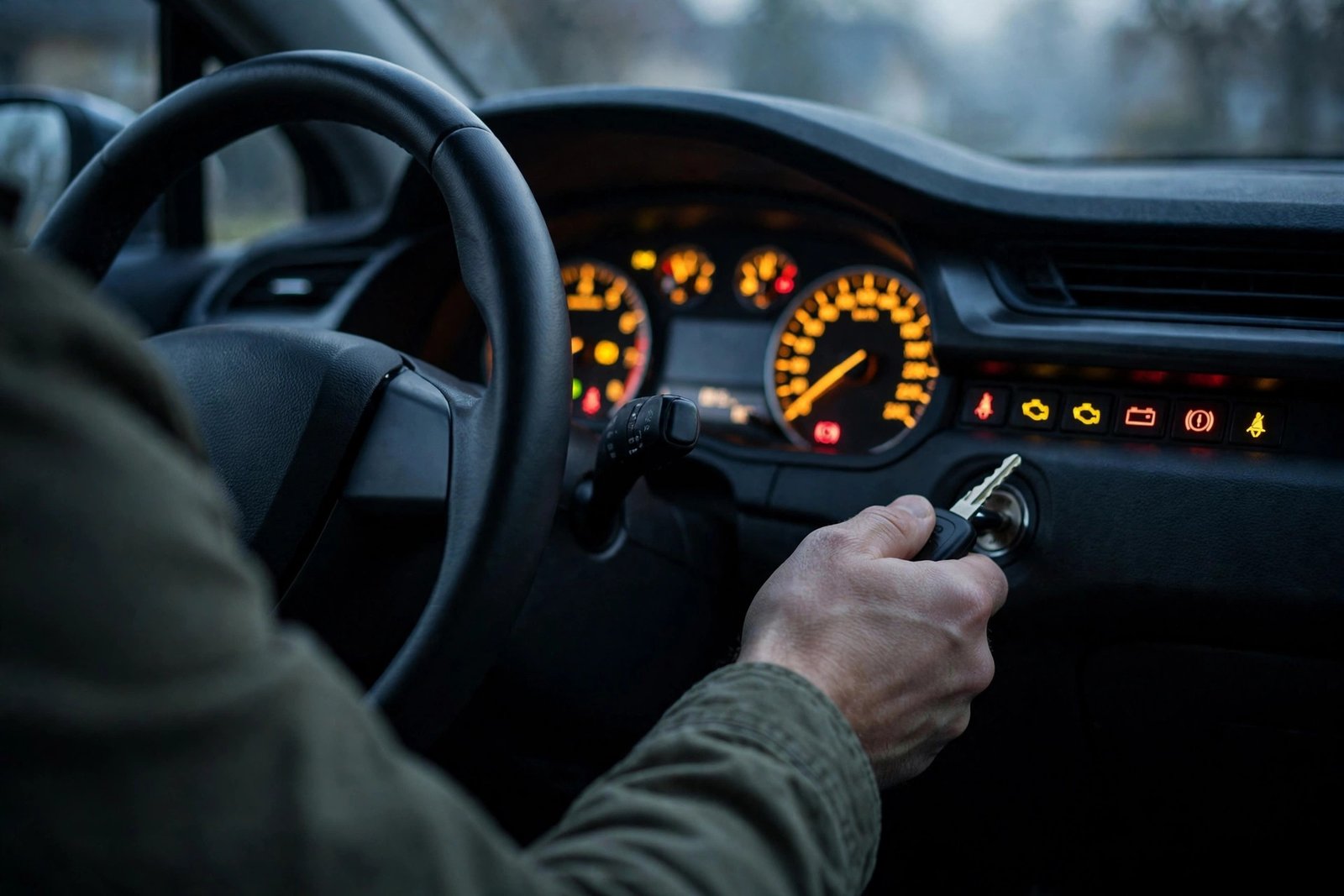
When your car cranks but won’t start — the engine spins over at full strength but never fires — the battery and starter have already done their job. Something the engine needs to actually run is missing: fuel, spark, compression, correct timing, or the immobilizer’s permission to start. This guide branches by what you see and hear in the first few seconds, so you diagnose in likelihood order instead of guessing.
Not your symptom? If you hear rapid clicking or a single click with no real cranking, that’s a battery/starter connection problem, not this one — see our guide car won’t start with a clicking sound but battery is good.
In this guide, you’ll learn:
- How to branch your diagnosis by crank speed, pump sound, security light, and tachometer behavior
- The 8 causes in order of likelihood, each with its signature symptom
- Safe checks you can do in the driveway with no tools
- When to stop cranking and call for a tow
- Typical repair cost ranges for each cause (verified 2026-10-14)
Safety first: Do all fuse/terminal inspections with the ignition OFF (disconnect the negative battery cable first, reconnect it last). Never crank more than ~10 seconds at a time — let the starter cool for about a minute between tries. Keep hands, clothing, and tools away from belts and fans. Fuel-system checks are observation-only: listen for the pump and read the gauge; never open fuel lines.
Which Branch Are You On? Read the Symptoms First
No two crank-no-starts fail the same way. Match yours before you touch anything — this is the fastest path to the cause:
- Gauge at or near E, or you can’t remember the last fill-up → add fuel first. It’s the cheapest fix in this guide and more common than anyone admits.
- Normal crank speed, but NO brief hum from the rear when you turn the key to ON → the fuel branch: empty tank, dead pump, or a blown pump fuse/relay.
- Normal crank speed, pump hums, but the tachometer needle stays flat at zero while cranking → the sensor branch: the ECU may not be seeing engine speed (crankshaft position sensor).
- Normal crank speed, pump hums, tach moves, never fires → the spark branch: coils or spark plugs (needs shop-level testing to confirm).
- Security or key/padlock light flashing while you crank → the immobilizer branch: the car isn’t recognizing your key. Try the spare key.
- Starts, runs a second or two, then dies → immobilizer or fuel supply problem — note which, the branches above split them.
- Fails only when hot; restarts after cooling down → a heat-sensitive crank sensor or a fuel pump failing when hot.
- Cranking sounds unusually FAST — a whirring spin with no resistance → stop immediately. Possible broken timing belt or chain (lost compression). Tow it; do not keep cranking.
- Cold morning, strong fuel smell, you moved the car briefly yesterday → flooded engine.
The Most Likely Causes, in Order
1. Empty or nearly empty fuel tank (check this first)
Signature: Gauge reads E — or reads a quarter but the car died right after a hard turn or steep hill.
Fuel gauges and senders aren’t precision instruments; a worn sender can read a quarter tank when the pickup is sucking air. And it happens to careful people too — a borrowed car, a broken fuel gauge habit, a long week.
What to do: Don’t trust the needle alone. If there’s any doubt, get a gallon or two of fuel in it before diagnosing anything else. If the gauge is the liar (reads fuel that isn’t there, or empty when full), the sender unit needs a shop visit — but rule out “actually empty” first.
2. Failed fuel pump
Signature: Turn the key to ON (don’t crank) and listen at the rear of the car — a healthy pump gives a brief 1–2 second hum as it primes the fuel rail. Silence means the pump isn’t running. Leading up to failure you may have noticed longer cranking, sputtering at highway speed, or a loud whine from the back of the car. Pumps commonly last 100,000–200,000 miles, and habitually running the tank low shortens their life — the fuel itself cools the pump motor.
What to do: The hum test is step one. If it’s silent, check the pump fuse and relay next (cause #3) — they’re cheaper than a pump. If those are fine, the pump itself is the suspect and replacement is a shop job (the tank usually has to come down). Keeping the tank above a quarter full is the single best habit for pump longevity.
3. Blown fuel-pump fuse or relay
Signature: Identical to a dead pump — no hum at key-on — but the pump itself is fine.
Fuses and relays are wear-and-consumable parts; a relay can simply die of old age. This is the cheapest possible fix in the fuel branch, so always check it before condemning the pump.
What to do: With the ignition OFF, find the fuel-pump fuse and relay in the owner’s manual diagrams. A visibly broken fuse filament means replace it with the same rating. If you can identify an identical relay (the horn relay is often the same part), a careful swap is a valid test. If a new fuse blows again immediately, stop — there’s a short in the circuit and that’s shop territory.
4. Failed crankshaft position sensor (no spark, no fuel injection)
Signature: The engine cranks at completely normal speed but never fires, and the tachometer needle doesn’t budge while cranking. Often fails when hot — the car dies while driving or won’t restart until it cools down.
This sensor tells the engine computer the crankshaft’s position and rotational speed; without that information, the computer suspends both ignition and fuel injection as a fail-safe. No signal, no spark, no start. It can throw codes in the P0335–P0349 range, but a code alone doesn’t prove the sensor is the fault — wiring, connectors, and the trigger wheel can all corrupt the signal. Heat exposure is a known killer of these sensors.
What to do: This one is diagnosis-before-parts: a scan tool showing zero RPM while cranking points here, and a technician confirms with wiring checks and signal testing. There is no bypass or temporary fix — replacement is the only solution once confirmed.
5. Bad ignition coil(s) or worn spark plugs
Signature: Usually telegraphed before the no-start — rough running, misfires under load, a check-engine light, or progressively harder starting in the weeks before. Modern cars use one coil per cylinder (coil-on-plug), so a single dead coil causes a misfire, but multiple failing coils or badly worn plugs can leave the engine unable to catch at all. Worn plugs force coils to work harder, so the two often fail together.
What to do: If the pump hums and the tach moves but it never fires — and especially if there were misfire symptoms beforehand — this is the branch. Confirming which coil or plug is bad needs scan data and component testing (a misfire code is a symptom, not a diagnosis). If plugs are overdue, replacing them with the coil is usually smart.
6. Immobilizer / security system not recognizing the key
Signature: The engine cranks perfectly — sometimes starts for a second or two, then dies — while the security light (a key or padlock symbol) flashes. Nothing mechanical has failed; the car is refusing to start on purpose because the key’s code wasn’t accepted.
This one fools experienced owners because the battery is strong and everything else looks normal. Note that a nearly dead car battery or a weak key-fob battery can also confuse the electronics into looking like an immobilizer fault — the fob battery (a few dollars) is the most common actual cause.
What to do, in order: try the spare key — if it starts, the daily key’s chip is the problem; replace the fob’s coin-cell battery; lock and unlock the driver’s door with the physical key, which resets several systems; try the key alone without other keys or a phone pressed against it. If both keys fail identically, the fault is on the car’s side (receiver, wiring, or module) and needs a locksmith or dealer-level programming — not parts guessing.
7. Flooded engine
Signature: Strong smell of petrol, and the engine cranks with a fast, high-pitched whirring sound. The classic setup: the car was started from cold, moved a few metres (out of the garage, around the driveway), switched off before warming up, and now won’t restart. Cold engines get extra fuel by design, and shutting down early leaves unburned fuel wetting the spark plugs — they can’t spark through it.
What to do: Press the accelerator pedal steadily all the way to the floor and hold it there while cranking (up to 10 seconds). On fuel-injected cars this tells the computer to cut fuel delivery and lets maximum air flush the excess out — do NOT pump the pedal; pumping makes flooding worse. Make sure there’s ventilation (the exhaust may puff smoke when it catches). If it still won’t start after a couple of attempts, stop and call for assistance — the plugs may be fouled beyond self-clearing.
8. Broken timing belt or chain (unusually fast cranking)
Signature: The starter spins the engine noticeably FASTER than normal, with a loose whirring sound and no rhythmic resistance — that’s the sound of lost compression. It often happens while driving: the engine simply dies and then cranks fast without ever catching.
The timing belt or chain synchronizes the crankshaft and camshaft; when it snaps, valves stop moving, compression vanishes, and on interference engines pistons can collide with open valves — bending valves and smashing pistons, turning a maintenance item into an engine rebuild. Belts are typically due every 60,000–100,000 miles or 5–7 years.
What to do: Stop cranking immediately — every extra revolution risks more internal damage on interference engines. This is a tow-truck situation, full stop. A shop confirms with a compression test and timing inspection.
Safe Checks You Can Do in the Driveway
- Fuel gauge + fuel: If there’s any doubt, add fuel before anything else.
- Pump hum test: Radio off, doors closed, turn the key to ON (not start). Listen at the rear for the 1–2 second prime hum. Silence = fuel branch.
- Security light watch: Key to ON, then crank — note whether a key/padlock symbol flashes. Flashing = immobilizer branch.
- Spare key + fob battery: Try the second key; swap the fob’s coin-cell battery (cheap, two minutes).
- Tach needle while cranking: On many cars the tach gets its signal from the engine computer — a needle that stays flat at zero while cranking points at the crankshaft sensor.
- Clear-flood attempt (only if the flooded signature fits): pedal to the floor, crank up to 10 seconds, ventilate the area.
- Fuel-pump fuse check: Ignition OFF. Use the owner’s manual fuse diagram; replace a blown fuse only with the same rating.
- OBD-II scan: A cheap scanner or auto-parts-store scan can reveal P0335–P0349 (crank/cam sensors), P0300-series (misfires), or fuel-pressure codes — useful evidence for the shop either way.
When to Stop and Call a Mechanic
- Cranking sounds unusually fast or whirring — tow it; don’t crank again (timing belt/chain).
- Burning smell, smoke, or melted wiring — stop immediately, tow it.
- The hum test, fuse/relay, and spare key all check out but it still won’t fire — the fault needs scan data and component testing.
- Tach stays dead while cranking — the sensor circuit needs professional diagnosis; don’t throw parts at it.
- A replaced fuse blows again — there’s a short; that’s shop work.
- It starts, then dies repeatedly, and it’s not the key — fuel pressure or immobilizer diagnosis needs equipment.
Typical Cost Ranges
(Verified 2026-10-14; ranges vary widely by vehicle, region, and shop labor rates.)
- Fuel pump replacement: roughly $600–$1,100 on most common cars; luxury models and large SUVs $1,000–$1,700+ (Empire Auto Protect 2026); national average $1,247–$1,506 (ConsumerAffairs 2026). UK: roughly £200–£600 (Gumtree Q&A, 2026).
- Crankshaft position sensor: the sensor part itself is usually $50–$200; total shop cost varies enormously because some sensors are easy to reach and others are buried — there is no meaningful universal figure (Auto Training Centre).
- Ignition coil: roughly $150–$400 per coil installed; replacing several at once $300–$1,000+; spark plugs alone $100–$300 on many 4-cylinder engines (VehicleRuns, 2026).
- Timing belt replacement: US average $918–$1,338; timing chain $2,120–$2,764 (RepairPal via AutoReviewUS, Sept 2026). UK: £300–£700 for a belt, £700–£1,500 for a chain (Bumper, 2026). A broken belt’s collateral damage can run to £2,000–£4,000+ in the UK.
- Immobilizer: key fob battery under $5; immobilizer relearn $120–$280; replacement programmed key $120–$600+ depending on type (Dallas Locksmith Pros, 2026).
- Fuel-pump fuse or relay: a few dollars, DIY.
- Flooded engine: free if the clear-flood procedure works.
FAQ
If it cranks at normal speed, can the battery still be the problem?
Usually no — normal-speed cranking means the starter is getting the power it needs. If cranking sounds slow or labored, that’s battery territory instead: see our guide on car won’t start with a clicking sound but battery is good, and if you need a jump, here’s how to jump start a car safely.
My car starts for a second or two, then dies. What does that mean?
The two classic causes are the immobilizer (watch for the flashing security light, try the spare key) and fuel supply (listen for the pump hum). That start-then-die pattern is especially telling for the immobilizer — the computer allowed the start sequence and cut fuel the moment authorization failed.
How do I tell a bad fuel pump from a bad crank sensor?
Two 30-second tests: the pump hum at key-on (silent = fuel branch) and the tachometer needle while cranking (flat at zero on many cars = sensor branch). They fail differently and cost differently, so don’t guess.
Is it safe to keep trying to crank it?
A few attempts are fine — never more than ~10 seconds at a time, with about a minute of cool-down between tries. The exception: if cranking sounds unusually fast and whirring, stop entirely and tow it — that’s the broken timing belt/chain signature.
Can a timing belt really snap without warning?
Yes. Belts usually give little warning before they go, which is why manufacturers specify replacement by mileage (typically 60,000–100,000) or age (5–7 years). After a snap on an interference engine, pistons can hit valves and turn a ~$1,000 maintenance job into an engine rebuild.
Sources
- Auto Training Centre — “Crankshaft Position Sensor Symptoms and Diagnosis” (sensor function; ECU suspends fuel + ignition without signal; missing RPM during cranking as diagnostic clue; codes P0335–P0349; heat exposure; no universal replacement cost) — https://www.autotrainingcentre.com/blog/crankshaft-position-sensor-problems-diagnosis/
- Brad’s Car Tunes — “Temporary Fix For Crankshaft Position Sensor” (no temporary fix/bypass; sensor part typically $50–$200; heat-related failure; cool-down restart behavior) — https://bradscartunes.com/blog/temporary-fix-for-crankshaft-position-sensor/
- Empire Auto Protect — “How Much Does Fuel Pump Replacement Cost in 2026?” (compact $600–$1,000; midsize $700–$1,100; truck/SUV $800–$1,350; luxury $1,000–$1,700; pumps last 100,000–200,000 miles; keep tank above 1/4) — https://empireautoprotect.com/blog/2026/04/04/fuel-pump-replacement-cost/
- ConsumerAffairs — “How Much Does It Cost to Replace a Fuel Pump? (2026)” (national average $1,247–$1,506; keep tank a quarter full to prevent failure) — https://www.consumeraffairs.com/automotive/how-much-does-it-cost-to-replace-a-fuel-pump.html
- Gumtree Q&A — “How much does it cost to replace a fuel pump in the UK?” (UK range £200–£600, 2026 answers) — https://www.gumtree.com/question-answers/how-much-does-it-cost-to-replace-a-fuel-pump.html
- VehicleRuns — “Ignition Coil Replacement Cost” (single coil $150–$400 installed; multiple $300–$1,000+; plugs $100–$300 on many 4-cylinder engines; 2026) — https://vehicleruns.com/maintenance-repair/ignition-coil/replacement-cost/
- AutoReviewUS — “Timing Belt vs. Timing Chain” (RepairPal Sept 2026: belt $918–$1,338, chain $2,120–$2,764; AAA interval 60,000–100,000 miles; interference-engine damage risk) — https://www.autoreviewus.com/2026/09/timing-belt-vs-timing-chain-differences-maintenance.html
- Bumper — “Timing Belt Replacement Cost (UK Prices 2026)” (UK belt £300–£700; chain £700–£1,500; broken-belt damage £2,000–£4,000+; interval 60,000–100,000 miles or 5–7 years) — https://www.bumper.co/blog/timing-belt-replacement-cost-uk
- The AA — “How to fix a flooded engine” (cold-start/shut-off cause; fast whirring crank + petrol smell; pedal-to-floor clear procedure up to 10 seconds) — https://www.theaa.com/breakdown-cover/advice/how-do-you-cure-a-flooded-petrol-engine
- Wikipedia — “Flooded engine” (clear-flood logic on fuel-injected engines; don’t pump the throttle) — https://en.wikipedia.org/wiki/Flooded_engine
- MoboKey — “Car Won’t Start? Immobilizer, Battery, or Starter: How to Tell” (crank-no-start + security light = immobilizer; spare key test; fob battery under $5) — https://mobokey.com/car-won-t-start/immobilizer-problems/immobilizer-warning-light-meaning/
- CarSymp — “Decode The Immobilizer (Anti-Theft) Warning Light Meaning” (6-step escalation: battery power, spare key, fob battery…; flashing vs solid behavior) — https://carsymp.com/car-won-t-start/immobilizer-problems/immobilizer-warning-light-meaning/
- Dallas Locksmith Pros — “Anti-Theft Light Flashing and the Car Won’t Start” (immobilizer withholds fuel/spark on purpose; spare-key test isolates key vs car; relearn $120–$280; keys $120–$600+; 2026) — https://www.dallaslocksmithspro.com/blog/anti-theft-light-flashing-car-wont-start-dallas