
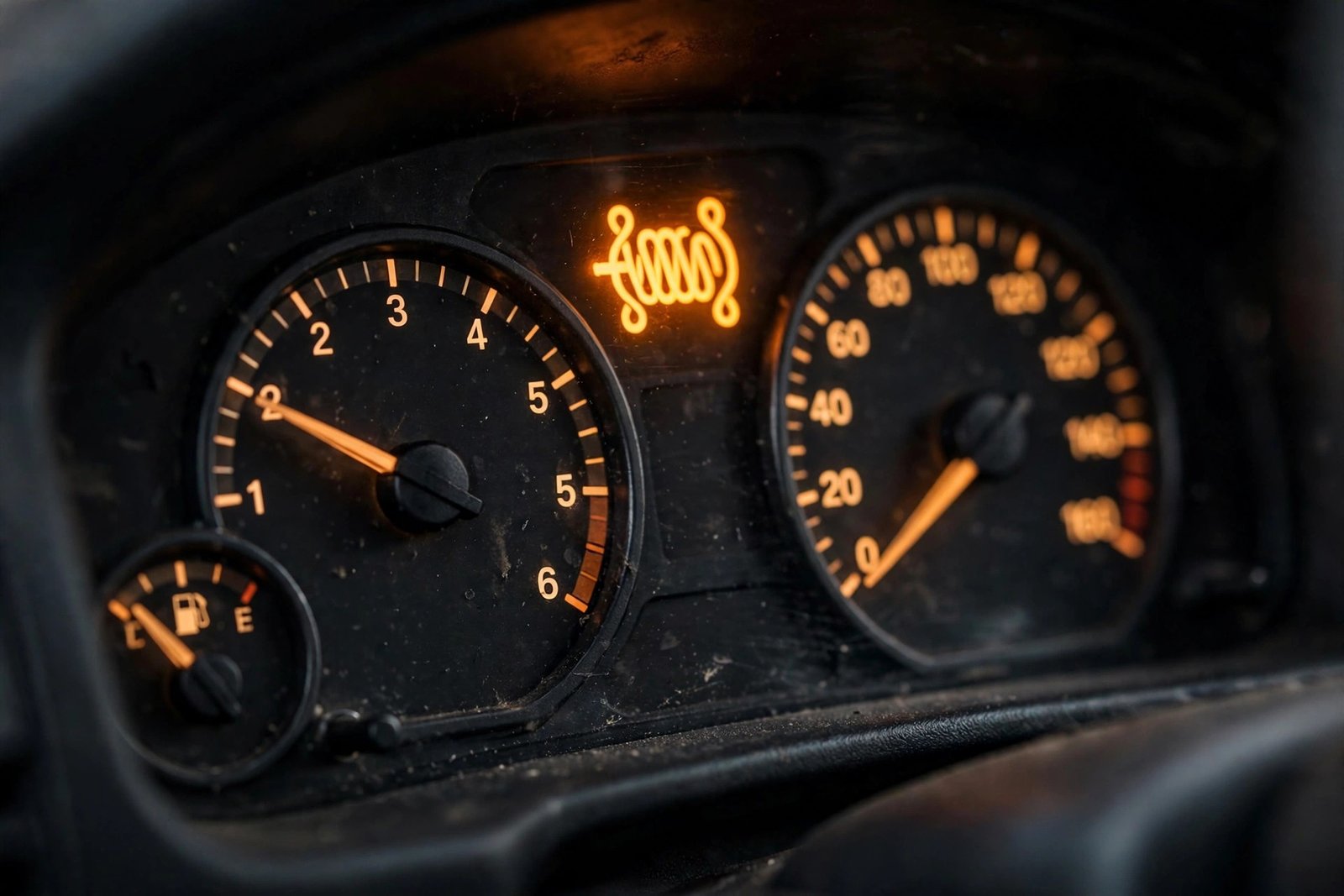
If you drive a diesel — a Ram 2500 Cummins, Ford F-250/F-350 Power Stroke, Chevy Silverado/GMC Sierra Duramax, or a VW/Audi TDI — you've seen the little coil-spring symbol on the dash. Most of the time it's completely normal. But when it misbehaves, it's telling you something specific. This guide covers the four behaviors of the glow plug light and exactly what each one demands.
In this guide, you'll learn:
- What glow plugs do (and why diesels need them)
- The four light behaviors: normal, long pre-heat, steady fault, flashing fault
- The "wait to start" habit that prevents hard starts
- The most common causes when the light misbehaves
- When to see a diesel mechanic
Quick Primer: What Glow Plugs Do
Diesel engines have no spark plugs — they ignite fuel with compression heat. In cold weather, that heat isn't enough on its own, so glow plugs pre-heat the combustion chambers before you crank. The coil symbol on the dash is the system telling you the pre-heat cycle is running. Modern systems heat in seconds; older ones can take 10–20 seconds in freezing weather.
The Four Light Behaviors
| Behavior | Meaning | What to do |
|---|---|---|
| On briefly at key-on, then off | Normal pre-heat cycle | Wait for it to go out before cranking — that's the whole habit |
| On longer than usual at key-on | Very cold weather, or weakening plugs | Wait it out; if it keeps getting longer, get the plugs tested |
| Stays on after the engine is running | Fault — one or more glow plugs, the relay, or the timer has failed | Book a diesel diagnosis; expect harder cold starts |
| Flashing | Fault code stored — on many diesels this doubles as an engine-management warning (not just the plugs) | Get it scanned soon; on VW TDIs a flashing coil often means an engine-management fault, not just plugs |
The "Wait to Start" Habit
The single most important diesel habit: turn the key to ON, wait for the coil light to go out, then crank. Cranking while the plugs are still heating gives you a hard start, white smoke, and unnecessary wear — and in freezing weather it can mean the difference between starting and not. Many trucks also show a "Wait to Start" message; same rule.
In very cold weather, some drivers do a double pre-heat: key ON, wait for the light to go out, key OFF, key ON again, wait, then crank. It genuinely helps old or tired glow plug systems on brutal mornings.
The Most Likely Causes When the Light Misbehaves
1. Worn glow plugs (most common)
Glow plugs are wear parts — one per cylinder. When one fails, cold starts get rough; when several fail, the engine may not start at all in winter. The light staying on after startup is the classic tell.
2. Failed glow plug relay or control module
The relay/module powers the plugs on a timed cycle. When it fails, the plugs never heat — same symptoms as dead plugs, but the fix is electrical.
3. Wiring or timer faults
Corroded connectors or a failed timer module interrupt the heating cycle.
4. Flashing coil = broader engine fault (especially VW/Audi TDI)
On many TDIs, a flashing glow plug light is the diesel equivalent of a check engine light — it can indicate EGR, turbo, fuel injection, or emissions-system faults well beyond the plugs themselves. Don't assume "just glow plugs" until it's scanned.
5. Related: DPF issues
On modern diesels, glow plug system faults can interfere with DPF (diesel particulate filter) regeneration, since the system uses plug heat during regen cycles. A neglected glow plug fault can cascade into emissions problems.
What You Can Do Yourself
- Practice the wait-to-start habit — free, and it solves most "hard start" complaints.
- In winter, keep the fuel tank above half and consider a block heater for overnight cold-soaks (common on diesel pickups for a reason).
- Note the pattern: light staying on vs. flashing, hard start only when cold vs. always, any smoke color on startup (white = unburned fuel from poor pre-heat).
- Get it scanned — a diesel-capable scanner reads glow plug circuit codes per cylinder, which tells you exactly which plug or whether it's the relay.
When to See a Diesel Mechanic
- The light stays on after the engine is running.
- The light flashes — scan soon; it may be an engine-management fault.
- Hard starting or no-start in cold weather.
- White smoke on startup that wasn't there before.
- You've replaced plugs before and the problem returned — suspect the relay/module.
FAQ
Is it safe to drive with the glow plug light on?
If it's just the steady "fault" light and the engine runs fine once warm, you can drive to get it diagnosed — but expect hard starts, worse fuel economy, and higher emissions until it's fixed. A flashing light deserves a sooner appointment.
How long should I wait for the glow plug light to go out?
Seconds on a modern diesel in mild weather; up to 15–20 seconds on older systems in freezing cold. If it's taking far longer than it used to, the plugs are weakening.
Do glow plugs need regular replacement?
They're wear parts with a finite life — manufacturers specify replacement intervals in the service schedule. If your diesel is hard to start in winter and the plugs have never been changed, they're the prime suspect.
My gas car doesn't have this light — why?
Gasoline engines use spark plugs for ignition and don't need pre-heating. The coil symbol is diesel-only.
all dashboard warning lights explained
Sources
- DENSO — "Glow plug warning light" (pre-heat cycle; DPF regeneration role; wear-part replacement intervals) — https://www.denso-am.eu/news/why-might-the-glow-plug-warning-light-come-on
- SINOCMP — "Glow Plug Warning Light: Symptoms & Troubleshooting Guide" (four-behavior quick reference table) — https://sinocmp.com/blogs/repair-technology/glow-plug-warning-light-what-it-means-and-what-to-do
- WeBuyAnyCar — "Glow plug warning light (diesel): Everything you need to know" (fault causes; flashing-light guidance) — https://www.webuyanycar.com/guides/car-ownership/glow-plug-warning-light/