
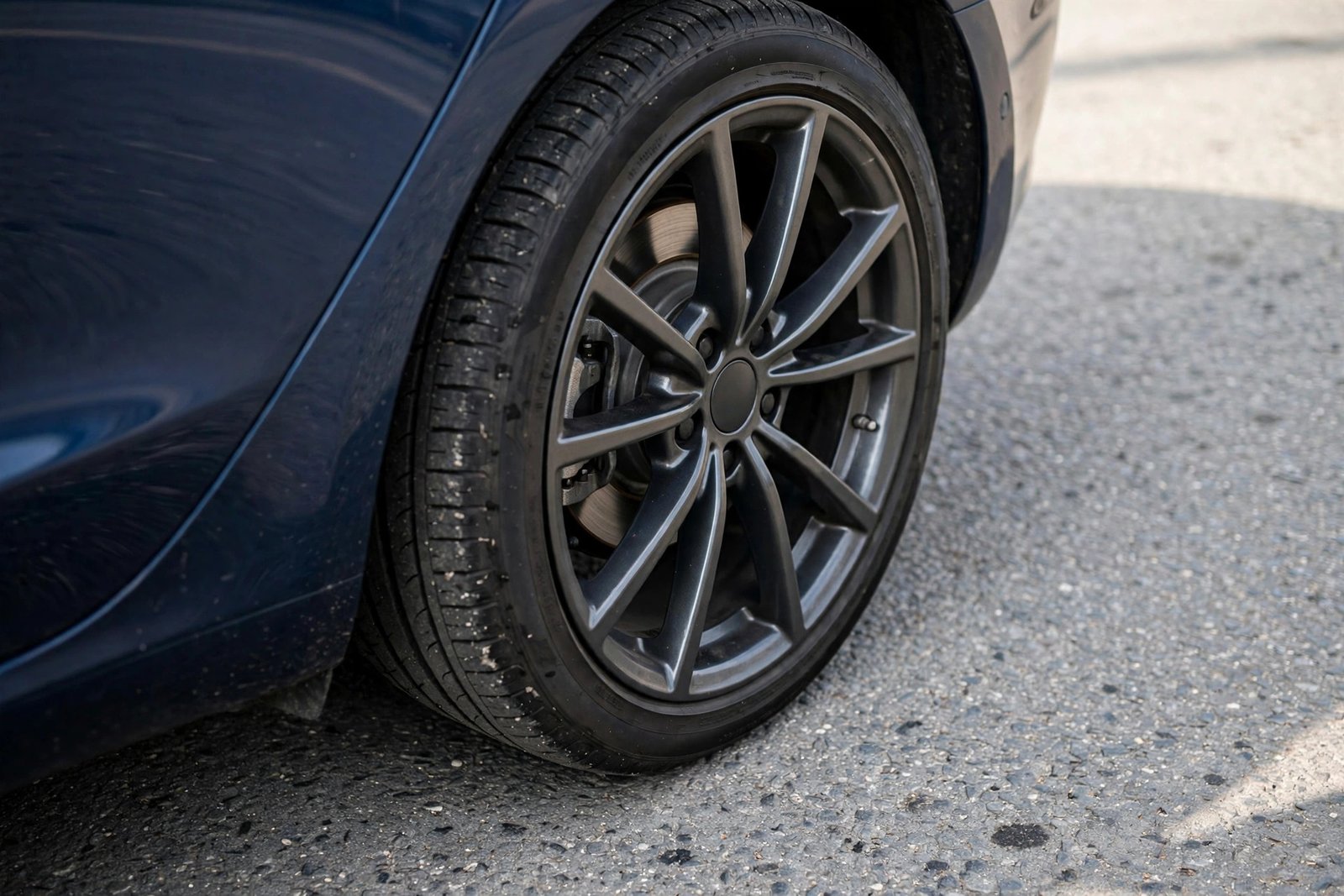
A thumping from the rear of the car is easier to diagnose than most noises, because the rear of the car is simpler: tires, rear suspension, exhaust, and (on some cars) the rear differential. One question does most of the work: is the thump rhythmic or random?
In this guide, you'll learn:
- The rhythmic-vs-random test (the whole diagnosis in one question)
- The most common causes, in order of likelihood
- Simple checks you can do in the driveway
- The tire-damage red flags that mean stop driving
Safety first: A rhythmic thump that speeds up with the car can be a damaged tire — a separating belt or sidewall bulge is a blowout risk. Inspect your rear tires visually before driving on, and don't ignore a thump that appeared suddenly.
The One-Question Branch: Rhythmic or Random?
Drive at a steady speed on a smooth road, radio off.
Rhythmic — a steady thump-thump-thump that gets faster as you speed up and slower as you slow down? → It's tied to wheel rotation: tire damage or a rear wheel bearing. Keep reading the "Rhythmic" section.
Random — thumps that come and go with bumps, turns, or acceleration, not tied to speed? → It's rear suspension or exhaust: shocks, bushings, sway bar links, hangers. Skip to the "Random" section.
Rhythmic Thumping: Causes in Order
1. Damaged or unevenly worn tire (most common)
A separated internal belt, a flat spot, a sidewall bulge, or severe cupping thumps once per revolution. The thump tracks road speed exactly — faster you go, faster it thumps. Check now: look for a visible bulge, a wavy tread, or a flat-spotted section. A bulging sidewall is a blowout risk — put on the spare or call roadside assistance rather than driving on it.
2. Rear wheel bearing
A worn rear bearing produces a rhythmic thump, hum, or growl that rises with speed. Unlike tire thumps, bearing noise often changes when the car's weight shifts in turns. See humming noise that gets louder with speed for the bearing road tests (they work for rear bearings too).
3. Bent rear rim
A rim bent by a pothole thumps rhythmically and can't be balanced out. If the thump started right after a hard pothole hit, mention it at the shop.
Random Thumping: Causes in Order
1. Worn rear shocks or struts (most common)
Dead shocks let the rear suspension bottom out and bang — a heavy thump over bumps, sometimes with a bouncy, floaty ride. Push down hard on the rear bumper: more than 1–2 bounces = worn.
2. Worn sway bar links or bushings (rear)
Same as the front (see clunking noise over bumps) — the rear bar's links and bushings clunk when the body rolls or one wheel hits a bump.
3. Exhaust hangers or heat shield
A broken rear hanger lets the muffler or tailpipe swing and thump the chassis over bumps — often a hollower sound than suspension. A loose heat shield adds a metallic buzz: see metallic scraping noise under the car.
4. Worn control arm / trailing arm bushings
Cracked rear bushings let the suspension shift under acceleration and braking — a dull thump when pulling away from stops or braking to a stop.
5. Loose spare tire or cargo
Before anything else: check the trunk. A loose spare, jack, or heavy cargo thumps over bumps and costs nothing to fix. (Every mechanic has a story about the "suspension noise" that was a toolbox.)
6. Rear differential issues (RWD/AWD)
A thump or clunk from the rear on acceleration or when shifting — especially with a whine — can be differential wear or low fluid. Less common, but worth mentioning if the thump is load-dependent.
Simple Checks You Can Do Yourself
- The rhythm test: Steady speed, smooth road — does the thump track your speed exactly? Yes = tire/bearing/rim. No = suspension/exhaust.
- Tire inspection: Look at both rear tires for bulges, flat spots, uneven wear, and embedded objects. Run your hand around the tread (parked) for high/low spots.
- The trunk check: Open the trunk — is the spare tight? Any loose heavy objects? Free fix first.
- The bounce test: Push down hard on the rear bumper and release. Excessive bouncing or any clunking = rear shocks/mounts.
- The bump log: Note whether thumps happen over bumps only, on acceleration only, or when turning — "rear thump over speed bumps, both sides" vs "rhythmic thump tracking speed" lead to completely different parts.
When to Stop Driving and Call for Help
- Rhythmic thump + visible sidewall bulge or tread separation: Blowout risk. Spare or tow — don't drive on it.
- Thump that started suddenly and violently: Something broke or came loose. Pull over and look; tow if anything's hanging or the tire is damaged.
- Thump + the rear feels unstable or bouncy at speed: Worn shocks reduce tire contact with the road — braking and handling suffer. Get it checked before highway driving.
- Thump + grinding or a hot/burning smell from a rear wheel: Bearing or brake failure developing. Stop and inspect.
FAQ
Why is it only from the rear?
Because the cause is at the rear — front noises transmit through the steering wheel, rear noises through the seat. "Felt in the seat, not the wheel" is itself a diagnostic clue pointing rearward.
Could it be the fuel tank?
A dull thump from the rear right after a fill-up, or a sloshing sound on turns, can be fuel moving in the tank — normal. A persistent rhythmic thump is not the fuel tank.
My car thumps once when I first start driving — normal?
Many cars run a brief ABS self-check shortly after pulling away — a single soft thump or click from the rear/center is normal on those models. If it's a repeated thump that continues as you drive, that's not the self-check.
Rear thump vs rear hum — which guide?
Rhythmic thump tracking wheel speed = this guide (tire/bearing). A steady hum or growl rising with speed = the wheel bearing guide: humming noise that gets louder with speed. They overlap at the bearing — the tests there settle it.
Sources
- yourmechanic.com — "It makes a thumping sound when driving straight and it gets worse when you go faster" (tire belt separation; suspension mounts; speed-tracking thump) — https://www.yourmechanic.com/question/it-makes-a-thumping-sound-when-driving-straight-and-it-gets-worse-when-you-go-faster-by-tony
- drivepoa.com — "Car makes thump sound when driving (meaning)" (uneven tire wear; worn struts/shocks; warped rotors) — https://drivepoa.com/car-makes-thump-sound-meaning/
- justanswer.com — "Thumping Noise When Turning Right on Kia Sportage AWD" (rear sway bar bushings/links; differential inspection) — https://www.justanswer.com/kia/l9fw8-thumping-noise-rear-when-turning-right.html
- automotiveforums.com — "Thumping Sound While Driving" (busted tire belt diagnosis by hand-feel; bent rim) — https://www.automotiveforums.com/t404577-thumping_sound_while_driving.html