Car AC Not Cold: 7 Reasons and What to Check First
Updated Nov 21, 2026

In This Guide
- The Quick Answer: Most Warm AC Comes From a Leak, a Dead Compressor, or a Stuck Blend Door
- How Your Car AC Works
- 1. Low Refrigerant From a Slow Leak
- 2. The Compressor Is Not Engaging
- 3. A Blend Door Actuator Is Stuck
- 4. The Condenser Is Blocked or Damaged
- 5. The Cooling Fan Is Not Running
- 6. A Clogged Cabin Air Filter
- 7. A Failed Pressure Switch or Sensor
- What a Shop Checks First, and Why the Order Matters
- What Does an AC Recharge Cost in 2026?
- Why Does My Car AC Smell Musty?
- When to Turn the AC Off and Get Help Right Away
- Quick Checks You Can Do Yourself
- Frequently Asked Questions
- The Bottom Line
The Quick Answer: Most Warm AC Comes From a Leak, a Dead Compressor, or a Stuck Blend Door
You press the car AC button, the fan blows hard, and the air coming out is barely cool, or not cool at all. That is the most common air conditioning complaint there is, and it has a short list of usual causes. In most cases the system is low on refrigerant because of a slow leak, the compressor is not engaging, or a blend door inside the dash is mixing hot air in with the cold. Less often the trouble is a clogged condenser, a failed cooling fan, a bad pressure switch, or a cabin air filter so dirty that air can barely get through.
The good news is that a proper diagnosis is quick and cheap. A shop puts gauges on the system, checks the pressures, and confirms whether the compressor is being told to run. That one test separates a $150 recharge from a $900 compressor job, so it is worth doing before buying any parts. This guide walks through the seven most common causes, what each one feels like, what it costs to fix in 2026, and the checks you can safely do yourself before booking the appointment.
In this guide, you’ll learn:
- How your car’s AC system works in plain terms
- The 7 most common reasons your AC blows warm air
- What a shop checks first, and why that order matters
- What a recharge, a compressor, and the other common repairs cost in 2026
- Why a musty smell means something different from warm air
- When to turn the AC off and get help right away
How Your Car AC Works
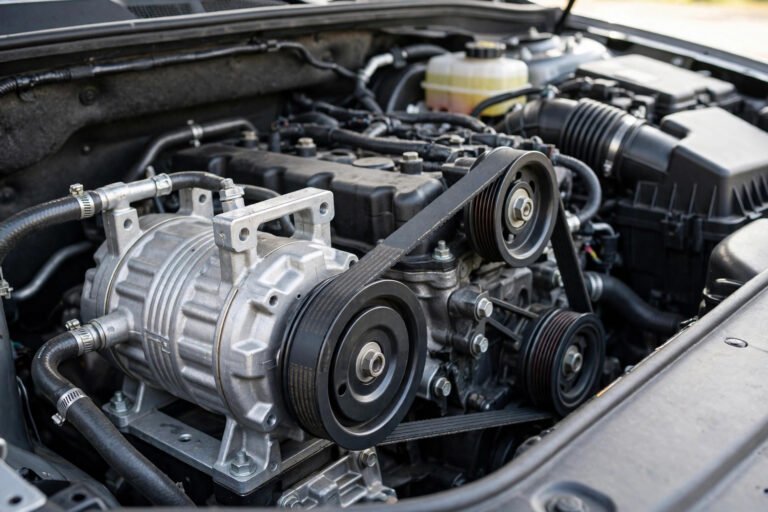
Your car AC is a closed loop that moves heat out of the cabin instead of making cold air from nothing. Refrigerant circulates through four main parts. The compressor, a belt driven pump on the front of the engine, squeezes the refrigerant into a high pressure gas. The condenser, which sits in front of the radiator, cools that gas back into a liquid and dumps the heat outside. The expansion valve lets the liquid refrigerant spray into the evaporator inside the dash, where it boils back into a gas and absorbs heat from the cabin air blowing across it. The blower fan then pushes that cooled air through your vents.
Refrigerant is the lifeblood of the whole loop, and the system is sealed. It does not get used up the way gas or oil does. If the level is low, refrigerant has escaped through a leak somewhere, and topping it off without finding the leak only buys a few weeks or months of cold air before the problem comes back.
Two refrigerants are in use today. Older cars use R-134a. Most cars built from 2018 on use R-1234yf, which costs several times more per pound and is more sensitive to the exact charge level. Check the label under your hood to see which one your car takes, because the wrong refrigerant, or the wrong amount, will not cool properly. Refrigerant handling is regulated by the EPA, and recovering and recharging it is work for a certified technician, not a driveway job.
1. Low Refrigerant From a Slow Leak
This is the number one cause of warm AC. Seals, hoses, and the condenser itself develop small leaks over time, and the system loses pressure bit by bit. The first sign is usually air that is cool but never really cold, or air that starts cold and fades to warm on a long drive. In the end the pressure drops so low that the low pressure switch cuts the compressor off to protect it, and the vents blow plain outside air.
A shop finds the leak with UV dye or an electronic sniffer, then repairs the leaking part and recharges the system. A refrigerant recharge runs about $120 to $155 according to RepairPal national estimates, and a small leak repair typically adds $150 to $650 depending on where the leak is. A can of refrigerant from a parts store is not a fix. It can overcharge the system, which cools worse than a slight undercharge, and it does nothing about the leak that caused the problem.
2. The Compressor Is Not Engaging
The compressor is the only hard working mechanical part in the AC loop, which is why it is also the most common major AC failure. When it quits, nothing else in the system can cool the air. You will feel the fan blowing at full strength with no cold air at all, and you may hear a grinding or squealing noise, or notice that the center of the compressor pulley does not spin when the AC is on.
Before blaming the compressor itself, a good shop checks the cheap things that imitate it. A blown fuse, a failed clutch relay, or a bad pressure switch can all keep a healthy compressor from engaging, and each costs far less to fix than the compressor. On some models a single relay is a known weak point, and owners have paid for a whole compressor job when a $20 part would have restored the cold air. That is why the diagnosis comes before the parts order. If the compressor itself has failed, replacement runs about $720 to $950 by RepairPal estimates, and up to $900 to $2,200 on some vehicles when the system also needs flushing and a new receiver drier. Our full guide to AC compressor repair covers the signs, the repair versus replace call, and the costs in detail. If the clutch never engages at all, start with our guide on an AC compressor not turning on.
If you hear grinding or rattling from the compressor area, turn the AC off and get the car checked promptly. A compressor breaking apart inside can pump metal debris through the whole system, and that turns a component swap into a full system flush with several more parts to replace.
3. A Blend Door Actuator Is Stuck
If your AC blows cold on one side and warm on the other, or if the temperature does not change when you turn the dial, the problem is often a blend door actuator. This is a small electric motor inside the dash that moves a flap to mix hot and cold air. When it sticks or its gears strip, hot air from the heater core leaks into the cold stream, and no amount of refrigerant will fix it.
The telltale sign is a clicking or tapping noise from behind the dash when you change the temperature setting. Replacement runs about $325 to $375 by RepairPal estimates. The part itself is cheap, but the labor is not, because the actuator often sits deep behind the dash. This is a diagnosis only job for most owners, since reaching the part can mean removing dash panels.
4. The Condenser Is Blocked or Damaged
The condenser needs clean airflow to dump heat. Leaves, bugs, and road grime pack into its fins over the years, and a bent or punctured condenser from a stone strike leaks refrigerant on top of it. The classic symptom is AC that feels fine while driving at highway speed but goes warm in traffic or at idle, when there is no ram air to help it.
A shop can clean clogged fins and check for leaks. If the condenser itself is damaged, replacement runs about $450 to $600 by RepairPal estimates. A quick look through the grille for packed debris is a safe check you can do yourself, and clearing it costs nothing.
5. The Cooling Fan Is Not Running
The condenser fan pulls air through the condenser when the car is not moving. If the fan motor fails, the system has no airflow at a stop, pressures climb, and the computer cuts the compressor out to protect it. The result is the same pattern as a blocked condenser: cold air while driving, warm air at idle.
You can check this safely with the car parked and the AC on. Open the hood and look at the fan behind the radiator. It should be spinning whenever the AC is running. If it is still, or if it only spins sometimes, the fan motor, its relay, or its wiring is the suspect. Condenser fan replacement runs about $385 to $475 by RepairPal estimates.
6. A Clogged Cabin Air Filter
Weak airflow is often the first symptom of a clogged cabin air filter, and it is the cheapest fix on this list. The filter catches dust and pollen before air enters the cabin, and when it is packed solid, air can barely get through the vents even with the fan on high. Moisture also lingers on the evaporator behind a clogged filter, which is what causes the musty smell many owners notice.
Replacing the filter runs up to $85 at a shop by RepairPal estimates, and $15 to $50 for the part if you do it yourself. On most cars it sits behind the glove box and takes about 15 minutes with no tools. If the airflow is weak and the filter has not been changed in a year or two, this is the first thing to check.
7. A Failed Pressure Switch or Sensor
Pressure switches guard the compressor. The low pressure switch cuts it off when refrigerant is too low, and the high pressure switch cuts it off when pressure climbs too high. If either switch fails, it can shut the compressor down even when the system is fine. A temperature sensor that reads wrong can cause the same shutdown.
These parts are not expensive, with a temperature sensor replacement running about $320 to $400 by RepairPal estimates, but they are easy to misdiagnose. A switch that cuts out because the pressure really is wrong is doing its job, and replacing it fixes nothing. That is why a shop checks the actual pressures with gauges before replacing any sensor.
What a Shop Checks First, and Why the Order Matters
A competent AC diagnosis follows the same order every time, because each step rules out the cheap causes before the expensive ones.
- Vent temperature and fan speed. The tech measures the air coming out of the center vent. A healthy system puts out air roughly 35 to 40 degrees Fahrenheit colder than the outside air.
- Compressor engagement. With the AC on, the tech checks whether the compressor clutch is spinning and whether the system is being commanded on.
- System pressures. Gauges on the high and low side ports show whether the system is low, overcharged, or blocked. Low on both sides points to a leak. High on one side and low on the other points to a restriction.
- Leak check. If the charge is low, UV dye or an electronic sniffer finds where the refrigerant is escaping.
- Electrical checks. Fuses, relays, pressure switches, and the clutch coil get tested before any part is condemned.
This order is what keeps a $20 relay from turning into a $900 compressor bill.
What Does an AC Recharge Cost in 2026?
A recharge is the most common AC service, and also the most misunderstood. It is not routine maintenance. A sealed system that has never leaked does not need topping off, so needing a recharge always means there is a leak somewhere, even if it is a slow one.
| Repair | Typical cost (RepairPal national estimates) |
|---|---|
| System inspection and diagnosis | Up to $70 |
| Refrigerant recharge | $120 to $155 |
| Cabin air filter replacement | Up to $85 |
| Blend door actuator replacement | $325 to $375 |
| Condenser fan replacement | $385 to $475 |
| Condenser replacement | $450 to $600 |
| Compressor replacement | $720 to $950 |
Costs vary by vehicle, by region, and by refrigerant type. Cars using R-1234yf cost more to recharge than cars using R-134a, because the refrigerant itself is far more expensive. A proper recharge always includes evacuating the old refrigerant, pulling a vacuum to remove air and moisture, and refilling to the exact weight listed on the underhood label. A shop that just tops the system off without a vacuum is cutting a corner that shortens the life of the repair.
AC stop leak products deserve a warning. They promise to seal small leaks from inside the system, but they can also clog the expansion valve and damage the recovery equipment a shop uses. Most shops will not work on a system that has had stop leak added, and a clogged valve turns a small leak into a much bigger bill. Skip the bottle and get the leak found properly.
Why Does My Car AC Smell Musty?
A musty or sour smell when the AC first turns on is a different problem from warm air, and it has a different fix. Moisture collects on the evaporator every time the AC runs, and in a dark, damp box behind the dash, mold and bacteria grow. A clogged cabin air filter makes it worse by trapping that moisture in place.
The fix starts with a fresh cabin air filter and an antimicrobial evaporator treatment, which a shop can do for about $100 to $200. You can also cut the smell down by turning the AC off a few minutes before you arrive and letting the fan run on its own, which dries the evaporator before you park. If the smell persists after a filter change and a treatment, the evaporator drain may be clogged, and that is a shop job.
When to Turn the AC Off and Get Help Right Away
Most AC problems are an inconvenience, not an emergency. You can drive with warm AC while you wait for an appointment. But a few signs mean you should switch the AC off now and get the car checked promptly:
- Grinding, rattling, or squealing from the compressor. The compressor may be coming apart inside, and running it spreads debris through the system.
- A burning smell from the vents or under the hood. A seized compressor can burn its drive belt, and a slipping belt can damage other parts.
- The engine starts overheating with the AC on. The AC adds load and heat, and an overheating engine should never be ignored. Turn the AC off, turn the heater on full to pull heat from the engine, and get the car checked. Never open a hot radiator or coolant cap.
- Refrigerant hissing from under the hood. A large leak can release refrigerant quickly. Keep clear of the vapor and let a certified technician handle it. Refrigerant is not something to breathe in or touch with bare skin.
For hybrid and electric cars, one extra note applies. Many hybrids use a high voltage electric compressor instead of a belt driven one, and those compressors cost far more to replace. High voltage AC work is a job for a certified EV or hybrid technician only, never a driveway repair.
Quick Checks You Can Do Yourself
Before you book the appointment, these checks cost nothing and can save a trip:
- Check the settings. Make sure the AC button is on, the temperature is set to the coldest setting, and recirculation is on. It sounds obvious, but a bumped control is the simplest explanation of all.
- Listen for the compressor. With the engine running and the AC on, you should hear a faint click from under the hood as the clutch engages, and the engine note should change slightly. No click at all points to an electrical fault or a pressure cutoff.
- Look at the cooling fan. With the AC running, the fan behind the radiator should be spinning. If it is not, the fan circuit is a prime suspect.
- Check the cabin air filter. If it is gray and packed with debris, replace it and see whether airflow and cooling improve.
- Note the pattern. Cold while driving but warm at idle points to airflow or the fan. Cold on one side and warm on the other points to the blend door. Air that starts cold and fades points to a leak or a freezing evaporator. That pattern is the most useful thing you can tell the shop.
What you should not do yourself is open the refrigerant system. Adding refrigerant without gauges risks overcharging, which cools worse and can damage the compressor, and venting refrigerant to the air is illegal under EPA rules. Leave the sealed system to a certified technician.
Frequently Asked Questions
How much does it cost to fix car AC?
It depends on the cause. A recharge runs about $120 to $155, a cabin air filter up to $85, and a blend door actuator $325 to $375 by RepairPal national estimates. A condenser runs $450 to $600, a fan $385 to $475, and a compressor $720 to $950. Diagnosis up to $70 comes first, because the cheapest cause is often the real one.
Why is my car AC not cold enough?
The most common reason is low refrigerant from a slow leak, followed by a compressor that is not engaging and a blend door mixing hot air in. If your car AC is not cold enough but still blows some cool air, the charge level is the first thing a shop checks. A system that starts cold and fades to warm usually has a leak or a freezing evaporator.
Can I just recharge my car AC myself?
A parts store can is not a real fix. It cannot find the leak, it cannot pull a vacuum to remove air and moisture, and it is easy to overcharge the system, which cools worse and can damage the compressor. Refrigerant work is regulated by the EPA and belongs with a certified technician. Have the leak found and the system charged to the exact weight on the underhood label.
How long does a car AC recharge last?
If there is no leak, a proper recharge lasts for years. If the system has a slow leak, the cold air may last weeks or months before fading again. A recharge that only lasts a few weeks means the leak needs to be found and repaired, not topped off again.
Why does my AC blow cold then warm?
Intermittent cooling usually means the compressor is cycling off. Low refrigerant, a failing clutch, a bad pressure switch, or a condenser fan that quits at idle can all cause it. Our guide on an AC that blows cold then warm walks through the pattern in detail.
What is Freon, and does my car use it?
Freon is a brand name that most people use for any AC refrigerant. Older cars use R-134a, and most cars built from 2018 on use R-1234yf. The two are not interchangeable, and the label under your hood says which one your car takes.
The Bottom Line
Warm car AC almost always comes down to one of seven things: a slow refrigerant leak, a compressor that is not engaging, a stuck blend door, a blocked condenser, a dead cooling fan, a clogged cabin filter, or a failed pressure switch. Start with the free checks, then let a shop put gauges on the system before anyone orders parts. That one step is the difference between a $150 recharge and a $900 compressor job, and it is the step that saves owners the most money.

lily John
The Fixtorial team writes hands-on car troubleshooting guides for everyday drivers — symptom first, honest costs, and fixes you can verify yourself.