
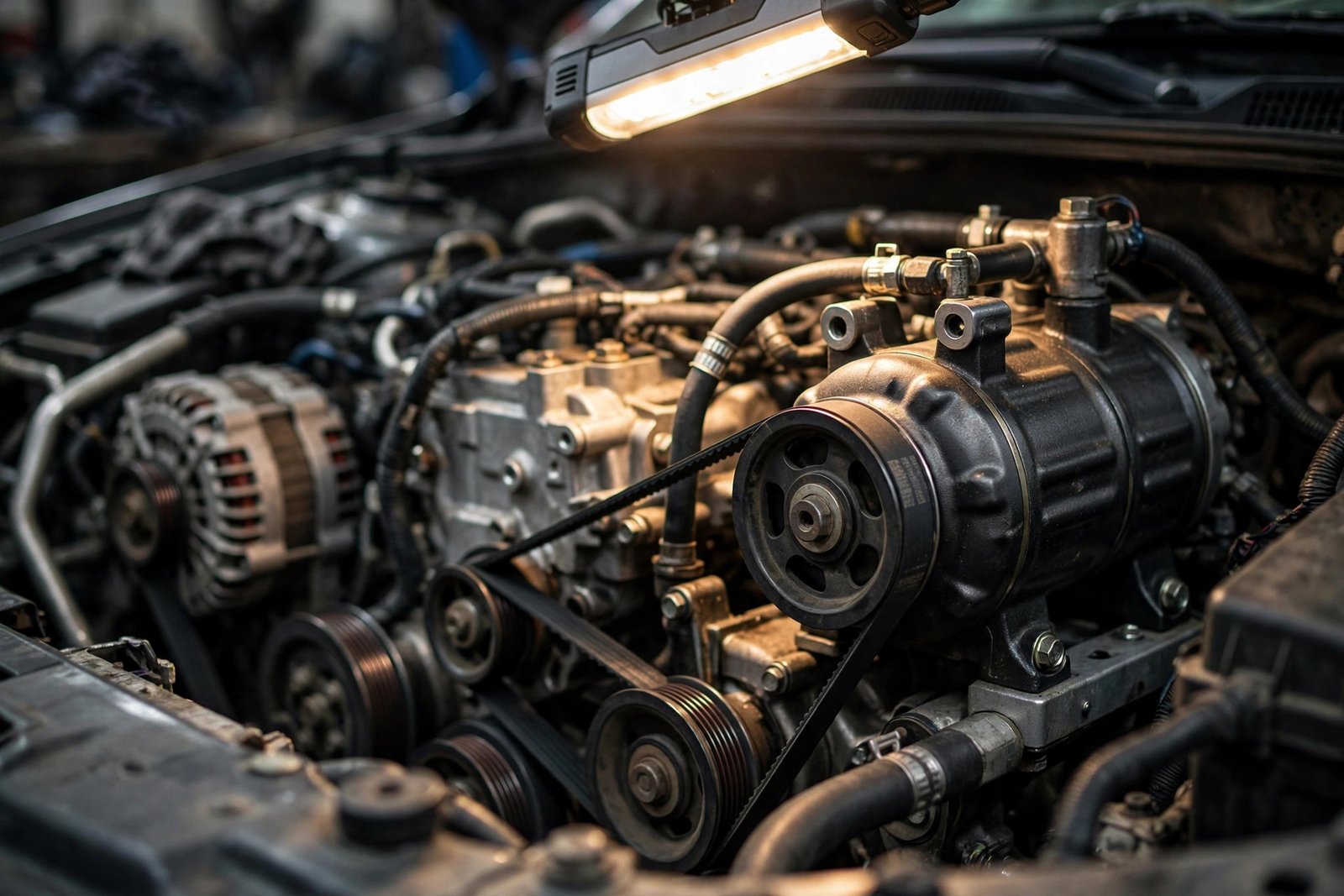
You press the AC button and… nothing. No click from under the hood, no change in engine note, no cold air. The compressor clutch is the electromagnetic coupling that connects the spinning pulley to the compressor itself — when it engages, you hear a distinct click. If it never engages, the refrigerant never circulates and nothing cools. The good news: the causes follow a clear electrical-first decision tree, and most of the diagnosis is observation, not tools.
Safety first: The AC system runs under high pressure, and refrigerant is regulated. In the US, the EPA requires technicians servicing motor-vehicle AC systems to be certified under Clean Air Act Section 609. Everything below is observation and simple electrical checks — anything involving refrigerant pressure, recovery, or recharging belongs to a certified technician. Do NOT buy a recharge can to "wake up" a dead compressor; if the system locked it out, there's a reason.
First: Confirm What "Not Turning On" Means
With the engine running and AC switched to max cold, look at the compressor (low on the engine, belt-driven). It has a pulley that always spins with the belt, and a center hub that should click and start spinning with the pulley when the AC engages:
- Center hub spins with the pulley → the compressor IS engaging; your problem is elsewhere (car AC not cold enough).
- Pulley spins, center hub stays still, no click → clutch not engaging — this article.
- Click, but rapid on-off cycling → engaging then cutting out — see AC blows cold then warm.
The Most Likely Causes, in Order
1. Low refrigerant pressure lockout (most common)
Modern systems have a low-pressure switch that deliberately prevents the clutch from engaging when charge is too low — this protects the compressor from running without the oil that circulates with the refrigerant. Low charge = a leak somewhere. This is protective behavior, not a broken part — and it's exactly why a recharge can won't fix the root problem.
2. Blown fuse
The clutch circuit has a dedicated fuse (owner's manual shows which). A blown fuse is a cheap fix — but if the replacement blows again, something downstream is drawing too much current (often a failing clutch coil). Don't keep feeding it fuses.
3. Failed relay
The relay is the high-current switch for the clutch coil. The classic driveway test: swap it with an identical relay from a non-critical circuit (like the horn) and see if the clutch engages. If yes, replace the relay.
4. Worn clutch (excessive air gap)
As the clutch wears, the gap between the pulley and hub widens until the electromagnet can't pull it in. Signature: it engages when cold but quits once everything heats up, or it clicks weakly without grabbing. Sometimes engages if you tap it — a confirmation, not a fix.
5. Failed pressure switches or sensors
Even with correct charge, a faulty low- or high-pressure switch can send a false "don't engage" signal. Electrical diagnosis territory.
6. Wiring, ground, or control-module faults
Corroded connectors, damaged wiring to the clutch coil, or a climate-control module that never sends the engage command. A multimeter check for 12V at the clutch connector (AC on) separates wiring faults from clutch faults.
7. Seized compressor
If the compressor is mechanically locked, the clutch may refuse to engage or the belt may squeal. This is the worst case — compressor replacement is a professional job.
Safe Checks You Can Do Yourself
- The click test: Engine running, AC on max — listen at the compressor for the engagement click. Have a helper toggle the AC while you listen.
- The hub test: Watch whether the clutch hub spins with the pulley.
- Fuse check: Find the AC/clutch fuse in the owner's manual; inspect and replace with the same rating if blown.
- Relay swap: Exchange the AC relay with an identical one (horn relay is the usual donor) — ignition OFF while swapping.
- Pattern note: Engages cold but not hot = worn clutch air gap. Never engages = fuse/relay/pressure lockout/wiring.
When to See a Certified Technician
- No engagement after fuse and relay check out (pressure lockout or deeper electrical fault)
- Suspected low refrigerant — leak detection plus proper recovery and recharge equipment required
- Worn clutch or seized compressor
- Anything involving opening the refrigerant circuit — pro-only, legally and practically
Tell the technician exactly what you observed: "no click at all, fuse and relay checked" or "engages cold, drops out hot" gets them to the answer fast.
FAQ
Can low refrigerant really stop the compressor completely?
Yes — by design. The low-pressure switch cuts the clutch to protect the compressor from running dry. It's the system's way of telling you there's a leak.
Is it the compressor or just the clutch?
If the pulley spins freely and the hub won't engage, the compressor itself may be fine — the fault is in the clutch, its coil, or the circuit feeding it. A technician can test each separately.
Why did it work yesterday and not today?
Electrical faults (relay, connector, pressure switch) and marginal clutch air gaps often fail intermittently before failing permanently. Note the conditions — hot vs. cold, first start vs. after driving.
Can I jump the clutch directly to test it?
That's a technician procedure with the right equipment. Incorrect jumping can damage the control module or the clutch coil — leave it to a pro.
Sources
- InstantCarFix — "AC Compressor Clutch Not Engaging? Causes, Fixes, Cost" (low refrigerant #1; relay/fuse; wiring; worn clutch; mechanic's check order) — https://www.instantcarfix.com/services/ac-compressor-clutch-not-engaging-diagnosis
- Engineer Fix — "How to Test a Car AC Compressor Clutch" (pressure-switch lockout thresholds; fuse/relay/voltage test sequence) — https://engineerfix.com/how-to-test-a-car-ac-compressor-clutch/
- MotorVerso — "How To Test Car AC Compressor" (clutch engagement blockers; lockout sensors) — https://www.motorverso.com/how-to-test-car-ac-compressor/
- MazdaFWB — "7 Signs of a Failing Car AC Compressor" (clutch engagement test; oily leak residue; fuse-blowing from seizing) — https://www.mazdafwb.com/signs-your-cars-ac-compressor-may-be-failing/
- Hinsdale Auto — "7 Signs Your Car AC Compressor Is Failing" (clutch not engaging causes; electrical vs mechanical) — https://www.hinsdaleauto.com/7-signs-your-cars-ac-compressor-may-be-failing/
- U.S. EPA — Regulatory Requirements for MVAC System Servicing (Section 609 technician certification) — https://www.epa.gov/mvac/regulatory-requirements-mvac-system-servicing