
Transmission fluid is the lifeblood of an automatic gearbox — it lubricates, cools, and (in automatics) is the hydraulic medium that actually shifts gears. But before the procedure, there’s a question most guides skip: many cars built in the last 15 years have no transmission dipstick at all. Start with the right branch for your car.
Branch 1: Which System Does Your Car Have?
- Dipstick (older automatics, many trucks/SUVs): a second dipstick in the engine bay, usually with a yellow/red handle, located toward the firewall. Follow the procedure below.
- Electronic level check (some newer cars): no physical dipstick — the level reads through the dashboard menu or requires a scan tool. Your owner’s manual shows the method.
- Sealed / “lifetime fill” (many modern automatics, CVTs, dual-clutches): no owner-serviceable check. The transmission is checked via a fill plug underneath the car on a lift — this is a shop job. If yours is sealed, the correct move is a professional inspection, not improvisation.
Your owner’s manual settles it in one page. Don’t guess.
Step-by-Step: Dipstick Check (Automatics)
- Park on level ground, set the parking brake.
- Warm the engine to operating temperature (a short drive). Transmission fluid expands with heat, and most dipsticks are calibrated for a warm reading.
- With the engine idling in Park (check your manual — a few models specify engine off), cycle slowly through the gears — Park → Reverse → Drive → Low and back to Park — pausing a few seconds in each. This circulates fluid.
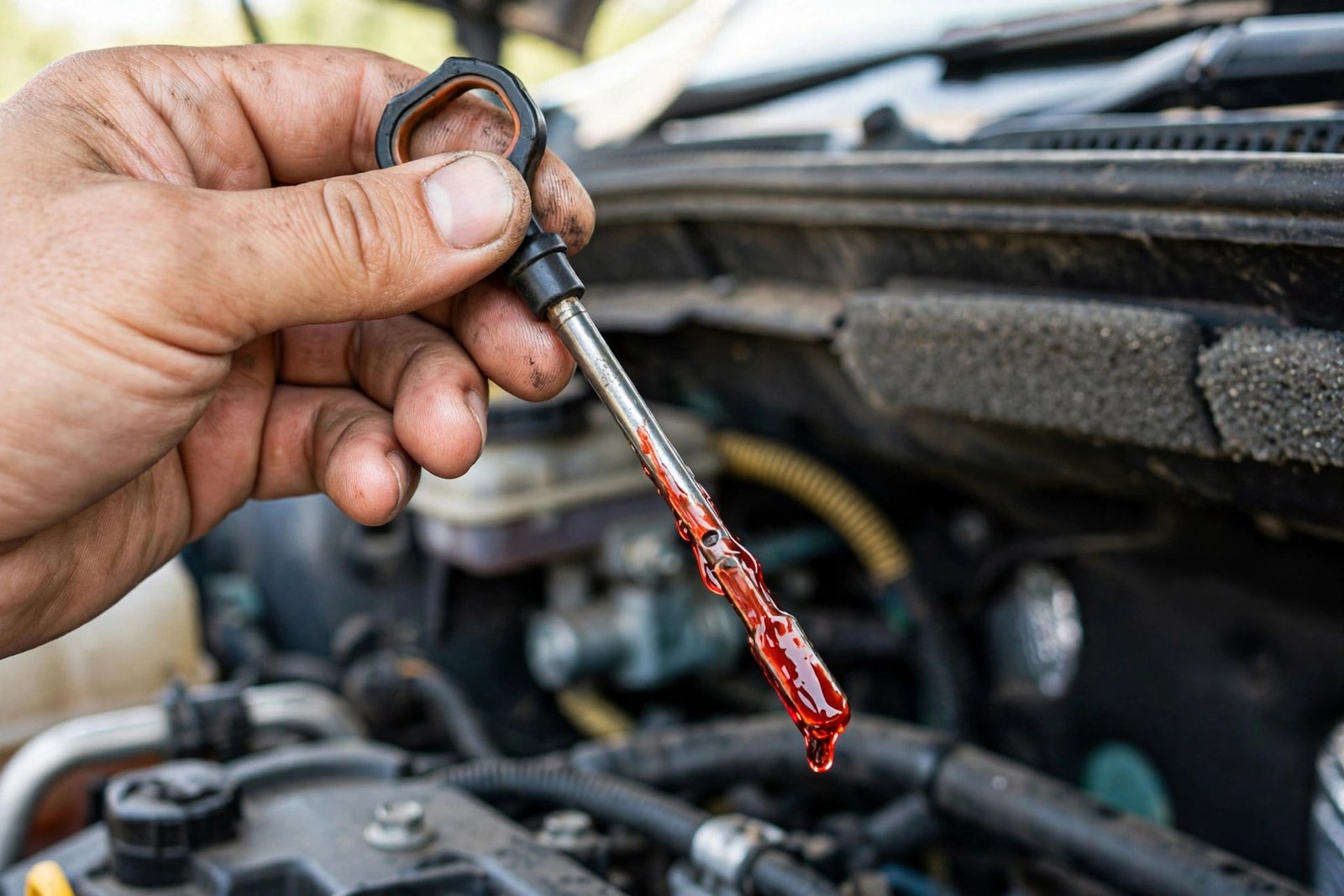
- Pull the transmission dipstick, wipe it clean with a lint-free rag.
- Reinsert fully, pull again, and read. The level should fall within the HOT range (or between the marks). Some dipsticks show both HOT and COLD zones — use HOT after driving.
- While the stick is out: check color and smell (details below).
- Reinsert fully.
Manual transmissions generally have no dipstick — level is checked at a fill plug underneath the car. That’s a shop job for most owners.
Reading the Fluid: Color and Smell
This is the part that actually diagnoses problems:
- Bright red / translucent pink-red: healthy.
- Darker red / light brown: aging but serviceable — plan a fluid service per your manual’s schedule.
- Dark brown or black: worn out — needs changing. If it also smells burnt, that’s a strong sign of overheating or internal wear.
- Milky pink: coolant contamination (failed heat exchanger) — needs professional attention promptly.
- Burnt smell: the transmission has been running hot. Get it diagnosed — don’t just top up and hope.
Topping Up (Dipstick Cars Only)
If the level is low: add the exact fluid type your manual specifies through the dipstick tube with a long-neck funnel — a little at a time, re-checking after each addition. Transmission fluids are NOT interchangeable: conventional ATF, CVT fluid, and dual-clutch fluid are different chemistries, and the wrong one can damage the transmission. Never overfill — too much fluid causes foaming, pressure problems, and seal damage, and draining the excess is a messy job.
Important: a low level means fluid escaped somewhere — transmissions are sealed systems. Find the leak (reddish spots under the car, often mid-vehicle) rather than just topping up forever.
Common Mistakes
- Checking cold and comparing to the HOT marks. Warm the car up first or use the COLD zone if your dipstick has one.
- Using the wrong fluid. “ATF is ATF” is false — CVT and DCT fluids especially. The manual’s spec is non-negotiable.
- Overfilling. Worse than slightly low in some ways — causes aeration and overheating.
- Flushing a neglected high-mileage transmission without advice. On very high-mileage cars that have never had a fluid service, some shops advise drain-and-fill over aggressive flushing. Discuss with a trusted mechanic — this is a judgment call, not a DIY experiment.
- Ignoring the smell. Burnt-smelling fluid is the transmission asking for help.
When to See a Mechanic
- No dipstick / sealed transmission — level check needs a lift
- Dark, black, or burnt-smelling fluid
- Milky/pink fluid (coolant contamination)
- Slipping gears, harsh shifts, or delayed engagement
- Reddish puddles under the car
- Transmission warning light on
FAQ
How often should transmission fluid be changed?
There’s no single answer — it ranges from ~30,000 to 100,000+ miles depending on the transmission type and manufacturer. “Lifetime fill” usually means “lifetime of the warranty,” not the car. Your manual’s severe-service schedule is the honest guide; many independent mechanics suggest 50,000–60,000 miles for conventional automatics under normal use.
Can I check transmission fluid on a CVT?
Most CVTs have no dipstick — they’re sealed and need a shop check. Also note CVT fluid is specific to CVTs; never substitute regular ATF.
What’s the difference between a fluid change and a flush?
A drain-and-fill replaces a portion of the fluid (what drains out); a flush exchanges nearly all of it with a machine. Both have their place — discuss with your mechanic based on mileage and service history.
My dipstick shows foamy fluid — what does that mean?
Usually overfilling (fluid aerated by moving parts) or contamination. Recheck the level carefully; if the level is correct and it’s still foamy, get it inspected.
Sources
- HowStuffWorks — “How to Check Your Transmission Fluid” (level surface; locate dipstick near firewall; warm engine; cycle gears; HOT/COLD marks; low = possible leak) — https://auto.howstuffworks.com/how-to-check-transmission-fluid.htm
- CarVertical — “How To Check Transmission Fluid” (white-towel color test: red = good, brown/black = change, milky = coolant contamination; don’t overfill; top up slowly) — https://www.carvertical.com/blog/how-to-check-transmission-fluid
- Autoblog — “How to check your car’s transmission fluid” (sealed transmissions and electronic dipsticks; manual transmissions via fill plug; burnt smell = issue) — https://www.autoblog.com/maintenance/how-to-check-transmission-fluid
- Jalopnik — “What The Color Of Your Transmission Fluid Is Telling You” (ATF color guide; many modern cars dropped the dipstick; level/color/odor triple check) — https://www.jalopnik.com/2200497/transmission-fluid-color-meaning/
- The News Wheel — “A Quick Look at Your Transmission Fluid Color Could Save You From a Major Repair Bill” (fluid-type differences: ATF vs CVT vs DCT; manual as the reference) — https://thenewswheel.com/transmission-fluid-color-could-major-repair-bill/