
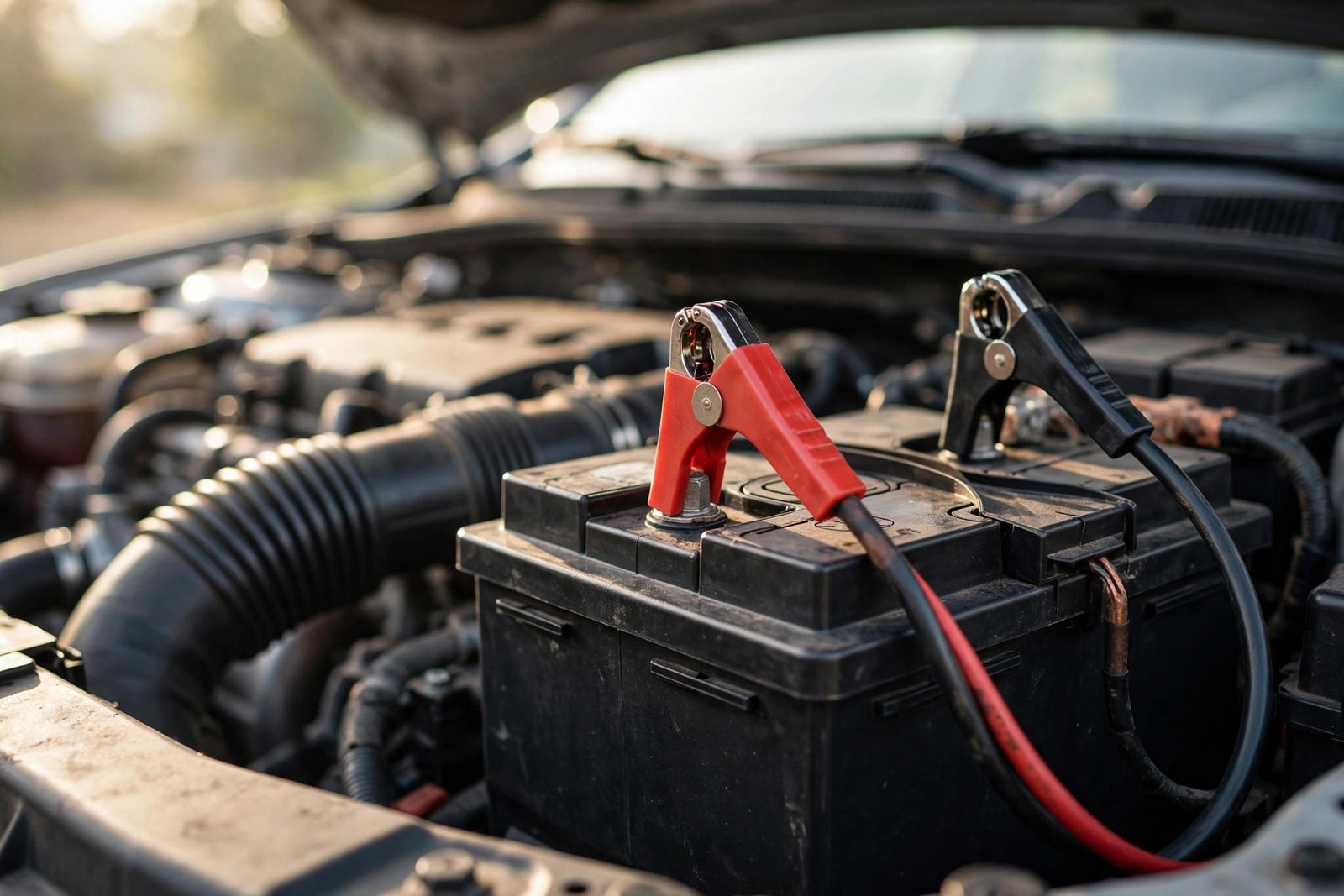
“Slow cranking” and “long cranking” sound similar, but they point to opposite sides of the car. Sorting out which one you have is the single most important step — it cuts your suspect list in half before you spend a dollar. This guide makes that split, then walks each side in order of likelihood.
In this guide, you’ll learn:
- The critical split: slow crank (electrical side) vs. long crank (fuel/sensor side)
- The most likely causes on each side, in order
- Simple checks that prove which side is failing
- When to stop and call a mechanic
- Typical repair cost ranges (verified 2026-10-14)
Safety first: Limit every cranking attempt to ~10 seconds, then rest 30–60 seconds — overheating the starter turns a small problem into a big one. If you smell burning plastic or fuel, stop and call for a tow.
The Critical Split: Which Symptom Is Yours?
Listen carefully to one start attempt. The crank speed is your branch point:
The engine turns over slowly and laboriously — ruh… ruh… ruh — That’s the electrical side: the starter isn’t getting enough power to spin the engine at full speed. Suspects: weak battery, bad connections, worn starter. Start with Section A below.
The engine spins at normal speed but takes several seconds (or many tries) to catch — That’s the fuel/sensor side: the starter is doing its job, but the engine isn’t getting the right fuel, spark timing, or air at the right moment. Suspects: fuel pressure, sensors, ignition. Start with Section B below.
Normal speed, but only bad on the first start of the day — Classic fuel-pressure bleed-off overnight (Section B), or a battery that recovers slightly after the first attempt (Section A). Note which one fits.
Normal speed, but worse when the engine is hot — Heat-sensitive sensor, usually the crankshaft position sensor. See won’t start when hot.
Normal, healthy starting: a modern fuel-injected engine should fire within about 1–3 seconds of cranking. Anything consistently longer deserves diagnosis.
Section A: Slow Crank — the Electrical Side
1. Weak or discharged battery (most common)
The starter needs hundreds of amps; a tired battery can’t deliver them. Batteries typically last 3–5 years. A proper load test — free at most auto parts stores — is the definitive check; a simple voltage reading can look fine while the battery collapses under load.
2. Corroded or loose terminals and cables
White/green crusty buildup or a clamp that wiggles by hand adds resistance exactly where the most current flows. Ignition OFF: disconnect negative first, clean posts and clamps with a wire brush, reconnect snugly (negative last). Don’t forget the ground cable’s chassis/engine bolt. See corroded battery terminals.
3. Failing starter motor
A worn starter draws excessive current or spins weakly even with a good battery. If a known-good battery and clean connections don’t fix the slow crank, the starter is the prime suspect. The tap test (light taps on the motor body while a helper cranks) can confirm it for one last start — then drive straight to a shop.
4. Thickened engine oil
Old or wrong-viscosity oil makes the engine physically harder to turn, mimicking a weak battery — worse in cold weather. Check your oil level and whether you’re due for a change with the correct grade.
Section A quick checks: Headlight test (headlights on, crank, watch them — heavy dimming = battery/connection side); terminal inspection; battery load test; try a jump start — if cranking speed returns to normal, the battery was the problem.
Section B: Long Crank at Normal Speed — the Fuel/Sensor Side
1. Fuel pressure bleeding off overnight (most common for morning-only cases)
Electric fuel pumps prime the system when you turn the key ON. If the pump’s internal check valve leaks, pressure drains while the car sits, and the first start cranks on vapor instead of fuel. The key-cycle test: turn the key to ON (not START), wait 3 seconds, back to OFF — repeat 3–4 times, then crank. If it fires right up, you’ve found it: the pump or check valve isn’t holding pressure.
2. Weak fuel pump or clogged fuel filter
A pump that can’t build full pressure, or a filter restricting flow, extends crank time — especially after the car has sat for hours. Listen at the rear seat when you turn the key to ON: you should hear the pump hum for 1–3 seconds. No hum = pump or relay problem.
3. Failing crankshaft position sensor
This sensor tells the computer when to fire spark and fuel. When it weakens, the computer hesitates — long cranking, occasional stalling, and eventually no-start when hot. Often sets codes P0335/P0336; a scan tool confirms.
4. Faulty coolant temperature sensor
If this sensor misreads engine temperature, the computer delivers the wrong cold-start fuel mix — too lean or too rich — and the engine takes forever to catch, particularly on cold starts.
5. Dirty air filter / restricted intake
Severely clogged air filters upset the air-fuel mix at startup. It’s the cheapest fix in this section — check it before paying for diagnostics.
When to Stop and Call a Mechanic
- The key-cycle test confirms fuel-pressure loss but the pump hums — the check valve or pump needs professional replacement (in-tank work, not a driveway job for most).
- Scan codes point to crankshaft or cam sensors — replacement is straightforward on some cars, buried on others; get a quote.
- Slow cranking persists with a known-good battery and clean connections — the starter needs professional testing.
- You smell raw fuel — stop cranking and call for help; don’t risk it.
Typical Cost Ranges
(Observed 2026-10-14; ranges vary widely by vehicle, region, and shop labor rates.)
- Battery replacement: roughly $100–$250 (CostWhale 2026: national average ~$175, range $75–$300)
- Terminal cleaning: free (DIY)
- Starter replacement: roughly $300–$900+ (Car Talk best estimate: $600–$900 common, $900–$1,400 luxury)
- Fuel pump replacement: roughly $400–$800 (themotorguy.com, 2026)
- Crankshaft/cam position sensor: roughly $120–$350 (themotorguy.com, 2026)
- The point of the split: don’t pay fuel-pump money for a corroded terminal, or starter money for a bleeding fuel pump.
FAQ
How long should a car normally crank before starting?
About 1–3 seconds for a modern fuel-injected engine. Limit any single attempt to ~10 seconds max, then rest 30–60 seconds before retrying.
Is long cranking damaging the car?
Extended cranking overheats the starter motor and drains the battery — both expensive. Diagnose it rather than living with it.
Will premium gas fix long cranking?
No. Long cranking is a delivery or sensor problem, not a fuel-grade problem. Save your money.
My car only cranks long on the first start of the day. What does that mean?
Almost always fuel-pressure bleed-off overnight — run the key-cycle test above to confirm before spending anything.