
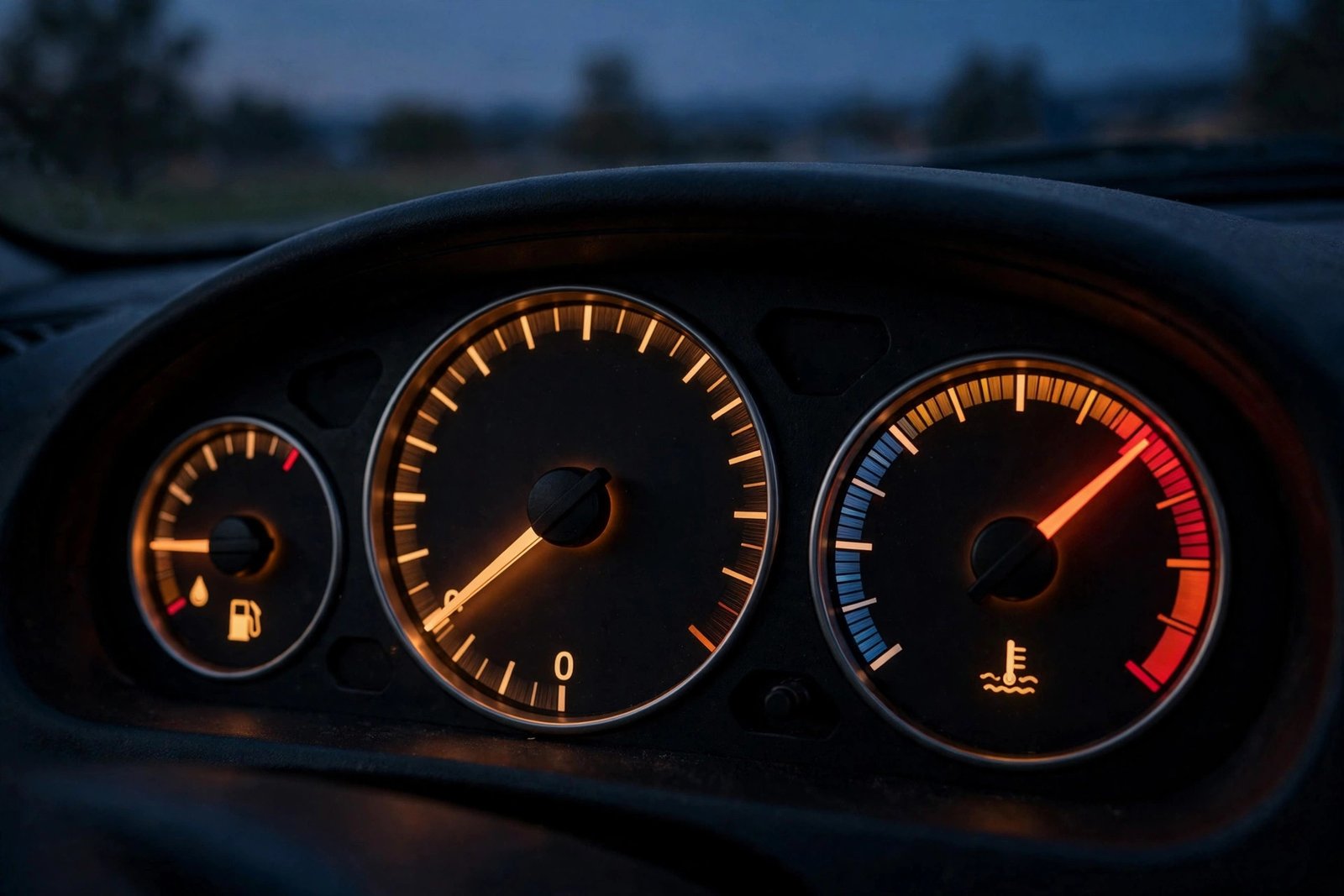
A temperature gauge that climbs, falls, and climbs again is not “just a quirk.” On most modern cars the gauge needle sits at the midpoint through a range of normal temperatures — so visible swings mean something is genuinely oscillating. The pattern of the swing is the diagnosis. A slow rise-and-fall points to different suspects than a needle that jitters or drops below normal. This guide maps each pattern to its most likely cause.
In this guide, you’ll learn:
- Which fluctuation patterns are harmless (and which aren’t)
- The most common causes, in order of likelihood
- What each swing pattern tells you
- Safe checks you can do yourself
- When to pull over immediately
Safety first: If the needle ever reaches the red zone or steam appears, pull over safely, shut off the engine, and let it cool completely. Never open the radiator or reservoir cap on a hot engine — pressurized coolant causes severe burns.
Read the Pattern First
| What the needle does | Most likely meaning |
|---|---|
| Slowly climbs, suddenly drops, repeats | Thermostat sticking then releasing |
| Jitters or bounces rapidly | Failing temperature sensor, air near the sensor, or electrical fault |
| Rises in traffic, falls on the highway | Weak radiator fan (airflow problem) |
| Drops below normal, especially on highway | Thermostat stuck open |
| Climbs and stays high | Genuine overheating — see car overheating even with full coolant |
One caveat: many modern gauges are “damped” — they sit at midpoint across a wide temperature range and only move when things are genuinely wrong. Small, slow movements in heavy traffic or on a long climb are usually harmless. Wide, repeated swings are not.
The Most Likely Causes, in Order
1. Thermostat sticking intermittently (most common)
A thermostat that sticks closed, builds pressure, then pops open floods the engine with cool radiator fluid — the needle plunges — then the cycle repeats. This slow rise-and-fall rhythm is the classic signature. Replacement is the only fix; a sticking thermostat eventually sticks permanently.
2. Low coolant level
With too little coolant, the sensor may be intermittently exposed to air instead of liquid, producing erratic readings — and the engine genuinely overheats in bursts. Check the reservoir only when cold.
3. Air pockets in the cooling system
Trapped air after a coolant change or repair disrupts circulation and gives the sensor intermittent air readings. Bleeding the system per the service manual resolves it.
4. Failing water pump
A worn or cavitating impeller circulates coolant inconsistently — fine at some RPMs, weak at others. Watch for coolant drips near the front of the engine, whining noises, or overheating that worsens under load.
5. Clogged radiator
Restricted passages can’t shed heat steadily. Overheating tends to build gradually and worsen — less “up and down,” more “climbs and stays.” But partial blockages can produce cycles.
6. Weak or intermittent radiator fan
The needle rises in stop-and-go traffic and settles once you move — airflow at speed is doing the fan’s job. Check whether the electric fans run at idle with the AC on.
7. Faulty coolant temperature sensor or gauge
If the engine behaves perfectly normally — no heat from the bay, no coolant loss, heater works — but the needle dances, the reading itself may be lying. A scan tool reading live coolant temperature (versus the gauge) settles it. This is the last suspect, not the first: assume the gauge is telling the truth until proven otherwise.
Safe Checks You Can Do Yourself
- Coolant level (cold engine): The reservoir between MIN and MAX. Below MIN = prime suspect.
- Watch the pattern: Match your needle’s behavior to the table above — the rhythm narrows the field enormously.
- Fan check: Engine warm, AC on — are the electric fans spinning?
- Look for drips: Coolant-colored stains or puddles under the front of the car.
- Heater test: Weak heat alongside a low-running gauge supports a stuck-open thermostat; heat that fades as the gauge climbs supports genuine overheating.
When to Pull Over Immediately
- The needle reaches the red zone — stop, shut off, tow if needed
- Steam from under the hood
- The gauge climbs and does NOT come back down
- Sweet coolant smell combined with rising temperature
Fluctuations that never reach red are still worth a prompt shop visit — a sticking thermostat or low coolant becomes a stuck-closed thermostat or an empty system, and both end in overheating.
FAQ
My gauge barely moves at all — is that normal?
Yes, on many modern cars. Damped gauges hold the midpoint across a wide normal range, so no movement is normal — it’s the sudden movements that matter.
Can a bad sensor really make the needle bounce?
Yes — a failing coolant temperature sensor or corroded connector can send erratic signals. But rule out coolant level, air, and thermostat first, because those are both more common and more dangerous.
Does a fluctuating gauge always mean the thermostat?
No — it’s the most common cause of the slow rise-and-fall pattern, but low coolant, air pockets, and a weak pump produce similar symptoms. The pattern table above helps you rank them.
Is P0128 related?
Code P0128 (coolant temperature below thermostat regulating temperature) points to a stuck-open thermostat or a sensor issue — consistent with a gauge that runs low. A scan at any auto parts store can read it.
Sources
- Motorist Malaysia — “Car temperature keeps going up and down? 7 causes” (7-cause list; normal mid-range behavior; never open hot cap) — https://motorist.my/article/6461/car-temperature-keeps-going-up-and-down-7-causes
- Engineer Fix — “Why Is My Temperature Gauge Going Up and Down?” (sticking thermostat mechanics; water pump cavitation; sensor vs real readings) — https://engineerfix.com/why-is-my-temperature-gauge-going-up-and-down/
- AutoChimps — “Temperature Gauge Goes Up And Down While Driving?” (fan, ECU/sensor branches) — https://autochimps.com/temperature-gauge-up-down-driving/
- Torque (Singapore) — “Temperature gauge fluctuation: What could be the cause?” (thermostat, fan, coolant level, head gasket) — https://www.torque.com.sg/advice/temperature-gauge-fluctuation-what-cause/
- Rick’s Auto Center — “My Car’s Temperature Gauge Is Bouncing Up and Down” (thermostat malfunction; erratic temperature damage) — https://ricksautocenterllc.com/my-temperature-gauge-needle-is-bobbing/