
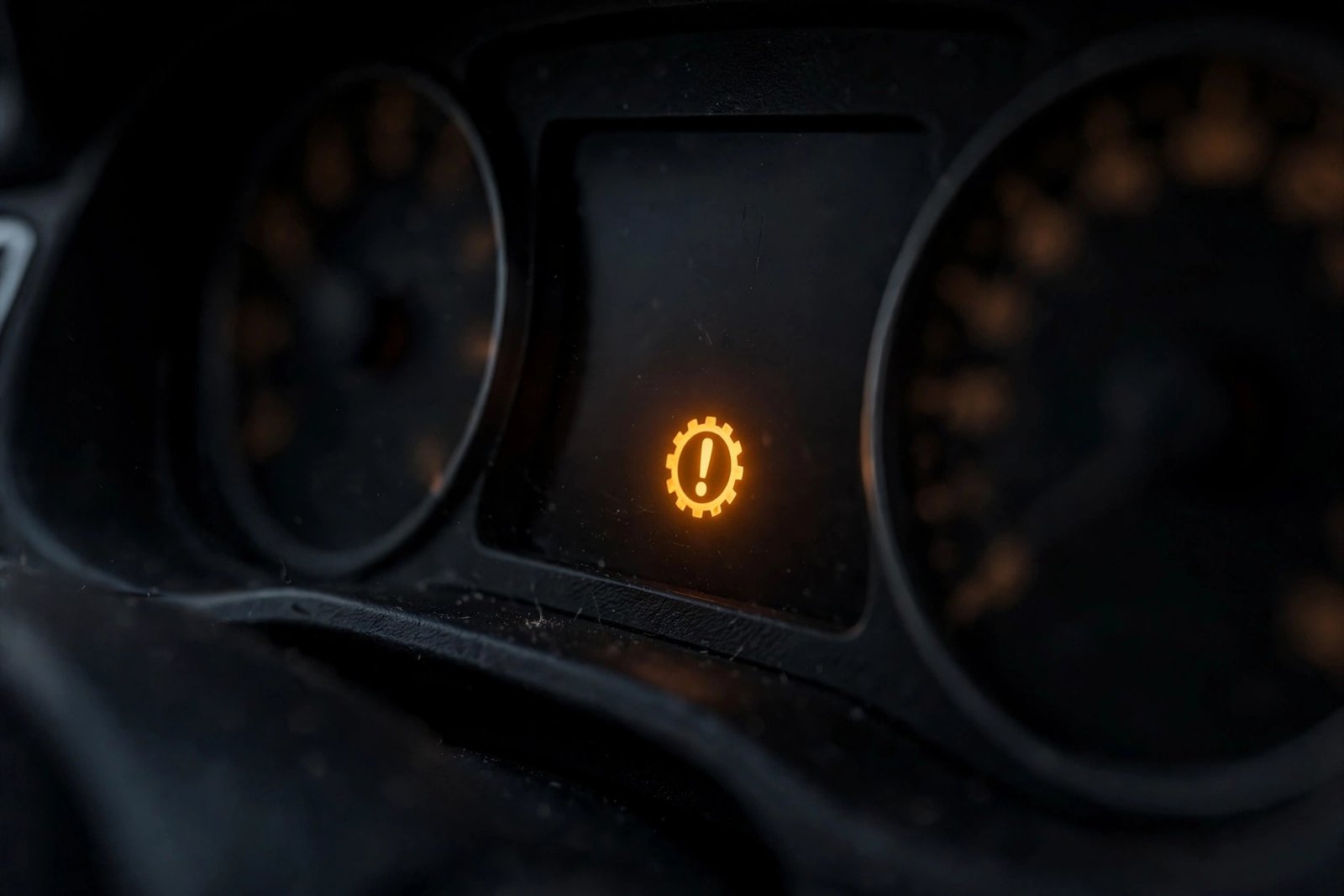
The transmission warning light is confusing because it isn’t one light — it’s three different icons with three different meanings, and many drivers (and some guides) mix them up. This guide starts by identifying exactly which icon you’re seeing, because that determines everything: urgency, likely cause, and whether you drive on or call a tow.
In this guide, you’ll learn:
- The three transmission icons and what each one means
- Urgency triage by icon and color
- The most common causes, in order of likelihood
- What “limp mode” is and why it happens
- Safe driver checks — and when to tow
Step 1: Which Icon Are You Seeing?
| Icon | Meaning | Urgency |
|---|---|---|
| Gear/cog with exclamation point | General transmission/drivetrain fault — the system detected something wrong (fluid, temperature, sensor, electrical, or mechanical) | Amber = diagnose soon; red = stop safely |
| Gear with a thermometer inside | Transmission fluid is overheating specifically | Pull over and let it cool — heat kills transmissions fast |
| No dedicated icon — instead the check engine light, a flashing overdrive light, “TRANS FAILSAFE,” or the car feels sluggish | Many cars report transmission faults through the check engine light or a text message | Diagnose by symptom + code |
check engine light on but car runs fine
Urgency Triage
| What you see | What it means | What to do |
|---|---|---|
| Gear + thermometer (overheat) | Fluid too hot — lubrication and cooling are failing | Pull over, engine off, let it cool 30+ minutes |
| Red gear icon | Severe fault | Stop safely; tow it |
| Amber gear icon, car drives normally | Stored fault; transmission protecting itself | Avoid towing/heavy loads; diagnose soon |
| Car in “limp mode” (stuck in one gear, no power, won’t shift) | Computer restricted operation to prevent damage | Drive gently straight to a shop — or tow if far |
| Burning smell + slipping | Fluid overheated/burned or internal damage | Tow it — driving on destroys clutches |
What Is Limp Mode?
When the transmission computer detects a serious fault, it may lock the transmission into a single gear (usually 2nd or 3rd) and limit power. The car feels gutless and won’t shift. This isn’t the failure — it’s the computer preventing the failure from getting worse. Don’t fight it: drive gently to the nearest shop, or tow.
The Most Likely Causes, in Order
1. Low transmission fluid (leak or overdue service)
The most common cause of both the general fault light and the overheat light. Low fluid = low hydraulic pressure for shifting + poor cooling. Many modern cars have no dipstick — level checks need a shop lift.
2. Overheating (towing, heavy traffic, hot weather)
The #1 killer of automatic transmissions. Heat above ~240°F starts degrading fluid fast; by ~260°F seals harden; approaching ~295°F, clutches slip and burn. Common triggers: towing over capacity, mountain grades, stop-and-go heat waves.
3. Degraded or burnt fluid
Fluid that has lost its lubricating and cooling properties triggers the same warnings as low fluid. Check the color and smell if you have a dipstick: healthy ATF is pinkish-red and sweet; brown or burnt-smelling fluid is overdue for service.
4. Faulty shift solenoid
Small electronic valves control fluid flow for gear changes. A failed solenoid causes wrong gear ratios, slipping, or harsh shifts — and sets the light.
5. Sensor faults (input/output speed sensors)
Codes like P0715/P0720 mean the computer can’t accurately monitor what’s happening inside the transmission. Often an electrical fix, not a mechanical rebuild.
6. Internal mechanical problems (valve body, torque converter, clutch packs)
Least common as a first cause — but the reason you don’t keep driving on the light hoping it clears.
What You Can Safely Do Yourself
- Identify the icon (gear, gear+thermometer, or check-engine/limp-mode) — it changes everything.
- If the thermometer icon: pull over and cool down. Check for obvious leaks once cool.
- Check ATF level/condition only if your car has a dipstick (many don’t — sealed units need a shop).
- Note the symptoms: slipping, delayed engagement, harsh shifts, whining, burning smell. These details are gold for the diagnosis.
- Stop towing / hauling immediately — heat is the enemy.
- Scan for codes. Transmission codes (P07xx series) narrow it fast; note that some generic readers miss them.
When to Tow, Not Drive
- Red gear icon.
- Thermometer icon that returns after cooling.
- Burning smell, slipping gears, or the transmission won’t engage a gear.
- Fluid leaking visibly under the car (reddish puddle).
- Limp mode on a highway far from a shop.
FAQ
Can I drive with the transmission warning light on?
Amber, car driving normally: carefully and briefly, to a shop — avoid towing and hard acceleration. Red, overheating, slipping, or burning smell: no — tow it.
Why does the light come on when towing?
You’re asking the transmission to work far harder than normal, generating heat the cooling system can’t shed. Reduce load, slow down, and let it cool. Repeated overheating while towing means the load is too much for the vehicle.
My car has no transmission dipstick — how do I check the fluid?
You don’t, easily — sealed transmissions need a shop with a lift and the correct procedure. This is one more reason not to guess at the cause.
Transmission light vs. check engine light — which is it?
Many cars have no dedicated transmission icon and report transmission faults as a check engine light (often code P0700 = “transmission control system malfunction”). If the car shifts badly with a CEL, suspect the transmission.
check engine light on but car runs fine
all dashboard warning lights explained
Sources
- Engineer Fix — “What Does a Transmission Warning Light Look Like?” (three icon patterns; color urgency) — https://engineerfix.com/what-does-a-transmission-warning-light-look-like/
- Engineer Fix — “What Does the AT Oil Temp Warning Light Mean?” (fluid temperature thresholds; heat damage progression) — https://engineerfix.com/what-does-the-at-oil-temp-warning-light-mean/
- Lube Oil Sales — “Transmission Fluid Symbol Warning Light Symbols” (three real patterns; root causes) — https://lubeoilsales.com/transmission-fluid-symbol/