
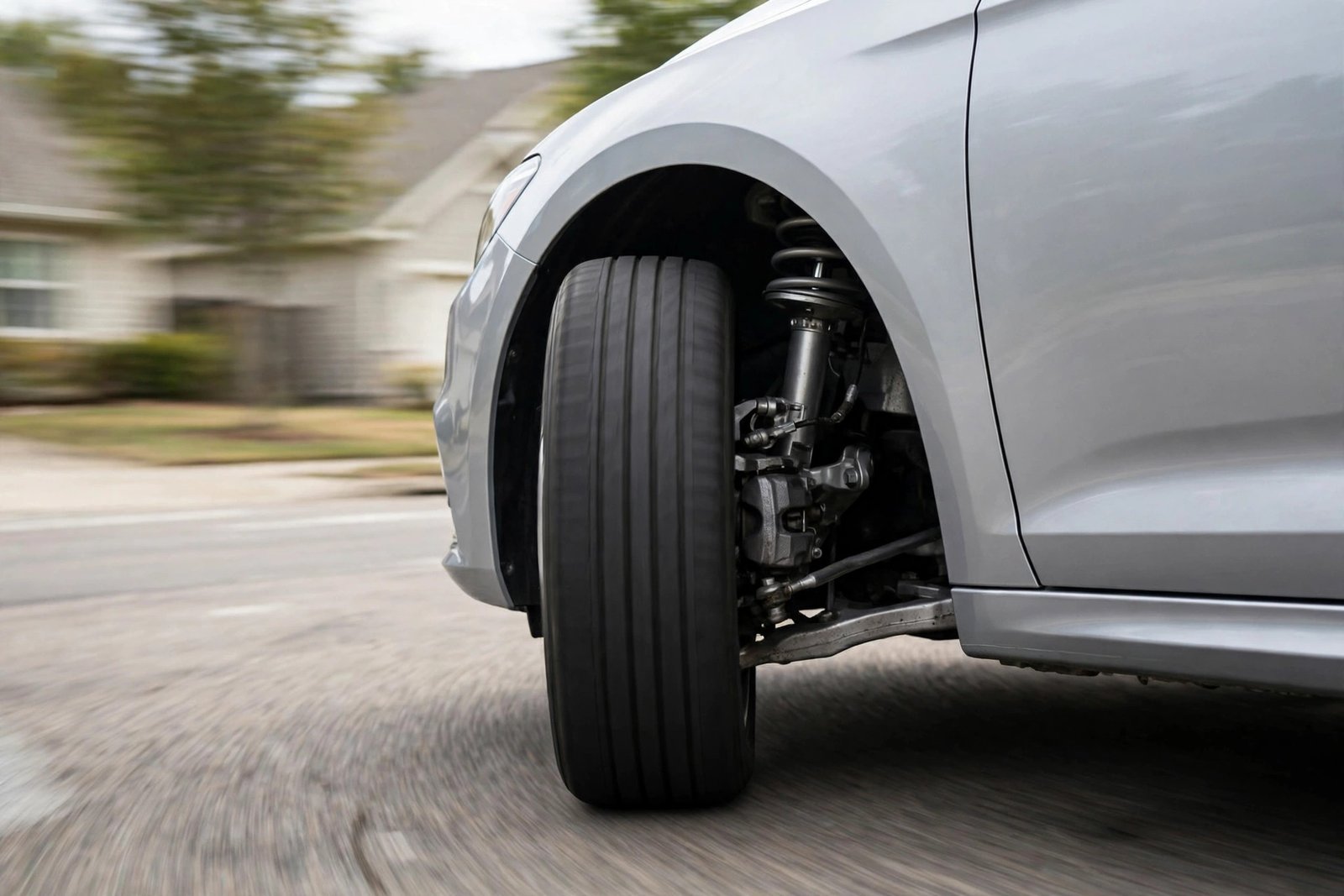
“Knocking when turning” isn’t one problem — it’s at least five, and they all knock for different reasons. Noises from the steering and suspension are timing problems: the exact moment the knock happens tells you which part is moving wrong. This guide works backward from that timing.
In this guide, you’ll learn:
- The knock-vs-click-vs-clunk-vs-pop vocabulary (they mean different parts)
- A branch-by-when diagnostic tree
- The most common causes, in order of likelihood
- Why this topic is diagnosis-only — and what a shop checks
Safety first: Steering and suspension parts keep your wheels attached and pointed the right way. A worn ball joint can separate — the wheel folds under the car and steering control is lost instantly. Do not attempt to diagnose by crawling under the car or yanking on suspension parts, and do not attempt steering/suspension repairs yourself. The checks below are observation-only: listen, note the timing, and hand the notes to a certified mechanic.
The Sound Vocabulary: Knock vs Click vs Clunk vs Pop vs Grind
Drivers use these words interchangeably; parts don’t. Use these definitions — every other noise article on this site uses the same ones:
- Knock — a heavy, single, low-pitched thud, like knocking on a door. One knock per event.
- Click — a light, sharp, rhythmic ticking that speeds up with the wheels. Many clicks per turn. → clicking noise when turning
- Clunk — a dull metallic thud, heavier than a click, usually tied to bumps or load shifts.
- Pop — a sudden snap, like a knuckle cracking. Often single, often at turn initiation. → popping noise when turning
- Grind — a harsh, continuous scraping. Means late-stage wear — act fast. → grinding noise when turning
If your noise is rhythmic clicking that speeds up with the wheels, go to the clicking guide — that’s the classic CV joint signature. If it’s a single heavy knock, keep reading.
The Decision Tree: When Exactly Does It Knock?
Do this in an empty parking lot at walking speed, windows down, radio off.
A rhythmic knock/click that gets faster as the wheels turn faster, worst at full steering lock → CV joint (see the clicking guide).
This is the #1 “knocking when turning” sound overall, and it usually presents as clicking rather than knocking. Worn outer CV joints knock loudest at full lock under power.
One sharp knock when you first start turning the wheel (especially from straight ahead) → strut mount bearing or tie rod end.
The strut mount bearing lets the whole strut rotate as you steer. When it binds, the spring winds up and releases with a single sharp knock or pop. Tie rod ends with play do the same single-knock as the steering load reverses.
Knock when the car’s weight shifts — e.g., turning into a driveway, or a knock that comes with body roll → sway bar (stabilizer) links or bushings.
Sway bar end links take up the side-to-side load in a turn. Worn ones clunk once as the bar shifts and strikes. Note: a clunk that happens both over bumps and when rocking the steering wheel while parked is a classic sway-bar-link signature.
Knock over small bumps while turning → ball joints or control arm bushings.
These carry the wheel’s vertical load through the turn. Play here knocks with every suspension movement. A worn ball joint is the safety-critical one — see the safety box above.
Knock or groan only when turning the wheel while stationary (dry steering) → strut mount bearing or steering rack mounts.
Stationary turning puts maximum torsional load on the strut mount bearing. If the knock happens with the car parked, CV joints are unlikely (they need wheel rotation to click).
The Most Likely Causes, in Order
1. Worn outer CV joint (most common overall)
The CV joint lets the front wheels receive power while steering. When its rubber boot tears, grease escapes, grit enters, and the joint wears — first clicking at full lock, progressing to knocking as wear advances. Look for dark grease splattered inside the wheel well — the telltale sign of a torn boot.
2. Worn sway bar (stabilizer) end links
Small links with ball sockets that connect the sway bar to the suspension. They live in road grime and wear out; the result is a light, repeatable knock over bumps and during turns. Often the single most common suspension knock.
3. Worn ball joints
The pivot between the control arm and the steering knuckle. Wear produces knocking over bumps and during turns, and — critically — a failed ball joint can separate. Any suspected ball joint issue goes straight to a shop; this is not a “wait and see” part.
4. Worn tie rod ends
The ball-and-socket joints linking the steering rack to the wheels. Play here knocks at low speed and when the steering load reverses, and causes uneven tire wear.
5. Failed strut mount bearing
The bearing at the top of the strut that lets the assembly rotate with steering. When it seizes or binds, turning the wheel produces a single knock, pop, or groan — often felt through the steering wheel.
6. Worn control arm bushings
The rubber bushings that cushion the control arm’s pivot points. When they crack or separate, the arm shifts under cornering load — a dull knock or clunk.
7. Loose steering rack mounts or internal rack wear
Worn rack mounting bushings let the whole rack shift in its mounts during sharp turns — a low-frequency knock. Internal rack wear adds steering play.
Observation-Only Checks (No Tools, No Crawling Under)
- The parking-lot circle test: Drive slow circles at full steering lock, both directions, windows down. Noise only at full lock, rhythmic with wheel speed = CV joint signature.
- The turn-initiation test: From straight ahead, turn the wheel slowly while parked (engine on, foot on brake). A single knock as you start turning = strut mount bearing or tie rod — not CV.
- The weight-shift test: Note whether the knock happens when the body rolls (turning into driveways, lane changes) — that points at sway bar links and bushings.
- The bump test: Does it knock over bumps even going straight? Then it’s suspension (bushings, ball joints, links), not steering-angle-specific.
- The grease check: Shine a flashlight at the inside of each front wheel and the rubber boots behind them. Dark splattered grease = torn CV boot.
Then take your notes to a certified mechanic. Tell them when the knock happens — that sentence alone can cut their diagnostic time significantly.
When to Stop Driving Immediately
- Knock + the steering feels loose, wanders, or needs constant correction: Possible ball joint or tie rod failure in progress. Tow it — do not drive.
- A knock that suddenly gets much worse, or is joined by vibration: Something has shifted or broken further. Park it and call a tow.
- Visible: wheel sitting at an odd angle, or clunking so loud passengers notice: Tow. These are late-stage failure signs.
FAQ
Is a knocking noise when turning dangerous?
It can be. CV joints and sway bar links usually degrade gradually; ball joints and tie rods can fail suddenly with loss of steering control. Any steering/suspension knock deserves prompt professional inspection.
Why does it only knock when turning left (or right)?
The joint on the outside of the turn carries more load. A knock only on left turns points at the right-side components, and vice versa — tell the mechanic which direction.
Can I just get an alignment to fix it?
No. Alignment adjusts angles; it doesn’t fix worn joints. A shop should inspect for play before aligning — aligning a car with worn parts is money wasted.
Knock vs click — does it matter which word I use?
Yes, for diagnosis. Rhythmic clicking that tracks wheel speed = CV joint. Single heavy knocks = suspension/steering joints. Using the right word gets you the right diagnosis faster — which is why this site defines each sound crisply.
Sources
- engineerfix.com — “Why Does My Car Make a Knocking Noise When Turning?” (sway bar links, rack mounts, strut mount bearings) — https://engineerfix.com/why-does-my-car-make-a-knocking-noise-when-turning/
- engineerfix.com — “Why Does My Steering Wheel Knock When Turning?” (single knock at turn initiation = loose linkage; CV click signature) — https://engineerfix.com/why-does-my-steering-wheel-knock-when-turning/
- engineerfix.com — “Why Is There a Knocking Noise From the Front Wheel When Turning?” (rhythmic click vs single clunk diagnosis) — https://engineerfix.com/why-is-there-a-knocking-noise-from-the-front-wheel-when-turning/
- trafficdave.com — “Car Makes Knocking Noise When Turning: Causes & Fixes” (tie rods, sway bar links, ball joints, strut bearings) — https://www.trafficdave.com/car-makes-knocking-noise-when-turning/
- autoracing1.com — “Vehicle Clunking over bumps: Understanding the Causes” (ball joint separation risk; sway bar links most common) — https://www.autoracing1.com/pl/476555/automotive-news-vehicle-clunking-over-bumps-common-causes-and-fixes/