
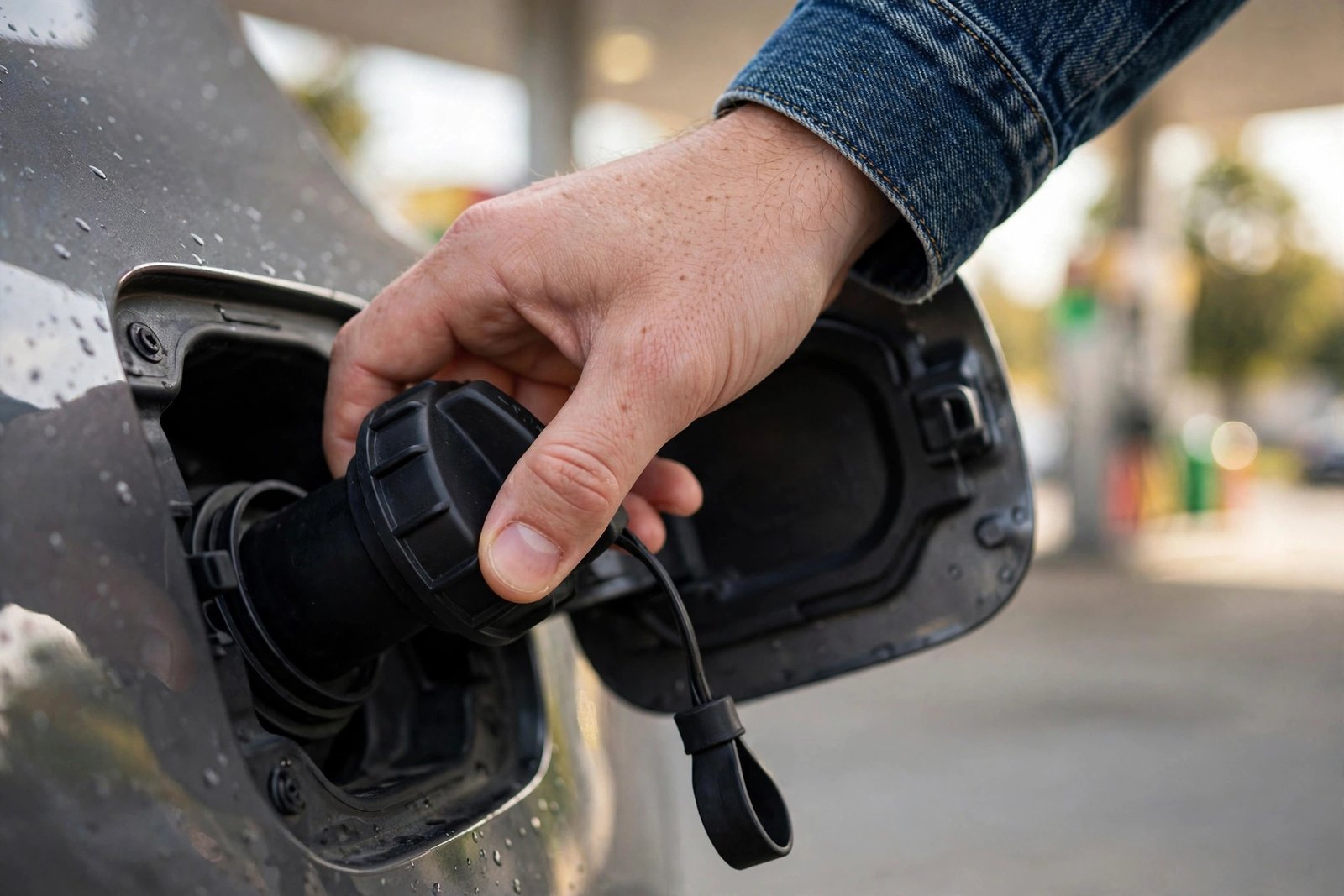
The timing is the diagnosis: a check engine light that appears within a drive or two of refueling is an EVAP-system problem until proven otherwise. The evaporative emissions system seals your fuel tank to trap gasoline vapors, and refueling is exactly when that seal gets disturbed. This guide walks the decision tree from the 30-second fix to the deeper causes.
In this guide, you'll learn:
- Why refueling triggers the light (the EVAP pressure test)
- The exact decision tree: cap → overfill → bad fuel → deeper EVAP fault
- What "drive cycles" mean for the light clearing itself
- When it's not the gas cap after all
- When to see a mechanic
Why Refueling Triggers It
Your car's computer periodically runs a pressure/vacuum test on the sealed fuel system to make sure no gasoline vapors escape. Anything that breaks the seal — a loose cap, a cracked cap gasket, an overfilled tank flooding the vapor system, or contaminated fuel — fails that test. The computer stores an EVAP code (commonly P0455 large leak, P0457 fuel cap loose/off) and turns on the light. The system doesn't know what is leaking, only that pressure can't be held.
The Decision Tree
Step 1 — The gas cap (30 seconds, fixes most cases).
Remove the cap and reinstall it firmly until it clicks. Inspect the rubber gasket for cracks, tears, or flattening — a worn seal leaks just like a loose cap. Then drive normally. The light usually clears on its own after several successful drive cycles (a few days of mixed driving). If the cap is cracked or the gasket is shot, replace the cap — it's one of the cheapest parts on the car.
Step 2 — Did you overfill the tank?
If you "topped off" past the pump's auto-shutoff, liquid fuel can flood the charcoal canister that's meant to hold only vapors. That damages the canister and sets EVAP codes. Lesson: when the pump clicks off, stop. If you overfilled, the light may clear after a few drive cycles once the system dries out — but a saturated canister sometimes needs replacement.
Step 3 — Did you leave the engine running while refueling?
With the engine on, the EVAP self-test can run mid-fill and detect the open filler as a massive leak. Same fix as Step 1: tighten, drive, wait.
Step 4 — Is the car running badly since the fill-up?
Hard starting, rough idle, or misfires right from the station point to contaminated or wrong-octane fuel, not the cap. This is the branch where "wait for it to clear" is wrong — bad fuel needs addressing (drive it down and refill with quality fuel from a reputable station; severe cases need the tank drained by a shop).
Step 5 — Cap is fine, fuel is fine, light persists.
The leak is deeper in the EVAP system: cracked vapor hoses, a failing purge valve or vent valve, or a damaged charcoal canister. These need a professional smoke test — the shop pressurizes the system with visible vapor to find the leak. Not a DIY diagnosis.
Drive Cycles: Why the Light Takes Days to Clear
A "drive cycle" is a specific pattern of cold start, warm-up, city and highway driving that lets the computer run its self-tests. The light doesn't clear the instant you tighten the cap — it clears after the computer runs enough successful tests to trust the seal again. That's usually a few days of normal mixed driving. Disconnecting the battery "resets" it instantly, but also wipes the evidence — and the light returns if the fault is real.
When It's Urgent Anyway
- The light is flashing — that's a misfire warning, not an EVAP quirk. (Different problem; different response.)
- Strong fuel smell around the car — possible liquid fuel leak, not just vapor. Don't drive with a strong raw-fuel smell; get it checked.
- The car runs poorly after refueling — contaminated fuel or a flooded canister.
FAQ
How tight should the gas cap be?
Until it clicks — most caps click 2–3 times. "Snug" isn't a setting; the click is.
Will the light go off by itself after I tighten the cap?
Usually yes, after a few days of normal driving (several drive cycles). If it's still on after a week of mixed driving, the problem is deeper than the cap.
Can a bad gas cap cause a failed emissions inspection?
Yes — any illuminated check engine light is an automatic failure in most states, whatever the cause. Fix it before your test.
I replaced the cap and the light is still on — now what?
Give it a week of driving first. If it persists, get the code read — P0455/P0456/P0457 point to EVAP, and a smoke test finds leaks the eye can't see.
check engine light on but car runs fine
check engine light that comes and goes
Sources
- Engineer Fix — "Can a Gas Cap Cause the Check Engine Light?" (EVAP pressure-test mechanism; federal emissions mandate) — https://engineerfix.com/can-a-gas-cap-cause-the-check-engine-light/
- SlashGear — "Why Your Check Engine Light May Be On After Getting Gas" (overfilled tank flooding the charcoal canister; EVAP components) — https://Www.slashgear.com/1772692/check-engine-light-after-gas-reason/
- RX Mechanic — "Why Does the Check Engine Light Come on After Getting Gas?" (worn cap seals; bad fuel; engine running during refuel) — https://rxmechanic.com/check-engine-light-after-getting-gas/
- Motorbiscuit — "Will Check Engine Light Turn Off by Tightening the Gas Cap?" (P0455/P0457 codes; cap inspection) — https://www.motorbiscuit.com/check-engine-light-turn-off-tightening-gas-cap/