
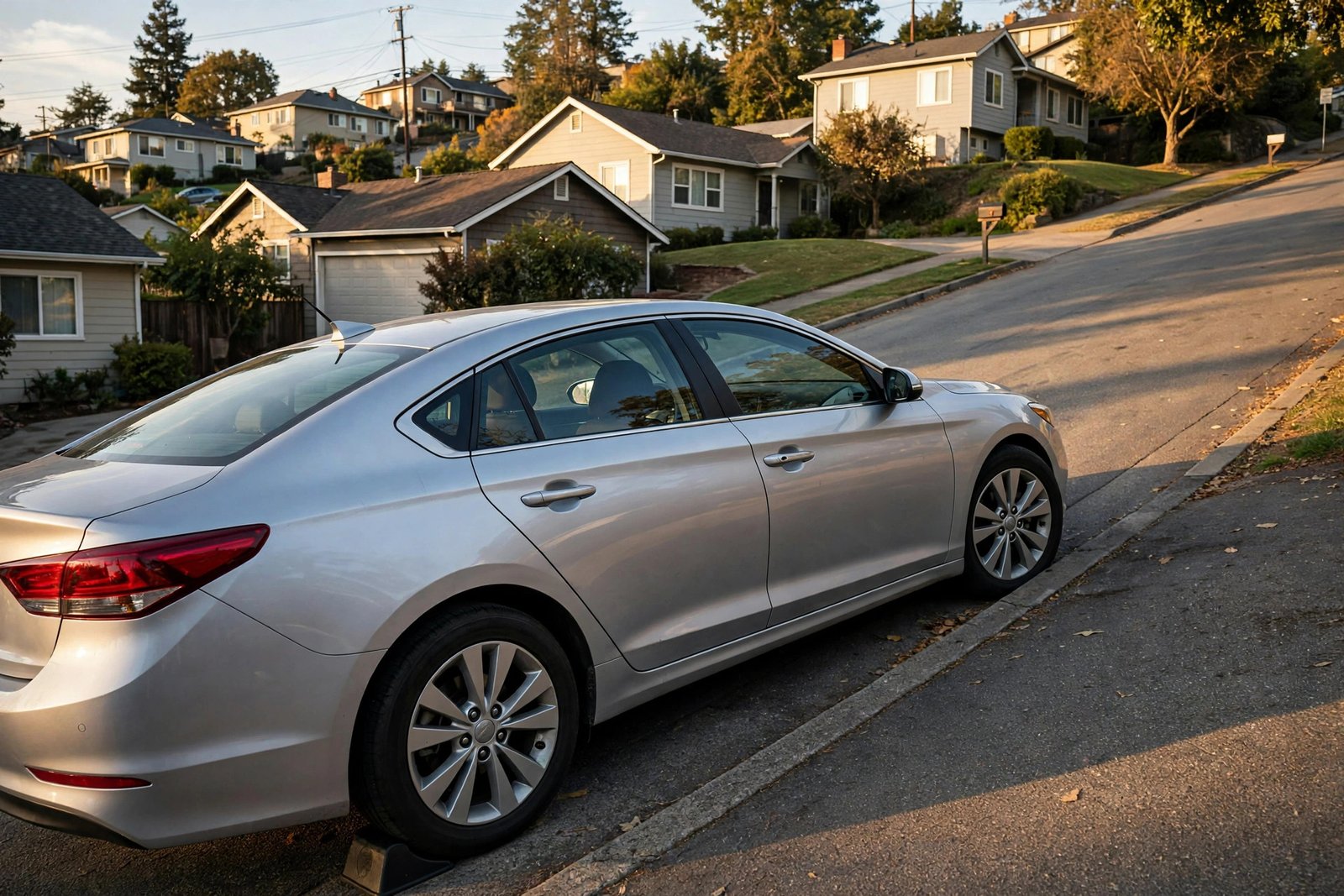
You engage the parking brake, put the car where you want it — and it creeps. Maybe an inch, maybe a foot, maybe it starts rolling down the driveway. A parking brake that can't hold the car is a real safety hazard: an unattended rolling car can cause injury and property damage, and on some steep grades it won't stop on its own. The good news is that the causes are well understood, and until it's fixed you can park safely with a few low-tech precautions.
Safety first: If the car is currently rolling, turn the steering wheel toward the curb (or the safest barrier), let the car stop against it, and keep the parking brake engaged while you assess. Never stand in front of or behind a car that may move. If the car won't stay put anywhere, don't leave it unattended — have it towed to a certified mechanic.
In this guide, you'll learn:
- Immediate safe-parking steps until it's fixed
- Why a fully engaged parking brake can still let the car move
- The most common causes, in order of likelihood
- Safe checks you can do without tools
- What to tell your mechanic
Park It Safely Right Now
Until a certified mechanic fixes the underlying cause, use every backup you have:
- Turn the wheels toward the curb (or the safest available barrier). On a steep grade with no curb, angle the wheels so a roll carries the car away from traffic and people.
- Leave a manual in gear (reverse facing downhill, first facing uphill); leave an automatic in Park — these are backups to the parking brake, not replacements for it.
- Use wheel chocks on the downhill wheels if you have them — cheap insurance while the brake is suspect.
- Avoid steep grades entirely until it's repaired. Park on level ground wherever possible.
Why an Engaged Parking Brake Can Still Let the Car Move
The parking brake holds the rear wheels with dedicated shoes or pads — but it only holds as hard as the mechanism allows. Anything that reduces the clamping force — stretched cables, worn friction material, misadjustment, or heat — lets gravity win on a slope. A car that holds fine on level ground and creeps only on hills is showing you that the margin is gone: the brake is weak, not necessarily dead.
The Most Likely Causes, in Order
1. Stretched or out-of-adjustment cables (most common)
Parking-brake cables stretch slowly over years of use, and the lever or pedal needs more travel to produce the same clamping force. The classic sign: the lever comes up very high (or the pedal travels far) before anything holds. Adjustment is a routine shop procedure — the parking brake needs a periodic check just like the service brakes.
What to do: Note how far the lever/pedal travels now versus when the car was new. A shop adjusts the cable and verifies the holding force — this is certified-mechanic work, not a driveway guess.
2. Worn parking-brake shoes or pads
The parking brake uses its own friction material (shoes inside a drum, or pads in a caliper-style setup). Like service brakes, it wears. Worn material holds less, and cars where the parking brake is rarely used can also develop rust on the drum or rotor surface that reduces grip.
What to do: Report whether the parking brake is used regularly and whether holding has degraded gradually or suddenly. A shop inspects the shoes/pads and the drum/rotor surface.
3. Applied while the brakes were hot (heat shrinkage)
If you engage the parking brake after heavy braking — a long downhill, stop-and-go traffic — the hot drums shrink slightly as they cool. That small contraction can be just enough to release the grip over the next hour. Fleet safety bulletins flag exactly this failure mode: the car holds at first, then creeps as the brakes cool.
What to do: If the creep started after a hot-brake stop, note the sequence. Going forward, after hard braking on arrival, re-check the brake's hold a few minutes later — and use the backup precautions above until a shop verifies the adjustment.
4. Corroded or seized cables/mechanism
Road salt and moisture corrode cables inside their housings. A corroded cable may not pull evenly — or at all — so the lever moves but the rear brakes barely engage. This often comes on gradually and is common in older cars in winter-climate regions. parking brake stuck and won't release
5. Contaminated rear brake surfaces
Grease or oil on the rear shoes or drum (from a leaking seal) drastically reduces holding friction. If a parking brake that used to hold suddenly holds nothing, contamination is on the suspect list — and it usually pairs with a service-brake smell or pull. burning smell after braking
Safe Checks You Can Do (Observation Only)
- Lever/pedal travel: How far does it go now vs. your memory of normal? Full travel with weak hold = stretch or misadjustment.
- When does it creep? Only on steep hills (weak but alive) vs. on level ground (dead) — that distinction tells the mechanic how urgent it is.
- Hot or cold? Did you brake hard just before parking? Heat-shrinkage leaves a telltale "held at first, then moved" pattern.
- Rust or disuse? Parking brakes that haven't been used in months can seize from corrosion — note the history.
When to See a Mechanic Promptly
- The car creeps on level ground, not just hills — the brake is effectively gone; don't park it anywhere sloped.
- The brake that holds cold fails after a hot stop — repeatable heat shrinkage means the margin is zero.
- Any paired symptom: burning smell, grinding from the rear, or the service brakes pulling — the fault may be bigger than the parking brake alone.
- You can't trust the car unattended — that alone justifies the visit.
What to Tell Your Mechanic
"Parking brake engaged but the car rolls" plus: where it rolls (hills only or level), hot or cold, how far the lever/pedal travels, whether holding degraded gradually or failed suddenly, and how often you use the brake. A shop checks cable adjustment, shoe/pad condition, and drum/rotor surfaces — ask what the measurements showed.
FAQ
Is it safe to rely on "Park" or leaving it in gear instead?
Only as a temporary backup. The parking pawl in an automatic isn't designed to hold the car's full weight on a steep hill, and a manual's engine compression can be overcome on steep grades too. Fix the parking brake; use gear/Park as belt-and-suspenders.
Why does my parking brake hold sometimes but not others?
The hot-brake shrinkage pattern is the classic explanation — it holds while the drums are hot, then creeps as they cool. Cable stretch near the limit also produces "holds on gentle slopes, not steep ones."
Can I just pull the lever harder?
Yanking a stretched or corroded cable harder risks snapping it or damaging the mechanism. Set the lever firmly but normally, use the backup precautions, and have a certified mechanic adjust it.
How often should a parking brake be checked?
Have it checked at every brake service at minimum. If the lever travel has grown noticeably, that's your early warning — get it adjusted before the brake stops holding.