
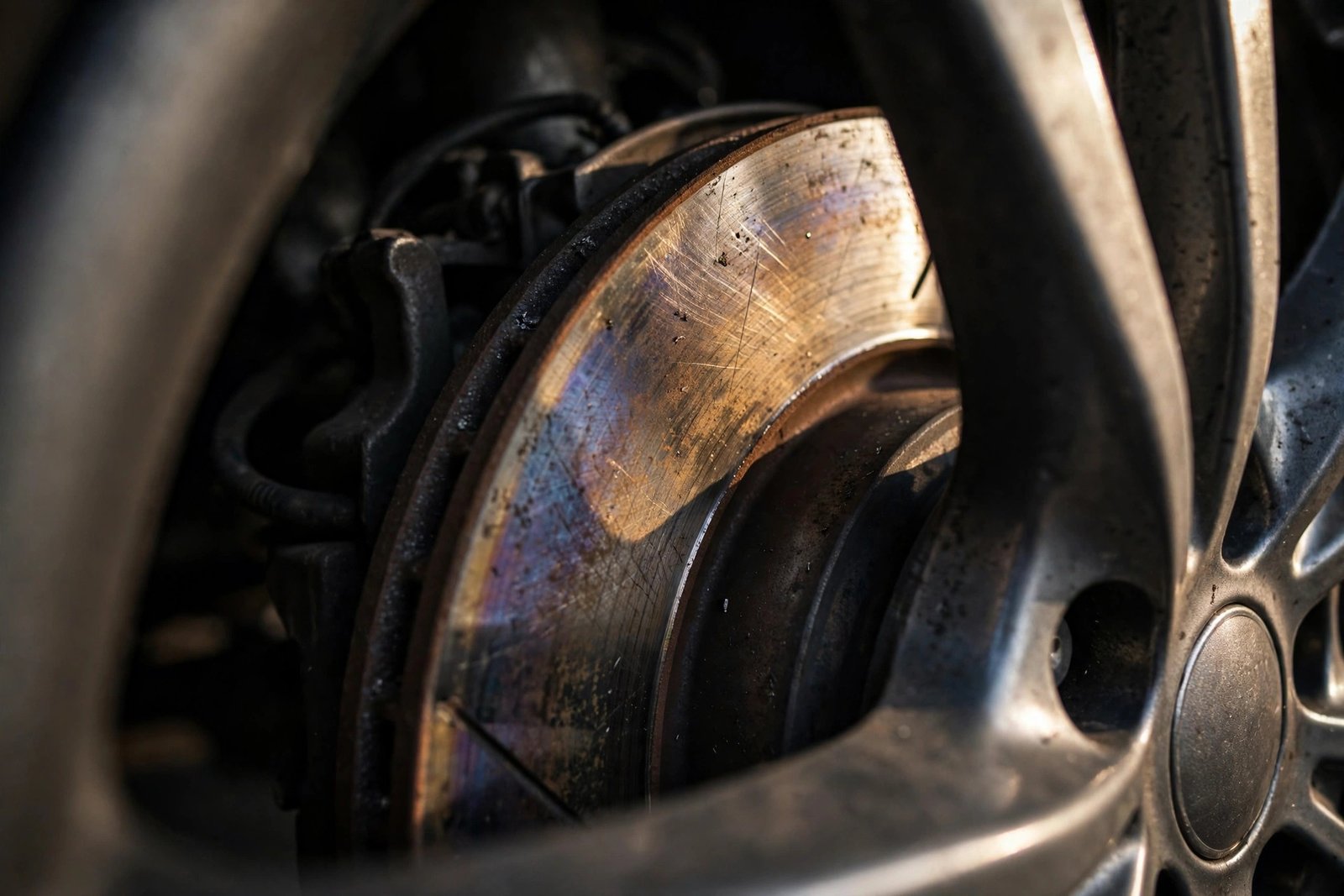
A rhythmic pulsing, throbbing, or vibration in the brake pedal when you slow down is one of the clearest symptoms brakes can give you — and one of the most misread. The instinctive diagnosis is "warped rotors," but modern brake rotors rarely warp under street driving. The real culprit in most cases is disc thickness variation (DTV): the rotor has become microscopically thicker in some spots and thinner in others, so the pads grab and release with every rotation — and you feel it through the pedal.
There is one important exception: a pulsing pedal during a hard emergency stop is usually the ABS doing its job, not a fault. This guide teaches you to tell the difference, then walks the real causes in order of likelihood. Diagnosis only — brake repair is certified-mechanic work.
Safety first: A pulsing pedal during normal, gentle braking is a mechanical issue that needs a certified mechanic's inspection. A pulsing pedal only during hard emergency braking is normal ABS operation — keep firm pressure on the pedal; never lift off in an emergency.
In this guide, you'll learn:
- The 5-second test: rotor problem vs. normal ABS
- What disc thickness variation actually is (and why "warped rotor" is usually wrong)
- The most common causes, in order of likelihood
- Safe observations you can make without touching brake parts
- What to tell your mechanic
The 5-Second Test: Rotors or ABS?
Pulse happens during normal, gentle-to-moderate braking on dry pavement — rotor/DTV issue. Action: see a certified mechanic.
Pulse happens only during hard/emergency braking, with a buzzing or grinding sound — normal ABS activation. Action: none; keep firm pressure on the pedal in emergencies.
Pulse happens during gentle braking at low speed (under ~10 mph) with a buzzing noise — possible false ABS activation from a wheel speed sensor fault. Action: see a mechanic — this is different from both above. ABS kicks in at low speed
Write down which one matches you — it determines the entire diagnosis.
What Disc Thickness Variation (DTV) Really Is
Every time the rotor turns, the pads ride across its face. If the face isn't perfectly uniform in thickness, the caliper piston gets pushed in and out with each rotation, and that oscillation travels back through the hydraulic fluid to your foot as a pulse.
Two things create DTV:
- Uneven pad-material transfer. Braking deposits a thin film of pad material on the rotor. Heavy braking followed by sitting still with hot pads clamped on the rotor (think: hard stop, then foot on the brake at a red light) deposits thick patches in one spot. Those patches become high spots the pad rides over unevenly.
- Lateral runout leading to uneven wear. If the rotor wobbles even a couple of thousandths of an inch as it spins — from a rusty hub face, debris behind the rotor, or uneven lug-nut torque — the pads tap the rotor every rotation, wearing microscopic high and low spots into it. The allowable thickness variation is often under 0.0005 inches, so it doesn't take much.
This is also why replacing just the pads often doesn't fix the pulse — the rotor's unevenness is still there.
The Most Likely Causes, in Order
1. Uneven pad deposits / disc thickness variation (most common)
The classic signature: a rhythmic pulse that appears at moderate braking, grows with speed, and may be joined by a light steering-wheel shimmy during harder stops. It develops gradually over weeks or months of driving.
2. Sticking caliper overheating one rotor
A caliper that drags on one side overheats that rotor, which accelerates uneven wear and deposits. Clues: the pulse comes with a pull to one side, one wheel hotter than the others after a drive, or a burning smell.
3. False ABS activation (sensor or tone-ring fault)
If the pulse comes mainly at low speed with a buzzing sound and little steering-wheel shake — and especially if the ABS warning light is on — a weak wheel speed sensor signal is tricking the ABS into firing when nothing is slipping. This is a distinct fault from DTV and needs its own diagnosis. ABS kicks in at low speed
4. Worn suspension components
Worn control-arm bushings, ball joints, or wheel bearings don't cause the pulse, but they amplify it — the same rotor unevenness that a tight car would barely show gets transmitted straight to the pedal in a worn car. A mechanic rules these out when the pulse is out of proportion to the rotor measurements.
5. Loose or improperly torqued lug nuts
A rotor that was mounted over rust/debris, or whose lug nuts were tightened unevenly, sits crooked — introducing runout that starts the DTV cycle. This one often traces back to a recent wheel installation.
Simple Observations You Can Make Safely
- Run the 5-second test (above) and note your answer — it's the single most valuable fact for your mechanic.
- Note the speed range: pulse only when braking from highway speed (rotor DTV) vs. pulse creeping to a stop under 10 mph (suspect false ABS).
- Note the rhythm: a true rotor pulse is perfectly rhythmic and wheel-speed-dependent — it slows as the car slows. Irregular buzzing points more toward ABS.
- Look for company: pull to one side, hot wheel, burning smell, ABS warning light — report every companion symptom; each one points at a different cause.
When to See a Mechanic
- Pulse during normal, gentle braking — the most common trigger; get the rotors measured.
- Pulse plus pull, heat, smell, or a warning light — prompt.
- Pulse that appeared right after a wheel was installed — the mounting is suspect.
- Any pulse that's getting worse week to week — DTV feeds on itself; early measurement is cheaper.
What to Tell Your Mechanic
"The pedal pulses during normal braking on dry pavement" — plus your 5-second-test answer, the speed range, whether it's rhythmic, and any companion symptoms (pull, heat, smell, ABS light). A good shop measures rotor thickness variation with a dial indicator and checks pad condition before quoting — ask what the measurements showed. A shop that skips measuring and goes straight to quoting new rotors is skipping the diagnosis.
FAQ
Are my rotors warped?
Probably not literally — true warping is rare in street driving. Disc thickness variation (microscopic unevenness) produces the identical pedal pulse and is the far more common cause.
Can I fix brake pulsation with new pads?
Usually no — if the rotor face is uneven, new pads conform to the unevenness and the pulse returns. The rotor must be measured and either resurfaced (if thick enough) or replaced.
Why did the pulse start after a hard mountain descent?
Heat plus clamping: heavy braking followed by sitting still with hot pads pressed against the rotor is the textbook way to create uneven pad deposits. Let brakes cool before clamping them still at a stoplight when possible.
My pedal pulses but the car shakes too — same cause?
Related but distinct: pedal pulse is rotor/pad contact; whole-car shake under braking often has the same root but can also involve suspension. car shakes when braking