
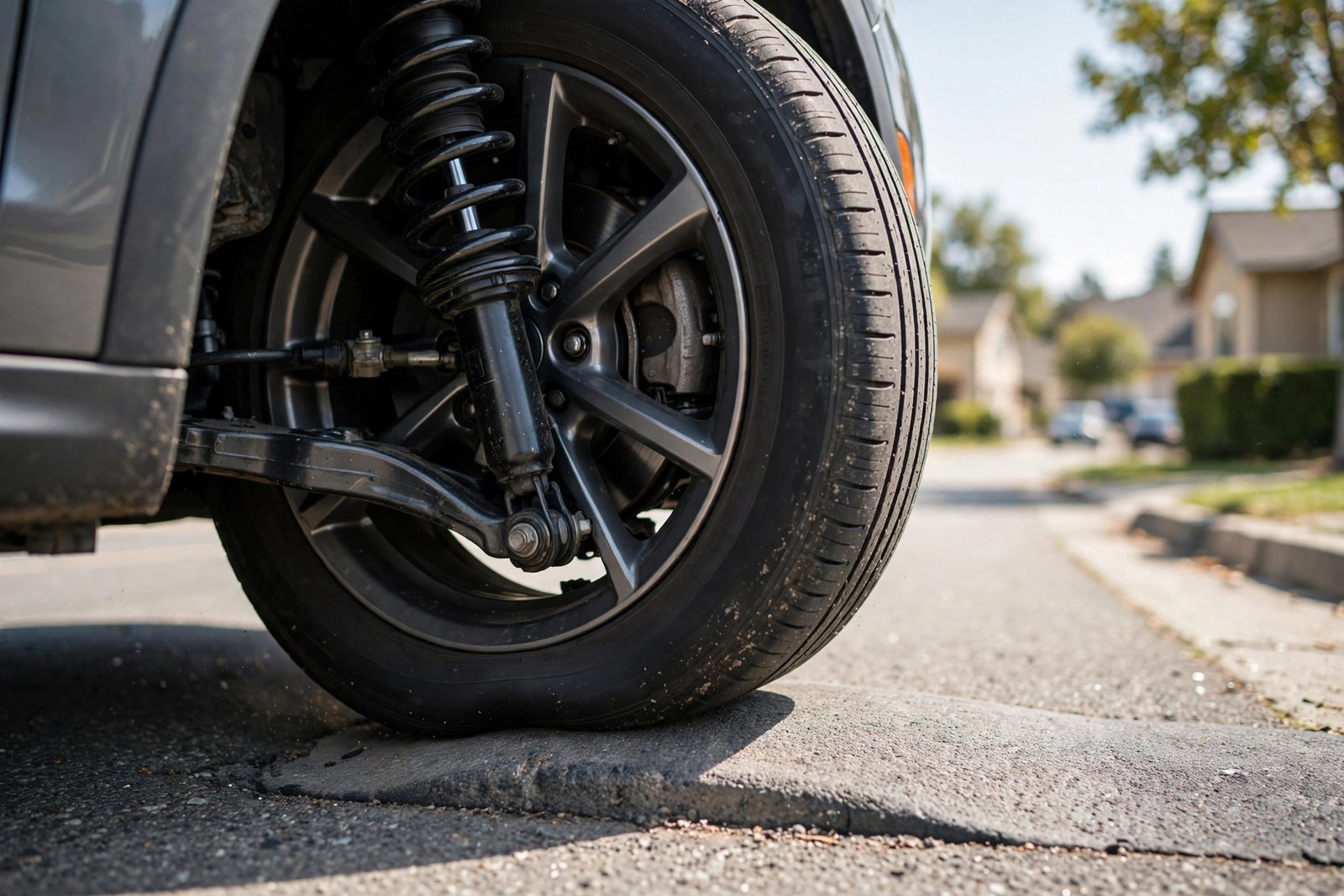
A hollow clunk or thud every time you hit a bump, pothole, or driveway entrance is your suspension telling you something has developed play. Suspension clunks are location problems: which corner, and what kind of bump triggers it, narrows the suspect list fast.
In this guide, you'll learn:
- How to localize the clunk (front/rear, left/right)
- The most common causes, in order of likelihood
- The simple brake-pedal test that catches one common imposter
- Why this topic is diagnosis-only — and the red flags that mean stop driving
Safety first — read this: The suspension and steering hold your wheels on and keep them aimed. Worn ball joints can separate and worn tie rods can fail — both mean sudden loss of steering control. This article is diagnosis-only: observe the pattern, note which corner, and take it to a certified mechanic. Do not attempt suspension or steering repairs yourself, and don't diagnose by yanking on parts under the car.
Localize It: Three Questions
Before anything else, answer these on your next drive:
- Front or rear? Front clunks are felt through the steering wheel and floor; rear clunks through the seat. Rear-only clunks have their own guide: thumping noise from the rear of the car.
- One side or both? A clunk over a speed bump hit straight-on (both wheels) vs a pothole hit with one wheel tells you whether it's a single-corner part (link, bushing, mount) or something spanning the car (sway bar bushings, subframe).
- What kind of bump? Sharp pothole edges stress different parts than rolling speed bumps. Sway bar links clunk most when one wheel moves independently of the other; strut mounts clunk on sharp impacts.
The Most Likely Causes, in Order
1. Worn sway bar (stabilizer) end links (most common)
The #1 suspect for bump clunks. These small links with ball-socket joints connect the sway bar to the suspension; they live in road grime and wear out. Signature: a light, hollow, repeatable clunk over bumps and when slowly rocking the steering wheel side to side while parked.
2. Worn strut mounts / top hats
The strut's upper mount cushions it against the chassis. When the rubber degrades or the bearing fails, sharp bumps produce a clunk — sometimes with a popping noise when turning (see popping noise when turning).
3. Worn control arm bushings
The rubber bushings at the control arm pivots crack and separate with age. Then the arm shifts under load — a duller, heavier clunk, often with vague steering or uneven tire wear.
4. Worn ball joints
The pivot between control arm and steering knuckle. Knocks over bumps and during turns. Safety-critical: a separated ball joint means the wheel folds under the car. Any suspected ball joint issue = prompt shop visit, no exceptions.
5. Worn shock absorbers / struts
Leaking or internally worn dampers clunk when they bottom out or when their mounts fail. The bounce test (push down hard on the corner — more than 1–2 bounces = worn) is a rough indicator, not a diagnosis.
6. Loose brake hardware (the imposter)
Worn caliper slide pins, loose caliper bolts, or missing anti-rattle clips let the brake pads shift in the bracket — a clank over bumps that vanishes the moment you touch the brake pedal. If your clunk stops when braking lightly over a rough road, it's brake hardware, not suspension.
7. Loose exhaust heat shield or hanger
A thin tinny rattle rather than a true clunk — but worth ruling out. If the "clunk" is really a metallic buzz, see the rattle guide in the Noises & Vibrations hub.
Simple Checks You Can Do Yourself
- The brake-pedal test: Drive slowly over a rough patch or speed bump while lightly pressing the brake. Clunk disappears = brake hardware (caliper/pad clips). Clunk unchanged = suspension.
- The steering-rock test (parked): With the car parked, slowly rock the steering wheel left-right. A clunk that also happens here = sway bar end links (they move with steering too).
- The corner log: Note front/rear, left/right, and bump type. "Front-right clunk on sharp potholes only" is worth more than any description of the sound.
- Visual only (no crawling under): Look through the wheel spokes with a flashlight for obviously broken sway bar links (hanging loose), torn rubber boots, or fluid leaking down a strut/shock body.
- The bounce test: Push down hard on each corner and release. More than a bounce or two, or any clunking during the bounce = worn damper or mount on that corner.
When to Stop Driving and Call for Help
- Clunk + steering feels loose, wanders, or pulls: Possible ball joint or tie rod failure in progress. Tow it.
- Clunk that started suddenly and is getting worse by the day: Something has broken or is breaking — don't wait for it to finish.
- Clunk + visible: wheel at an odd angle, or something hanging under the car: Tow. Do not drive to "see if it's okay."
- Any clunk you can feel through the steering wheel as a sharp knock: Get it inspected before your next highway drive.
FAQ
Is it safe to drive with a clunking suspension?
It depends on the cause — and you can't know the cause by ear alone. Sway bar links: degraded handling but rarely catastrophic. Ball joints/tie rods: potentially catastrophic. Since the stakes differ so much, get any new suspension clunk inspected promptly.
Why does it clunk over bumps but not on smooth roads?
Because the noise is play — metal parts with clearance banging together. Smooth roads don't move the suspension enough to take up the slack. Bumps do.
Can I just turn up the radio?
You can, and many drivers do for months. The risk: a $30 sway-bar-link clunk ignored becomes uneven tire wear, and a ball-joint clunk ignored becomes a separation. The inspection is cheap; the failure isn't.
Does cold weather cause suspension clunks?
Cold stiffens rubber bushings and thickens damper oil, so marginal parts clunk more on cold mornings. A clunk that's new with cold weather still deserves an inspection — cold just reveals the wear that was already there.
Sources
- autoracing1.com — "Vehicle Clunking over bumps: Understanding the Causes" (end links most common; ball joint separation risk; diagnosis-only framing) — https://www.autoracing1.com/pl/476555/automotive-news-vehicle-clunking-over-bumps-common-causes-and-fixes/
- engineerfix.com — "What Causes a Clunking Noise in the Front End When Going Over Bumps?" (end links, bushings, mounts; metal-on-metal play) — https://engineerfix.com/what-causes-a-clunking-noise-in-the-front-end-when-going-over-bumps/
- engineerfix.com — "What Causes a Rattle in the Front End When Going Over Bumps?" (ball joint separation warning; brake-hardware rattle test) — https://engineerfix.com/what-causes-a-rattle-in-the-front-end-when-going-over-bumps/
- travelmechanic.ai — "Mobile Clunking Noise Over Bumps Inspection" (inspection checklist: ball joints, links, strut mounts, tie rods, bushings) — https://travelmechanic.ai/services/mobile-clunking-noise-when-i-drive-over-bumps-inspection