
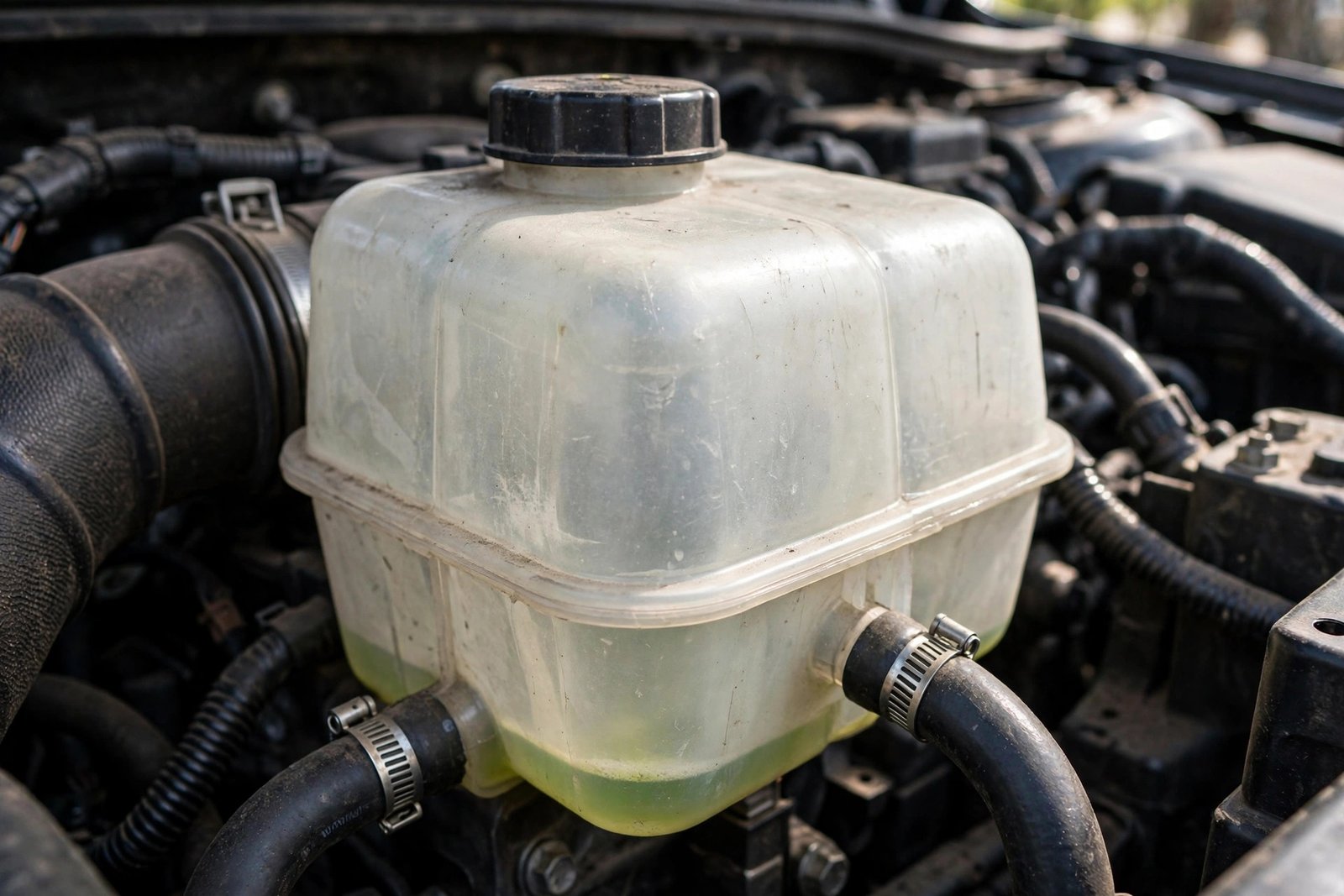
You keep topping up the coolant reservoir, and it keeps emptying — but there's never a puddle under the car. Coolant doesn't just vanish; it's going somewhere you're not looking. There are only four places it can go: out as liquid you haven't spotted, out as vapor or steam, into the engine (oil or combustion chamber), or out the overflow from overfilling. This guide is a detective process that eliminates each one.
In this guide, you'll learn:
- The four places disappearing coolant can go
- The most common causes, in order of likelihood
- The oil-dipstick and exhaust checks that catch internal leaks early
- When to stop driving immediately
Safety first: Never open the radiator or reservoir cap on a hot engine. If the temperature gauge climbs, pull over and shut off — an engine run low on coolant can suffer head-gasket failure in minutes. And remember: coolant is toxic to pets and children — clean up any spill.
The Four Hiding Places
| Where it goes | How to catch it |
|---|---|
| Evaporates off hot engine parts before dripping | Dried crusty residue (white/green/orange) on hoses, radiator, pump |
| Leaks only under pressure | Pressure test at a shop; check when fully hot |
| Into the engine (head gasket / internal) | Milky oil on dipstick or cap; white exhaust vapor; bubbling reservoir |
| Out the overflow as steam (weak cap) or from overfilling | Reservoir empties to a stable lower level; sweet vapor smell, no drip |
The Most Likely Causes, in Order
1. Pinhole leak that evaporates on hot parts (most common)
Tiny seeps at hose connections, the radiator, or the water pump only open under full pressure and temperature. The coolant hits a hot surface and evaporates before it can drip — no puddle, ever. What it leaves behind: dried crusty residue in white, green, or orange around the leak point. Inspect every hose end, the radiator seams, and the water pump area with a flashlight (cold engine).
2. Internal leak: head gasket or cracked head
Coolant entering the combustion chamber exits as white exhaust vapor; coolant entering the oil shows as milky, chocolate-milk residue on the dipstick or inside the oil filler cap, and the oil level may read above full. These are the two checks that catch it early:
- Dipstick test: Pull the dipstick — milky or foamy oil = coolant in the oil. Do not drive the car in this state; coolant destroys bearings.
- Exhaust test: Persistent white vapor (not the brief steam of a cold start) with a sweet smell = coolant burning.
3. Weak radiator cap venting steam
The cap is a pressure valve, not just a lid. A weak spring lets coolant boil at a lower temperature and vent as invisible steam through the overflow. Signature: the reservoir drops to a lower level and then stabilizes there, with a faint sweet smell but no drip. Caps are cheap — but confirm before replacing.
4. Overflow/expansion hose problems
A cracked, kinked, or disconnected overflow hose means coolant pushed to the reservoir never returns to the radiator — or escapes before it gets there. The radiator stays full while the reservoir mysteriously empties.
5. Heater core seep
A slow heater-core leak may never drip on the ground — it mists into the cabin. Clues: faint sweet smell inside, greasy film on the windshield, damp passenger footwell.
6. Overfilling (the innocent one)
If you filled past the MAX line, the system simply expels the excess through the overflow until it stabilizes. If the level drops once and then holds steady at the correct mark, that was it.
Safe Checks You Can Do Yourself
- Cold-engine residue hunt: Flashlight over every hose connection, radiator seam, water pump, and thermostat housing. Dried crust = the leak's address.
- Dipstick test: Milky or foamy = stop driving, tow to a shop.
- Oil cap test: Milky residue inside the filler cap = coolant in the oil.
- Exhaust watch: Persistent white vapor after full warm-up + sweet smell = internal leak.
- Level tracking: Mark the reservoir with tape and check cold every morning for a week. Steady drop = active loss; drop-then-stable = cap or overfill.
When to Stop Driving Immediately
- Milky oil on the dipstick or under the oil cap (coolant in oil destroys bearings fast)
- Rapid coolant loss with rising temperature gauge
- Thick white exhaust smoke
- Any overheating — tow it, don't nurse it
For slow, steady loss with none of the above: top up with the correct coolant, book a cooling-system pressure test — it pressurizes the cold system and makes hidden leaks visible. It's the definitive answer to this exact mystery.
FAQ
How much coolant loss is "normal"?
Essentially none. A sealed system shouldn't need regular top-ups. Any recurring drop means something is wrong.
Can I just keep topping it up?
Short-term, with the correct coolant, yes — but you're buying time, not fixing anything. Internal leaks get worse, and pinhole leaks grow.
Why does the reservoir empty but the radiator stay full?
The radiator is the pressurized side; the reservoir is the overflow side. A weak cap or bad overflow hose breaks the return path — coolant gets pushed out but never siphoned back.
Does a pressure test find internal leaks too?
It finds external ones definitively. For internal leaks, shops use a combustion-gas test on the coolant (block test) or inspect the oil and exhaust — the checks above tell you which to ask for.
Sources
- InstantCarFix — "Why Is My Coolant Low But There Are No Leaks" (internal vs evaporating leaks; radiator cap steam loss; FAQ structure) — https://www.instantcarfix.com/article/why-is-my-coolant-low-but-there-are-no-leaks
- InstantCarFix — "Coolant Reservoir Empty But Radiator Full" (bad radiator cap as #1 cause; overflow hose failures) — https://www.instantcarfix.com/article/coolant-reservoir-empty-but-radiator-full
- Engineer Fix — "What Causes a Coolant Reservoir to Empty?" (cap pressure physics; premature boiling; overfill behavior) — https://www.engineerfix.com/what-causes-a-coolant-reservoir-to-empty/
- Engineer Fix — "Why Is My Coolant Reservoir Empty When Hot?" (external vs internal leak branches) — https://www.engineerfix.com/why-is-my-coolant-reservoir-empty-when-hot/
- Car From Japan — "Your Car Is Losing Coolant But No Leak" (pinhole evaporation; turbo seals; EGR cooler) — https://carfromjapan.com/article/losing-coolant-but-no-leak/
- Salazar's Auto Repair — "Why is My Coolant Reservoir Empty Even Though I Don't See Leaks?" (internal leaks; head gasket; evaporation) — https://salazarsautorepair.com/why-is-my-coolant-reservoir-empty-even-though-i-dont-see-leaks/