
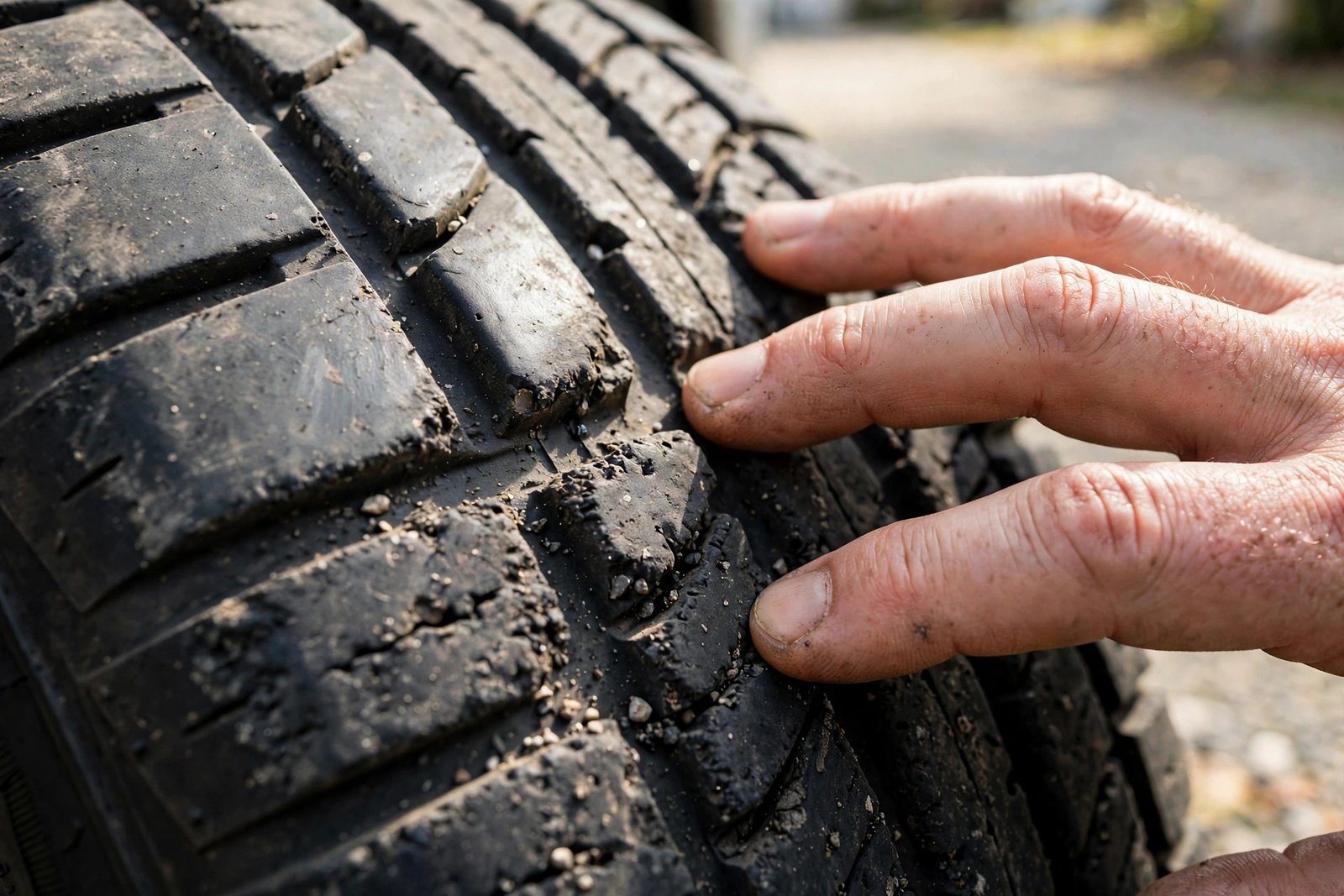
Tires don't wear randomly. The pattern of wear is a diagnostic readout — it tells you whether the problem is inflation, alignment, balance, or suspension. Learning to read it means catching a $100 alignment issue before it eats a $800 set of tires.
How to Inspect Your Tires Properly
A quick glance isn't enough — inner-edge wear hides where you can't see it from the curb.
- Check tread depth at three points on each tire: inner edge, center, outer edge. A tread-depth gauge is best; the penny test works in a pinch (insert a penny upside-down into the tread — if you can see the top of Lincoln's head, you're at or below 2/32", the legal minimum in most US states).
- Turn the steering wheel to full lock to see the front tires' inner edges.
- Run your hand across the tread in both directions — smooth one way, rough the other means feathering.
- Look at the sidewalls too — bulges, cuts, and cracks are immediate-fail conditions (see the safety box below).
Stop driving — get it inspected now — if you see: visible cords or fabric, sidewall bulges or blisters, deep cuts, tread at or below 2/32", rapid or repeated air loss, or damage after hitting a pothole/curb hard. These are safety failures, not maintenance reminders.
The Pattern → Cause → Fix Guide
| Pattern | What you see | Most likely cause | What to do | Urgency |
|---|---|---|---|---|
| Center wear | Middle of tread worn, edges fine | Over-inflation | Set pressure to the door-placard spec | Check soon |
| Both edges worn | Shoulders worn, center fine | Under-inflation (or overloading) | Correct pressure; check for slow leaks | High — heat + blowout risk |
| One edge worn | Inner OR outer edge wearing faster | Alignment / camber issue | Professional alignment + suspension check | High |
| Cupping / scalloping | Dips or scoops around the tread | Worn shocks/struts, imbalance, loose suspension | Suspension inspection + wheel balance | High |
| Feathering | Sawtooth edges; smooth one way, rough the other | Toe misalignment | Alignment (toe correction) | Check soon |
| Diagonal / patchy | Irregular wear across the tread | Multiple issues (alignment + balance + missed rotations) | Full inspection, not just an alignment | High |
Pattern Details
Center wear (over-inflation): too much pressure balloons the tire so only the center contacts the road. Fix: set to the placard pressure — not the sidewall maximum.
Edge wear on both shoulders (under-inflation): the tire's edges carry the load because the center sags. Under-inflated tires also run hot internally, which is the real blowout mechanism. Fix: correct the pressure, then figure out why it was low (slow leak? never checked?).
One-sided wear (camber/alignment): inner-edge wear especially is the silent killer — invisible from the curb, and it can take a tire to the cords while the outer half looks fine. Fix: alignment; if it returns quickly, suspect worn suspension components (bushings, ball joints, control arms).
Cupping (suspension/balance): the tire bounces as it rolls, hammering the tread in patches. Often accompanied by a rhythmic thumping or droning noise that gets louder with speed — and it's frequently misdiagnosed as a bad wheel bearing. Fix: shocks/struts and balance; the worn tire itself usually can't be saved.
Feathering (toe): the tires scrub sideways as they roll. Fix: toe adjustment during alignment.
Prevention: The Real Fix
- Check pressure monthly (cold tires, placard spec) — prevents the two most common patterns
- Rotate tires per your manual's schedule (typically every 5,000–7,500 miles) — evens out front/rear wear differences
- Align when: you notice uneven wear, the car pulls, the steering wheel is off-center, or after suspension work or a hard pothole/curb hit
- Balance when: you feel vibration at highway speed
Common Mistakes
- Replacing worn tires without fixing the cause. New tires will wear the exact same way.
- Only inspecting the outer half. Inner-edge camber wear is the pattern most drivers miss entirely.
- Assuming "it still has tread" means it's fine. A cupped or feathered tire with legal tread depth can still be noisy, vibrate, and grip poorly.
- Ignoring age. Tires older than ~6 years can be unsafe regardless of tread (check the DOT date code — see our sidewall guide).
When to See a Mechanic / Tire Shop
- Any pattern in the "High" urgency column above
- Vibration, pulling, or new noises accompanying the wear
- Wear returns quickly after an alignment (points to worn suspension parts)
- You're unsure which pattern you're seeing — a tire shop reads these daily
FAQ
Can uneven wear be fixed, or do I need new tires?
Fixing the cause stops further abnormal wear, but worn rubber doesn't grow back. Mild feathering sometimes evens out after correction; cupping and severe one-sided wear usually mean replacement.
How often should I rotate my tires?
Follow your owner's manual — commonly every 5,000–7,500 miles, often paired with oil changes. Skipped rotations are a top cause of diagonal and patchy wear.
My tires are wearing on the inside edge only — is that dangerous?
It can be — inner-edge wear can reach the cords while the visible outer tread looks acceptable. Get an alignment and suspension check promptly.
Does cupping always mean bad shocks?
Not always — imbalance and loose suspension parts cause it too. But worn shocks/struts are the most common cause, and cupping is one of the patterns most worth taking seriously.
Sources
- TireDriver — "Tire Tread Wear Patterns Explained: 7 Types, Causes, & Fix" (pattern→cause→fix→urgency table; 3-point tread inspection; safety limits: cords/bulge/2-32") — https://tiredriver.com/tire-tread-wear-patterns-explained-7/
- Les Schwab — "How to Read Tire Wear Patterns" (pattern/solution chart: center = over-inflation, edge = under-inflation, cupping = alignment/suspension, feathering = camber/toe) — https://www.lesschwab.com/article/tires/how-to-read-tire-wear-patterns.html
- EngineerFix — "Can Uneven Tire Wear Cause Noise?" (cupping noise vs wheel bearing; feathering hum; hand-feel test) — https://engineerfix.com/can-uneven-tire-wear-cause-noise/
- 1A Auto Blog — "How to Check Tire Tread with a Penny or Tire Tread Gauge" (penny test; center/edge/one-side wear causes) — https://blog.1aauto.com/how-to-check-tire-tread/