
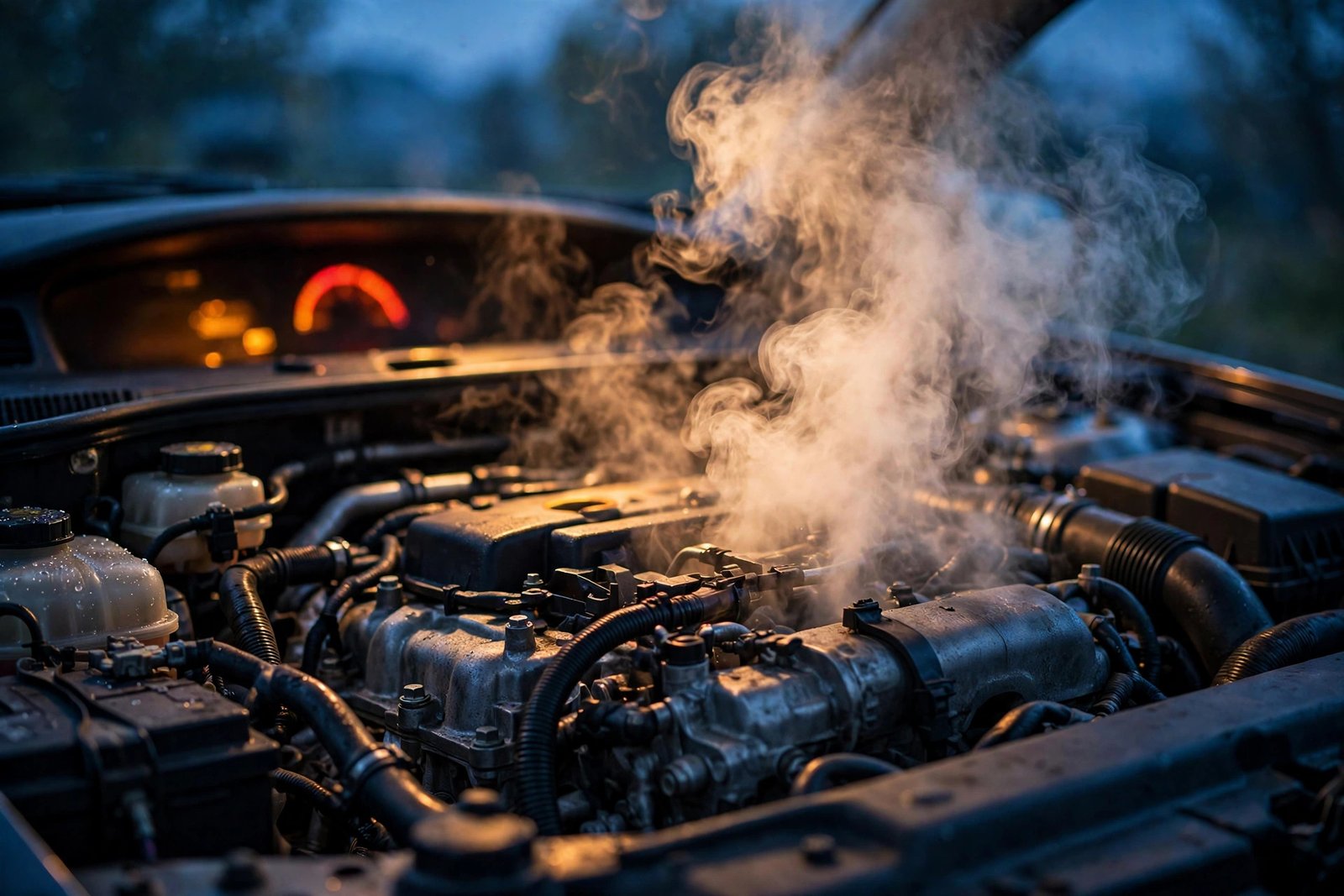
When your car is overheating but the coolant is full, it feels like a contradiction. The tank is right there at the MAX line, so the cooling system should be doing its job — yet the temperature gauge keeps climbing. Here’s the uncomfortable truth: a full reservoir does NOT mean the cooling system works. Coolant level is only one part of the equation. The coolant also has to circulate through the engine, reach the radiator, shed its heat, and return under pressure. When any link in that chain breaks, the engine overheats with the reservoir sitting perfectly full.
In this guide, you’ll learn:
- How the overheating pattern points to the cause (your fastest diagnostic clue)
- The 7 most common causes, in order of likelihood
- Safe checks you can do in your own driveway
- When to stop and call a mechanic
- Typical repair cost ranges for each cause (verified 2026-10-14)
Safety first: NEVER open the radiator cap or coolant reservoir cap on a hot engine — the system is pressurized and a sudden release can throw scalding coolant several feet, causing severe burns. Wait at least 30 minutes (longer after a hard overheat) before touching anything. Keep hands, clothing, and tools clear of the cooling fan — it can start without warning, even with the engine off on some cars. If the temperature gauge is in the red or steam is coming out: pull over safely, switch the engine off, and do NOT keep driving. Every extra minute running hot risks a warped cylinder head or blown head gasket.
What the Overheating Pattern Tells You
Before you touch anything, note when it overheats. That pattern is the single most useful diagnostic clue — and no part of this needs tools:
- Overheats at idle or in traffic, cools back down at highway speed → Cooling fan or airflow problem. At speed, forward motion pushes air through the radiator for free; at a standstill, the electric fan has to do that job. If temperature rises in traffic and falls at speed, check fan operation first.
- Overheats fast — gauge climbing within minutes of a cold start → Thermostat stuck closed. Hot coolant can’t get from the engine to the radiator.
- Sweet smell, bubbles in the reservoir, milky residue under the oil cap, or white exhaust vapor → Head gasket breach. Combustion gases are getting into the cooling system (or coolant into the engine).
- Started right after a coolant change, flush, or cooling-system repair → Air pocket trapped in the system. The most common reason a freshly serviced cooling system misbehaves.
- Gradual overheating that gets worse uphill, towing, or under hard acceleration → Restricted coolant flow — a clogged radiator or a weak water pump. The system copes at idle but can’t shed heat under load.
- Gauge bouncing up and down; heater blowing cold, then suddenly hot → Air pocket or a sticky thermostat. The sensor is alternating between coolant and trapped air.
The Most Likely Causes, in Order
1. Thermostat stuck closed
The thermostat is a temperature-controlled valve that stays shut while the engine warms up, then opens to let hot coolant flow to the radiator. When it jams shut, coolant never reaches the radiator and the temperature rises rapidly — often within minutes of driving. Warning signs include a sudden gauge climb, little or no warmth in the upper radiator hose while the engine is hot, and poor cabin heat. A thermostat can also stick intermittently, making the overheating seem to come and go.
2. Cooling fan not running
Electric cooling fans switch on automatically once coolant passes a set temperature. A failed fan motor, blown fuse, bad relay, faulty temperature sensor, or damaged wiring leaves the radiator with no airflow at a standstill — fine at highway speed, overheating in traffic. If the fans never seem to switch on at all, that’s a red flag; loud fans running in slow traffic on a hot day is the system working as designed.
3. Air pocket trapped in the system
After a coolant drain, flush, or component replacement, air can get trapped in coolant passages. Because air doesn’t transfer heat like coolant, the pocket acts as a blockage: erratic temperature gauge, gurgling or bubbling sounds from the dashboard area, the heater blowing cold even with a warm engine, and the coolant level in the reservoir fluctuating up and down. Air can also enter through a small leak or a faulty radiator cap. Some modern cooling systems with heater circuits, turbos, or multiple loops are genuinely difficult to bleed and need the specific procedure in the owner’s manual.
4. Failing water pump
The water pump is what keeps coolant moving. It can fail several ways: a worn bearing (grinding or whining noise), a leaking seal (coolant near the front or side of the engine), or a damaged internal impeller. Importantly, an impeller can fail internally without any visible leak — the reservoir stays full while circulation quietly drops. Rising temperature with no other obvious cause, especially on higher-mileage cars, warrants a pump inspection.
5. Clogged or restricted radiator
The radiator is the system’s heat exchanger, and it loses efficiency when internal passages clog with deposits, corrosion, or sludge from neglected coolant service, or when external airflow is blocked by bent cooling fins, leaves, or debris. Hot coolant flows in, but heat can’t get out — so temperatures creep up gradually, worst under load. Using the wrong coolant or mixing incompatible formulations can accelerate internal deposits.
6. Faulty radiator cap
The cap isn’t just a lid — it’s a calibrated pressure valve. Pressure raises the coolant’s boiling point; if the cap can’t hold its rated pressure (typically around 13–16 psi), coolant boils at a lower temperature than designed, escapes as vapor, and lets air into the system. A weak cap can cause overheating with zero other symptoms. The replacement must match the pressure rating stamped on the original cap.
7. Blown head gasket
The head gasket seals the joint between the engine block and cylinder head, keeping combustion, oil, and coolant passages separate. When it fails, combustion gases force their way into the cooling system — pressurizing it, creating air pockets, and driving temperatures up — or coolant leaks into the cylinders or oil. Look for bubbles or excessive pressure in the reservoir, unexplained coolant loss with no visible leak, white exhaust vapor after warm-up, or milky “milkshake” residue on the oil dipstick or filler cap. Note: not every head gasket failure produces milky oil, and not every overheated engine has a failed gasket. A chemical block test (blue test fluid that turns yellow/green in the presence of combustion gases) or a cooling-system pressure test confirms it — both are shop-level diagnostics.
Quick Checks You Can Do Yourself
Do these only with the engine cold unless stated otherwise, and never open the reservoir cap while there’s any heat or pressure in the system.
- Fan test: Start the engine and let it reach normal operating temperature. Watch and listen (from a safe distance, hands well clear) for the electric fan to kick on. If the gauge climbs past normal and the fan never moves, you’ve found a strong suspect — check the owner’s manual for the fan fuse and relay locations.
- Upper hose feel: Once the engine is warm, carefully feel the upper radiator hose. It should get hot as the thermostat opens and lets coolant through. A hose that stays cold while the engine overheats points at a stuck thermostat. Touch briefly — hoses and nearby parts are hot.
- Reservoir watch: With the engine warm and idling, look at the coolant reservoir (don’t open it). Steady bubbling or boiling there suggests pressure problems or combustion gases entering the system.
- Oil and coolant cross-check: Pull the dipstick and look inside the oil filler cap for milky, light-brown sludge. Check the reservoir for an oily film floating on the coolant. Either one means fluids are mixing — a shop visit, not a driveway fix.
- Airflow inspection: With the engine off and cold, look through the grille at the radiator fins. Leaves, plastic bags, bent fins, or packed dirt block the airflow the radiator depends on — a gentle rinse with a low-pressure hose (never a pressure washer on the fins) clears debris.
- Hose and leak look-over: Squeeze the radiator hoses (cold engine). They should be firm but pliable — not swollen, cracked, mushy, or rock-hard. Look for dried crusty residue around the water pump, hose connections, and radiator seams.
When to Stop and Call a Mechanic
- Temperature gauge in the red, steam from under the hood, or a temperature warning light — pull over and switch off. Do not drive on.
- Sweet coolant smell plus bubbles in the reservoir, white exhaust vapor, or milky oil — possible head gasket failure; needs testing, not guessing.
- The gauge climbs back into the red right after a cooldown — the underlying fault (thermostat, pump, gasket) hasn’t gone away.
- Repeated overheating episodes, even mild ones — every hot run increases the risk of a warped cylinder head.
- Any check above points to the water pump, internal radiator clog, or head gasket — all shop jobs involving disassembly, pressure testing, or chemical testing.
Typical Cost Ranges
(Verified 2026-10-14; ranges vary widely by vehicle, region, and shop labor rates.)
- Radiator cap: roughly $10–$30 for the part; around $25–$75 fitted (LatestCost 2026 guide)
- Coolant flush / system bleed: $131–$209 (Kelley Blue Book, checked Oct 1, 2026)
- Thermostat replacement: RepairPal national average $616–$716 (updated Sept 3, 2026); simpler cars often $200–$500 at an independent shop
- Cooling fan motor: roughly $300–$600+
- Water pump replacement: RepairPal average $857–$1,106; typical independent-shop range roughly $600–$1,000+ (ConsumerAffairs 2026)
- Radiator replacement: RepairPal national average $1,368–$1,550 (updated Sept 3, 2026)
- Head gasket replacement: RepairPal $2,572–$3,386 (updated Sept 3, 2026); JD Power cites $1,000–$3,000, averaging ~$1,500
The point of diagnosing by pattern first: don’t pay head-gasket money for a $30 radiator cap or a trapped air pocket.
FAQ
If the coolant is full, how can the engine still overheat?
Because level is only one part of the system. The coolant has to circulate through the engine, reach the radiator, release its heat, and return under pressure. A stuck thermostat, dead water pump, clogged radiator, failed fan, air pocket, or lost pressure breaks that chain while the reservoir sits full.
Can I keep driving if the gauge is only slightly above normal?
Don’t risk it. Pull over at the next safe opportunity and switch off. The one exception: if the needle rises only slightly while you’re already pulling into a safe stopping point within a minute or two, that brief stretch rarely causes damage — sustained running hot is what warps heads and blows gaskets.
Does turning the heater on full actually help?
As an emergency measure, yes. The heater core acts as a small extra radiator, pulling heat from the coolant into the cabin. It won’t fix the fault, but with the fan on max and windows down it can buy you enough margin to reach a safe stopping point.
Should the cooling fan run all the time?
No — electric fans switch on automatically once coolant passes a set temperature, usually well before the gauge reaches the middle. Loud fans in slow traffic on a hot day are normal. What’s abnormal is a fan that never switches on at all.
Can a bad radiator cap really cause overheating?
Yes. The cap holds the system at pressure, and pressure raises the coolant’s boiling point. A cap that can’t hold its rated pressure lets coolant boil at a lower temperature, pushes vapor out, and lets air in. It’s one of the cheapest fixes in the cooling system — but the replacement must match the pressure rating on the original.
Sources
- Kennedy Tire & Auto — “Why Is My Car Overheating? Common Causes and Fixes” (full-reservoir causes; thermostat, water pump, fan, radiator, cap, air, head gasket; idle vs. speed patterns) — https://kennedytireauto.com/why-is-my-car-overheating-common-causes-and-fixes/
- Engineer Fix — “How to Test for a Head Gasket Leak” (milky oil/coolant signs; pressure test 13–16 psi hold 15–20 min; block test blue→yellow/green) — https://engineerfix.com/how-to-test-for-a-head-gasket-leak/
- Engineer Fix — “How to Flush Air Out of a Coolant System” (air-pocket symptoms: erratic gauge, cold heater, gurgling, level fluctuation; bleeding procedure) — https://engineerfix.com/how-to-flush-air-out-of-a-coolant-system/
- Motoring Chronicle — “What to Do if Your Car Overheats on the Motorway Before the Engine Fails” (pull over immediately; 30-min cooldown; never open hot cap; heater as emergency radiator) — https://motoringchronicle.com/what-to-do-if-your-car-overheats-on-the-motorway-before-the-engine-fails/
- Insurance Panda — “Radiator Replacement Cost: Prices, Signs, Insurance” (RepairPal national averages, updated Sept 3, 2026: radiator $1,368–$1,550, thermostat $616–$716, water pump $891–$1,135, head gasket $2,572–$3,386; KBB flush $131–$209) — https://www.insurancepanda.com/faq/car-radiator-replacement-cost/
- ConsumerAffairs — “Water Pump Replacement Cost (2026 Guide)” (independent-shop range $600–$1,000+; RepairPal $857–$1,106) — https://www.consumeraffairs.com/automotive/water-pump-replacement-cost.html
- MoneyWise / AAA — “How much does a car radiator repair cost?” (thermostat $212–$502, fan motor $341–$534, radiator $592–$1,096 on common models) — https://moneywise.com/managing-money/budgeting/car-radiator-repair-cost
- LatestCost — “Radiator Cap Replacement Cost Guide 2026” (part $6–$40, typical total $26–$75 installed) — https://latestcost.com/radiator-cap-replacement-cost/
- InstantCarFix — “Why Is My Car Overheating But the Coolant Is Full” (circulation causes; air pockets after repairs; weak cap lowers boiling point) — https://www.instantcarfix.com/article/why-is-my-car-overheating-but-the-coolant-is-full
- JD Power — “How Much Does It Cost To Replace A Head Gasket?” ($1,000–$3,000, averaging ~$1,500) — https://www.jdpower.com/cars/shopping-guides/how-much-does-it-cost-to-replace-a-head-gasket?srsltid=afmboort-hlow4g8jxdexnvnjz6o8l3hgb6taplh9myf6gneoqyy4mce