
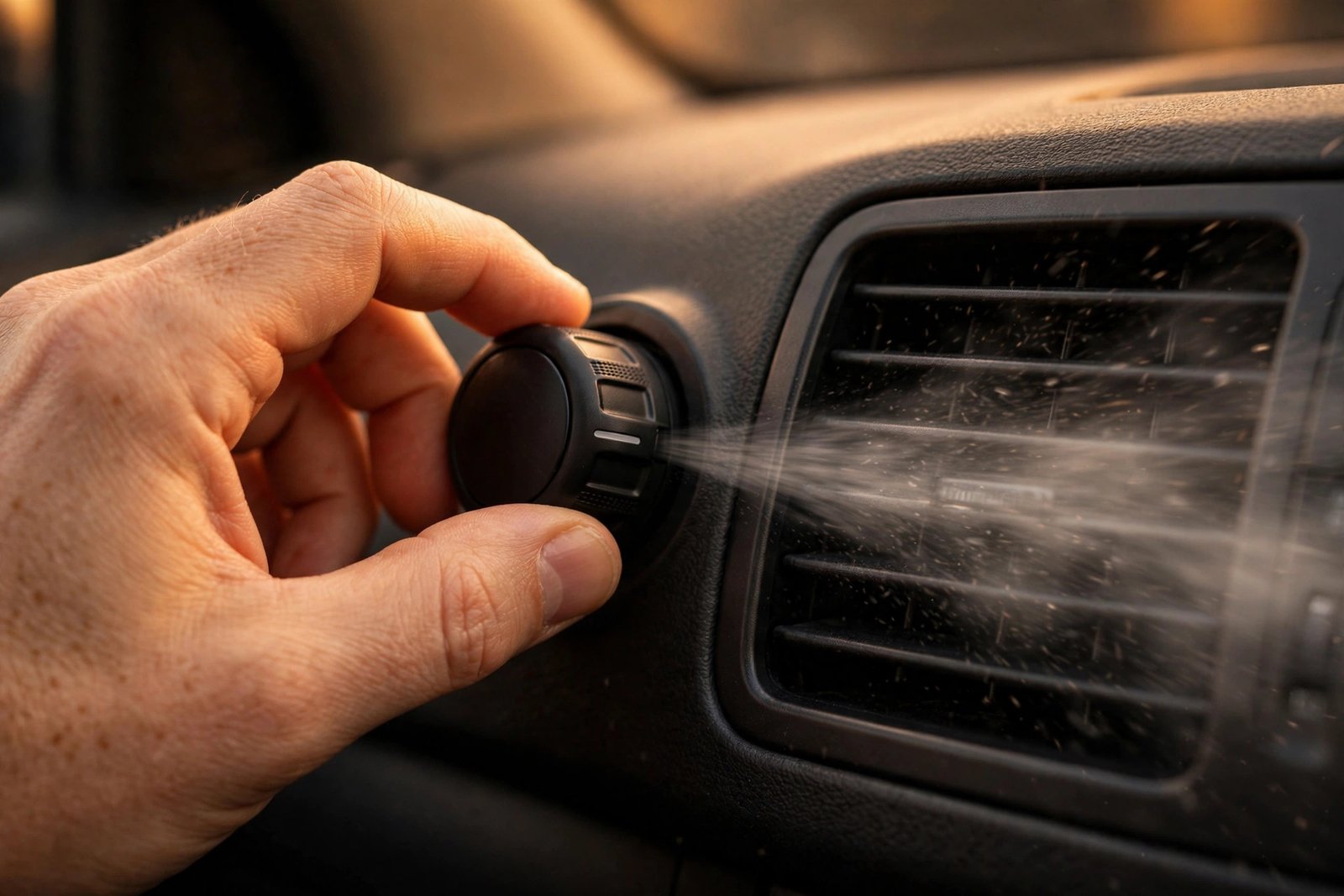
Fan speeds 1, 2, and 3 do nothing — but crank it to 4 (max) and the blower roars to life. This is one of the most clear-cut diagnoses in car repair: the blower motor resistor pack has failed. Here's why: lower fan speeds work by routing power through resistors that step the voltage down. The highest speed bypasses the resistor entirely, sending full battery voltage straight to the motor. So a dead resistor kills every speed except max. This guide confirms the diagnosis and covers the exceptions.
In this guide, you'll learn:
- Why "works on high only" points at the resistor
- How to confirm it before buying parts
- Why resistors fail (and what kills the replacement too)
- When it's something else
Safety first: Disconnect the negative battery terminal before touching the resistor or its connector (ignition OFF at minimum). Resistors live in the airflow duct because they get hot — inspect the connector for melting or burning smell; damaged wiring needs professional attention.
Confirm the Diagnosis in 30 Seconds
- Turn the fan through every speed: 0 → 1 → 2 → 3 → max.
- Dead on all lower speeds, works on max → blower motor resistor. Diagnosis confirmed in the vast majority of cases.
- Dead on ALL speeds including max → different problem: fuse, motor, relay, or switch — see AC blower fan not working at all.
- Works on some lower speeds but not others → still the resistor pack (individual resistor coils fail progressively — losing speed 1, then 2, then 3 over months is the classic progression).
Why the Resistor Fails
The resistor pack sits in the HVAC duct so passing air cools it — it generates significant heat by design. It fails when:
- Age and heat cycling — the most common reason; the coils or thermal fuse simply wear out.
- A struggling blower motor — worn bearings or debris make the motor draw more current, overheating the resistor. If your replacement resistor fails quickly, suspect the motor.
- Running the fan on low constantly with a clogged cabin filter — reduced airflow means reduced cooling for the resistor.
Important: the resistor usually has a thermal fuse that blows when it overheats. A blown thermal fuse = the whole pack is done; it's replaced as a unit, not repaired.
What to Check Before Replacing
- The connector. Pull the resistor's electrical connector and look for melting, discoloration, or a burnt smell. A melted connector must be replaced too — a new resistor on a damaged connector will fail again (and it's a fire risk).
- The blower motor's health. Spin it by hand if accessible — it should turn freely without grinding. Squealing or stiff bearings mean the motor is overloading the circuit; replace both.
- The cabin air filter. A clogged filter starves the resistor of cooling airflow. Replace it — it's cheap insurance for the new part.
- Fuse. The blower fuse should be intact (if it were blown, max wouldn't work either — but check anyway).
Replacement Notes
On most vehicles the resistor is under the passenger-side dash, near the blower motor, held by two screws — often accessible after removing the glove box. It's typically a 15–30 minute job with basic tools. Disconnect the battery first. Match the part to your exact year/make/model — resistor packs are not universal. If your car has automatic climate control, it uses an electronic blower control module instead of a resistor pack; the symptom is the same but the part (and price) differ.
When It's NOT the Resistor
- Dead on all speeds → fuse, motor, relay, switch, or wiring
- Works on high only AND the blower squeals → motor bearings are shot; replace the motor (and the resistor, since the motor likely killed it)
- Intermittent on all speeds → loose connector or failing switch
- Automatic climate control with erratic behavior → blower control module or control head diagnosis
FAQ
Can I just keep using it on high?
You can, but it's hard on the motor (full voltage constantly accelerates bearing wear) and the lack of speed control is miserable. The part is inexpensive — fix it.
Why did the speeds die one by one over months?
Each speed uses a different resistor coil. They fail progressively as heat takes its toll — losing speed 1 first, then 2, then 3, leaving only max.
Is this a DIY job?
On most cars, yes — it's one of the more accessible dash repairs. If your model buries it deep behind the dash, a shop can do it quickly.
Will a bad resistor drain my battery?
No — a failed resistor is an open circuit (no current flows). It can't drain anything; it just can't pass power to the motor.
Sources
- JustAnswer — Nissan Frontier heater fan motor works on high setting only (resistor location; thermal fuse; high-speed bypass) — https://www.justanswer.com/car/03mge-nissan-frontier-heater-fan-motor-works-high-setting.html
- JustAnswer — 2002 Hyundai Elantra heater/AC fan works on high only (resistor failure; squealing = worn motor bearings needing both replaced) — https://www.justanswer.com/hyundai/4kvyy-2002-hyundai-elantra-heater-ac-fan-works-high-blower.html
- Car Talk Community — "Heater only works on highest setting" (resistor pack bypass on #4; 12V direct; connector and location guidance) — https://community.cartalk.com/t/heater-only-works-on-highest-setting/59671
- Tire Depot Mechanical — "Why does my car heater only work on high?" (resistor pack voltage regulation; high-speed bypass) — https://tiredepotmechanical.com/why-does-my-car-heater-only-work-on-high/
- YourMechanic — heater only works on high diagnosis (faulty blower motor resistor; resistor bypass on highest setting) — https://www.yourmechanic.com/question/the-heater-takes-a-long-time-to-come-out-it-only-works-on-high-and-its-not-that-hot-by-roy-d