Radiator Fan Not Working: 7 Causes and What to Check
Updated Nov 22, 2026
In This Guide
- Radiator Fan Not Working: How to Tell the Fan Is the Problem
- Quick Symptom Match
- The AC Test: One Minute, Big Clue
- Cause 1: Blown Fuse
- Cause 2: Failed Fan Relay
- Cause 3: Low Coolant Level
- Cause 4: Faulty Coolant Temperature Sensor
- Cause 5: Dead Fan Motor
- Cause 6: Damaged Wiring, Connectors, or Fan Control Module
- Cause 7: Thermostat Stuck Open — Or a Fan Clutch Problem on Older Cars
- Safe Checks You Can Do in the Driveway
- When to Stop Driving and Call a Tow
- What the Repair Typically Involves
- Frequently Asked Questions
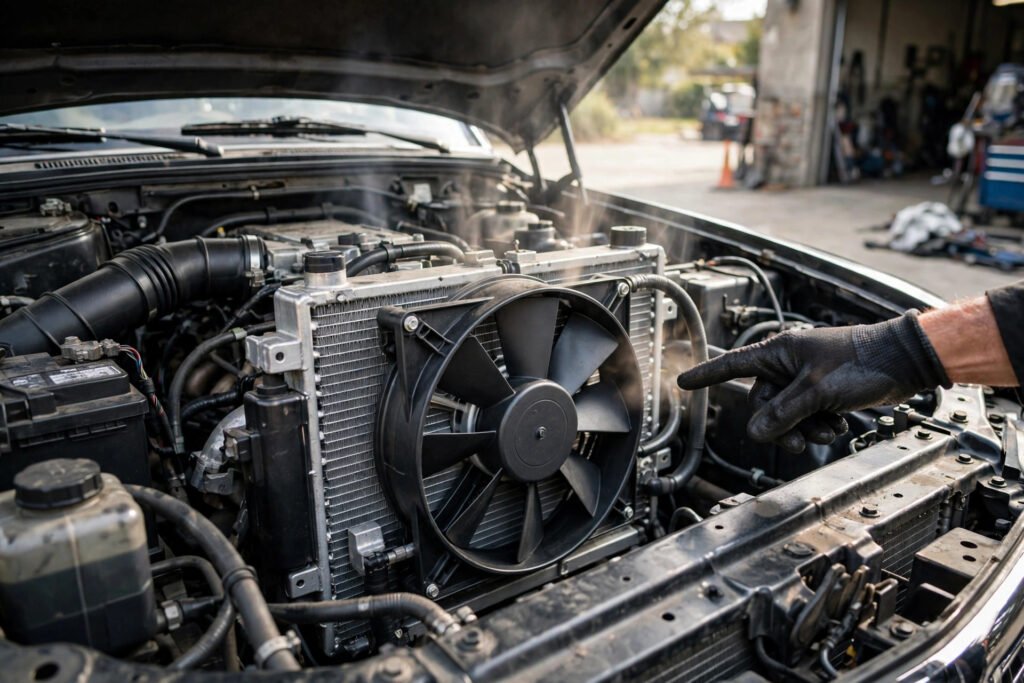
Radiator fan not working: you are sitting in traffic on a warm day when you notice the temperature gauge creeping past its normal spot. The car was fine at highway speed, but now, barely moving, the needle keeps climbing. When you pop the hood later, you find the likely culprit: the radiator fan is not spinning at all.
That pattern — fine while moving, overheating while stopped — is the classic signature of a dead radiator fan. At speed, air rushing through the grille does the cooling work for free. In traffic, at idle, or in a drive-through line, the fan is the only thing pulling air through the radiator. When it stops, heat builds fast, and an overheated engine can go from a warning light to serious damage in minutes.
The good news is that a silent fan often has a simple cause: a blown fuse, a failed relay, or low coolant. The bad news is that the other causes — a dead motor, a faulty temperature sensor, or damaged wiring — need proper electrical diagnosis. This guide walks through all seven causes, the one simple test that narrows them down in under a minute, and, most importantly, when to switch the engine off and call a tow instead of limping home.
In this guide, you’ll learn:
- How to tell whether your radiator fan is actually the problem
- The 7 causes, matched to the symptom you are seeing
- The AC test that separates an electrical fault from a sensor fault
- Safe checks you can do in the driveway
- When an overheating engine means stop driving immediately
- What a mechanic will test, and what the repair typically involves
Safety first: Never open a radiator cap or coolant reservoir cap on a hot engine. The cooling system is pressurised, and opening it can release scalding steam and coolant. Wait until the engine is completely cool before touching anything in the cooling system. If the temperature gauge is in the red or a warning light is on, pull over safely and switch the engine off — driving on an overheating engine risks a blown head gasket, a warped cylinder head, and a repair bill many times larger than the fan fix. This article helps you diagnose; electrical and cooling-system repairs belong with a certified mechanic if you are not confident working around hot, pressurised systems and live wiring.
Radiator Fan Not Working: How to Tell the Fan Is the Problem
A radiator fan does not run constantly. On most cars it cycles on and off as needed, so a still fan on a cold engine is normal. It becomes a problem when the fan stays off while the engine is clearly hot. Look for this combination:
- The temperature gauge climbs above normal in traffic or at idle, but drops back once you are moving at speed again.
- The fan never spins even when the gauge is high or a temperature warning light is on.
- The air conditioning blows noticeably less cold in traffic than it does on the highway, because the same fan also pulls air across the AC condenser.
- The check engine light comes on alongside the temperature problem.
If your car overheats in traffic but behaves on the open road, the fan is the first suspect. If it overheats everywhere, including at highway speed, look wider — a stuck thermostat, a coolant leak, or a failing water pump may be involved instead. And if you see a puddle of brightly coloured fluid under the car or smell something sweet near the engine, check for radiator leak symptoms before blaming the fan at all: a fan cannot cool an engine that has lost its coolant.
Quick Symptom Match
| What you notice | Most likely cause | What to check first |
|---|---|---|
| Fan never runs, gauge climbs in traffic | Blown fuse, failed relay, dead motor, broken wiring | Fuse, then relay, then power at the fan plug |
| Fan runs only when the AC is on | Coolant temperature sensor fault, or one speed circuit failed | Live coolant temperature reading vs. gauge |
| Fan runs slowly, or only one speed works | Worn motor, failed resistor, fan control module fault | Motor current draw and speed circuits |
| Fuse blows again right after replacing it | Seized motor or a short in the wiring | Motor and wiring — do not keep fitting bigger fuses |
| Weak AC in traffic, fine at speed | Fan not running, or a blocked condenser | The AC test below, plus a look at the condenser fins |
| Fan rattles, grinds, or wobbles | Worn motor bearings, damaged blades, debris | Blades and shroud for cracks, debris, or play |
| Gauge swings up and down rather than climbing steadily | Sensor or thermostat issue, or air in the system | Compare with a temperature gauge fluctuating diagnosis |
The AC Test: One Minute, Big Clue
Before you touch a fuse, try this. With the engine running, switch the air conditioning to its coldest setting and maximum fan speed, then look at the radiator fan. On most cars, turning the AC on commands the radiator fan to run so air moves across the condenser.
- The fan starts with the AC on but never runs on engine temperature alone. The fan motor, fuse, relay, and wiring are almost certainly fine. The fault is in the temperature-sensing side: the coolant temperature sensor, its wiring, or the control module is not telling the fan the engine is hot.
- The fan stays off even with the AC on. The problem is in the fan’s power path: fuse, relay, motor, control module, or wiring. Work through causes 1, 2, 5, and 6 below.
- The fan runs with the AC on but the AC still blows warm in traffic. The fan may be running too slowly, or the condenser may be blocked with leaves, bugs, or bent fins. Either way, airflow across the condenser is inadequate.
This single test splits the seven causes into two groups and saves you from replacing parts that were never broken.
Cause 1: Blown Fuse
The fuse is the cheapest and most common cause, and the right place to start. The radiator fan draws a large current, and its fuse protects the circuit from overload. A fuse can blow from age, from a momentary surge, or because the fan motor is starting to seize and drawing too much current.
The giveaway: the fan is completely dead — no movement, no noise — and the fuse for the cooling fan circuit shows a broken filament or a darkened window when you inspect it. Your owner’s manual or the fuse-box lid diagram will identify which fuse feeds the fan; on most cars it lives in the under-hood fuse box.
What to do: replace it with a fuse of exactly the same rating — never a higher one, which removes the protection the circuit relies on. If the new fuse blows immediately or within a few days, stop replacing fuses. A fuse that keeps blowing is a symptom, not the disease: the motor is likely seizing or there is a short in the wiring, and both need diagnosis (see causes 5 and 6).
Cause 2: Failed Fan Relay
The relay is the heavy-duty switch that carries the fan’s large current on command from the engine computer. The computer’s signal alone cannot power the fan, so it flips the relay, and the relay connects the fan to battery power. Relay contacts burn, pit, and stick over years of switching a high-current load, and a failed relay is one of the most common fan faults on older cars.
The giveaway: the fuse is good, but the fan never runs — not on temperature, not with the AC on — and you hear no click from the relay area when the fan should switch on. Some cars use two or three relays for different fan speeds, so a car with a dead low speed but a working high speed may have just one failed relay.
What to do: a relay can be tested with a multimeter, or swapped with an identical relay from a non-critical circuit (same part number) as a test — if the fan springs to life, the relay was the fault. Replace it with the correct part, not a lookalike with different ratings, and have the relay socket checked for heat damage or melted plastic, which points to a motor drawing excessive current.
Cause 3: Low Coolant Level
This one surprises people: the fan can be perfectly healthy and still never switch on if the coolant level is low. The coolant temperature sensor measures the temperature of the coolant flowing past it. If the level drops far enough that the sensor sits in air or steam instead of liquid, it reads incorrectly — or reads nothing useful — and the fan never gets its switch-on signal. Low coolant also means less heat-carrying capacity overall, so the engine overheats faster once the fan does fail to run.
The giveaway: the coolant reservoir is visibly low or empty, you have recently noticed a sweet smell or a puddle under the car, or the heater has started blowing cold air even with the engine warm — all classic low-coolant signs.
What to do: only when the engine is completely cool, check the reservoir against its min/max marks and top up with the correct coolant type for your car (mixing types can cause deposits). Then find out why it was low. Coolant does not evaporate away in a healthy system; a low level means a leak somewhere, and topping up without fixing the leak just buys time until the next overheat.
Cause 4: Faulty Coolant Temperature Sensor
The coolant temperature sensor is the fan’s messenger. It reports the engine’s temperature to the computer, which decides when to switch the fan on, and at which speed on multi-speed systems. When the sensor fails, it typically reads too cold — sometimes stuck at a fixed low value — so the computer believes the engine is fine and never commands the fan. A sensor that reads erratically can also produce a gauge that swings, and a sensor stuck reading hot can leave the fan running constantly instead.
The giveaway: the AC test result — the fan runs fine with the AC on, proving the motor and power path work, but it never switches on from engine temperature alone. A scan tool showing a coolant temperature reading that does not rise with the engine, or a reading wildly different from the dashboard gauge, confirms it.
What to do: this is a diagnosis, not a guess-and-replace job. A mechanic will compare the sensor’s live reading against the actual coolant temperature and check the sensor’s wiring and connector for corrosion before replacing the part. Replacing a sensor is usually straightforward, but on some cars the sensor sits where coolant will escape when it is removed, so the job belongs with someone equipped to bleed the system afterwards — trapped air can itself stop the fan from switching on correctly.
Cause 5: Dead Fan Motor
Fan motors wear out. Bearings dry up, brushes wear down, and windings fail, especially after years of heat cycling in the engine bay. A motor can fail suddenly — working one day, silent the next — or fade gradually, running slower and noisier until it stops altogether.
The giveaway: power is reaching the fan connector (fuse and relay test good), but the motor does not spin even when powered directly. Earlier warning signs include a fan that rattles, grinds, or hums loudly, spins slowly, or only works after a tap on the motor housing — a tap that temporarily frees stuck brushes is a near-certain motor diagnosis.
What to do: confirm power at the connector with a test light or multimeter before condemning the motor; a motor replaced while the real fault was upstream wiring wastes the part and the labour. Motor replacement usually means a new fan assembly (motor plus blades and shroud), and the job involves working around the radiator and, on some cars, the AC condenser — another reason to hand it to a shop if access is tight. Never reach into a fan shroud with the engine running: a fan that starts unexpectedly can cause serious hand injuries, and some fans keep running for a short time after the engine is switched off.
Cause 6: Damaged Wiring, Connectors, or Fan Control Module
Between the fuse box and the fan sit metres of wiring, several connectors, a ground connection, and — on many modern cars — a fan control module that varies the fan’s speed instead of simply switching it on and off. Corrosion, chafed insulation, a loose ground, a melted connector, or a failed module can all break the circuit while every individual part tests fine on its own.
The giveaway: the fault is intermittent — the fan works on some days and not others, or cuts out over bumps — or a connector shows green corrosion, melted plastic, or heat discoloration. A module fault often shows up as a fan stuck on one speed, or a fan that ignores both temperature and AC commands while the fuse, relay, and motor all test good.
What to do: inspect the visible wiring and connectors for damage, corrosion, and loose grounds, and check the fan connector for voltage and a solid ground while the fan should be running. Beyond that, module and wiring diagnosis needs wiring diagrams and a scan tool that can command the fan on — a shop job, and one worth doing properly, because a shorted wire that keeps blowing fuses can damage the control module if it is left to keep faulting.
Cause 7: Thermostat Stuck Open — Or a Fan Clutch Problem on Older Cars
Two edge cases complete the picture. On older trucks, SUVs, and some rear-wheel-drive cars, the fan is not electric at all: it is driven by the engine through a viscous fan clutch. A worn clutch slips instead of engaging, so the fan spins lazily even when the engine is hot — overheating in traffic with a fan that looks like it is turning, just not fast enough. The giveaway is a fan that spins freely by hand with the engine off and hot (a healthy clutch resists), or a roaring fan noise that never arrives as the engine warms up.
The other edge case is a thermostat stuck open. This does not stop the fan, but it mimics fan trouble: the engine warms up very slowly or never reaches normal temperature, the heater stays lukewarm, and the gauge sits low. If your complaint is “the engine never warms up” rather than “the fan never runs,” the thermostat is the likelier suspect — and a thermostat stuck closed is the opposite danger, causing rapid overheating even with a working fan.
Safe Checks You Can Do in the Driveway
With the engine cold and switched off, you can narrow the fault without special tools:
- Look at the fan. Check the blades for cracks, missing pieces, and debris caught in the shroud. Spin it gently by hand (engine off, keys out) — it should turn freely without grinding or wobbling.
- Check the coolant level. Reservoir between min and max, engine cold. Low? Top up with the correct type and start hunting for the leak.
- Inspect the fuse. Pull the cooling-fan fuse and look for a broken filament. Replace only with the same rating.
- Do the AC test. Engine running, AC on coldest and maximum: does the fan start? Record the result — it is the most useful thing you can tell a mechanic.
- Look at the connectors. The fan plug and relay socket should be clean, tight, and free of corrosion or melted plastic.
- Watch the gauge, not just the fan. A gauge that climbs only in traffic and falls at speed points at the fan; a gauge that climbs everywhere points wider.
Stop at the boundary of your comfort and tools. Testing a relay with a multimeter is reasonable DIY; probing a live control module or opening a hot cooling system is not.
When to Stop Driving and Call a Tow
Pull over safely and switch off if any of these are true:
- The temperature gauge is in the red zone or a temperature warning light is on.
- Steam is coming from under the hood, or you smell hot coolant.
- The gauge is climbing fast even at moderate speed, not just in traffic.
- You have already topped up coolant and it is dropping again, or the fuse keeps blowing.
Turning the heater to maximum and the blower to full can buy a few minutes of extra cooling in an emergency — the heater core acts as a small second radiator — but treat it as a way to reach a safe stopping place, not a way to finish the journey. An engine driven deep into the red can suffer a blown head gasket, a cracked head, or seized pistons, turning a fan repair into an engine rebuild. A tow is cheaper than that gamble, every time.
What the Repair Typically Involves
Costs vary widely by vehicle, part, and labour rates, so treat any single figure you see online with suspicion — a fuse costs very little, a relay is a modest part, and a full fan assembly plus diagnosis is a bigger job, with control-module and wiring repairs varying the most. What matters more than a price guess is avoiding the wrong repair: a fan motor replaced when the relay was at fault, or a sensor replaced when the wiring was corroded, costs twice — once for the wrong part, once for the right one. A good shop will test in order — fuse, relay, power and ground at the fan, sensor reading, module command — and show you which link in the chain actually failed before quoting. Ask for that sequence, and be wary of any quote that starts with the most expensive part.
Frequently Asked Questions
Can I drive with a radiator fan not working? Short distances at steady speed, where airflow through the grille cools the radiator, may be possible — but stop-and-go traffic, idling, and hot weather will overheat the engine quickly. If the gauge climbs past normal, pull over and switch off. Driving to a nearby shop is a judgement call; driving across town in traffic is not worth the risk.
Why does my car overheat in traffic but not on the highway? Because at highway speed, air forced through the grille does the fan’s job. In traffic there is almost no natural airflow, so the fan is the only thing moving air through the radiator. A fan fault therefore shows up exactly where airflow is lowest.
Is a radiator fan supposed to run all the time? No. On most cars it cycles on when the coolant reaches a set temperature (or when the AC is on) and off again as it cools. A fan that never stops can indicate a stuck relay, a faulty sensor, or a failsafe mode — a different fault from the one in this guide, but one worth diagnosing rather than ignoring.
Will a bad radiator fan trigger the check engine light? It can. If the engine computer commands the fan and detects that temperatures are not responding, or if the temperature sensor circuit itself is faulty, it may store a code and light the warning. A scan for codes is a useful early step in diagnosis.
Can low coolant stop the fan from working? Yes. If the coolant level drops so the temperature sensor is no longer immersed in coolant, the sensor can report a wrong temperature and the fan may never receive its switch-on signal. That is why a low reservoir is always worth checking before condemning electrical parts.
How long does a radiator fan repair take? A fuse or relay swap takes minutes. A fan assembly or sensor replacement is typically a same-day shop job, though access varies by model — on some cars the bumper or other parts must come off first. Wiring and module faults take longer because the diagnosis itself is the work.

lily John
The Fixtorial team writes hands-on car troubleshooting guides for everyday drivers — symptom first, honest costs, and fixes you can verify yourself.