
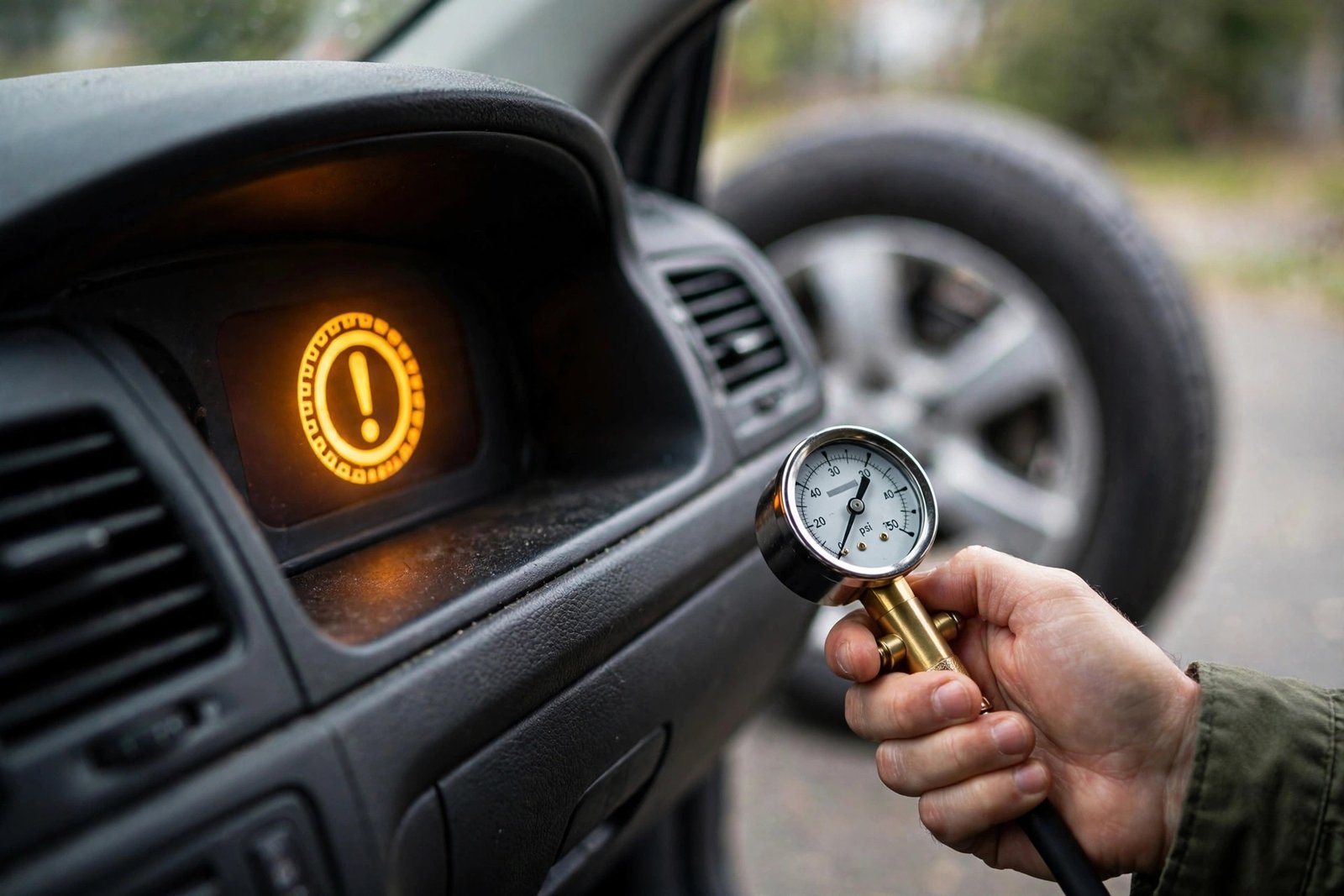
This exact pattern — the tire pressure light flashes for about 60–90 seconds when you start the car, then stays on solid — has a very specific meaning, and it’s different from the steady light most people know. The steady light means “a tire is low.” The blink-then-solid pattern means the monitoring system itself is broken. Adding air won’t fix it.
In this guide, you’ll learn:
- Why blink-then-solid = system fault (and why more air won’t help)
- The most common causes, in order of likelihood
- The spare-tire and after-rotation traps
- What to do while the system is down
- How it’s fixed — and what it costs
Blink-Then-Solid vs. Steady: Know Which One You Have
| Pattern | Meaning | Fix |
|---|---|---|
| Steady from the start | Low tire pressure — a real pressure problem | Check with a gauge; inflate to the door-jamb spec |
| Blinks ~60–90 sec, then solid | TPMS malfunction — the system can’t monitor your tires | Diagnose the system; sensor/relearn needed |
| Blinks continuously, never solid | Active communication fault (varies by car) | Same as above — system diagnosis |
| Comes on intermittently | Borderline pressure (temperature swings) or a dying sensor battery | Check pressures; if it persists, suspect a sensor |
TPMS light on but tires look fine
Why This Matters
While the system is in a fault state, it cannot warn you about a real pressure loss. A nail in your tire tomorrow won’t trigger any warning — the light is already on. Until it’s repaired, you’re driving blind on tire pressure, so manual gauge checks become your TPMS.
The Most Likely Causes, in Order
1. Dead TPMS sensor battery (most common)
Each wheel’s sensor runs on a tiny sealed battery lasting roughly 5–7 years. When one dies, that wheel goes silent and the system flags a malfunction. If your car is in that age range and the light just appeared, this is the odds-on cause.
2. Damaged sensor
Sensors live inside the wheel, attached to the valve stem. Potholes, curb strikes, road debris, and — very commonly — rough tire mounting can crack the sensor housing or break the valve stem.
3. Recent tire service without a relearn
After a tire rotation, new tires, or sensor replacement, many cars need a TPMS relearn/sensor-matching procedure so the computer knows which sensor is at which corner. Skip it, and the system can’t map the signals → blink-then-solid.
4. Spare tire in use (no sensor in the spare)
Many spares have no TPMS sensor. Bolt the spare on and the system sees a missing wheel → malfunction light. It clears when the regular wheel (with its sensor) goes back on and the relearn completes.
5. Aftermarket wheels or incompatible sensors
Non-OEM wheels may not fit the original sensors, or cheap universal sensors may not communicate properly with your car’s receiver. Sensor compatibility matters.
6. Radio interference or module fault
Rare, but documented: strong radio-frequency interference (or a failing TPMS control module) can block sensor signals. The module itself is the last thing to suspect.
What to Do
- First, rule out pressure anyway. Check all four tires with a gauge — a combination fault (one low tire and a dying sensor) is possible.
- Think about recent work. New tires? Rotation? Curb hit? Pothole? The trigger is usually in the last few weeks.
- Try the owner’s-manual relearn/reset procedure — on some cars a simple button sequence or a 10–20 minute drive re-establishes communication.
- Get a TPMS scan. Tire shops and many auto parts stores can read which sensor is silent. This takes minutes and pinpoints the fix.
- While it’s down: check your pressures manually every week or two — you’re the TPMS now.
How It’s Fixed (and What It Costs)
- Single dead sensor: replaced and relearned — typically roughly $75–$250 installed per wheel depending on aftermarket vs. dealer parts (OBDadvisor, observed 2026-10-14).
- Relearn after rotation: often free or cheap at the tire shop that did the work.
- Damaged valve-stem sensor: same as a replacement sensor.
- Pro tip: if one sensor battery died of age, the other three are close behind. Replacing all four during your next tire change is often the economical move.
FAQ
Will the light go off by itself?
Only if the underlying fault resolves (e.g., you put the regular wheel back on after a spare). A dead sensor never heals — it needs replacement.
Can I pass inspection with the TPMS light on?
It depends on your state. Some states fail a car for a TPMS malfunction light; others don’t test it. Check your state’s inspection rules before your appointment.
I just got new tires and now the light blinks — did the shop break something?
Maybe — or maybe they just skipped the relearn. Call them first; a proper shop rechecks this free.
Is it safe to drive with the blink-then-solid pattern?
The car itself is fine — this light doesn’t affect handling or braking. The risk is invisible: you won’t be warned about future pressure loss. Keep a gauge in the car until it’s fixed.
TPMS light on but tires look fine
Sources
- Lancer Service — “Flashing Tire Pressure Light: Why It’s Blinking and What It Means” (blink-then-solid = system fault; causes) — https://www.lancerservice.com/flashing-tire-pressure-light
- FIXD — “Tire Pressure Light” (blinking vs. solid distinction; sensor fault guidance) — https://www.fixdapp.com/blog/tire-pressure-light/
- GMC/Cadillac/Buick owner’s manuals (via GMcia) — TPMS malfunction light behavior (flashes ~1 minute then stays on; relearn triggers) — http://www.gmcia.com/guide-2423.html