
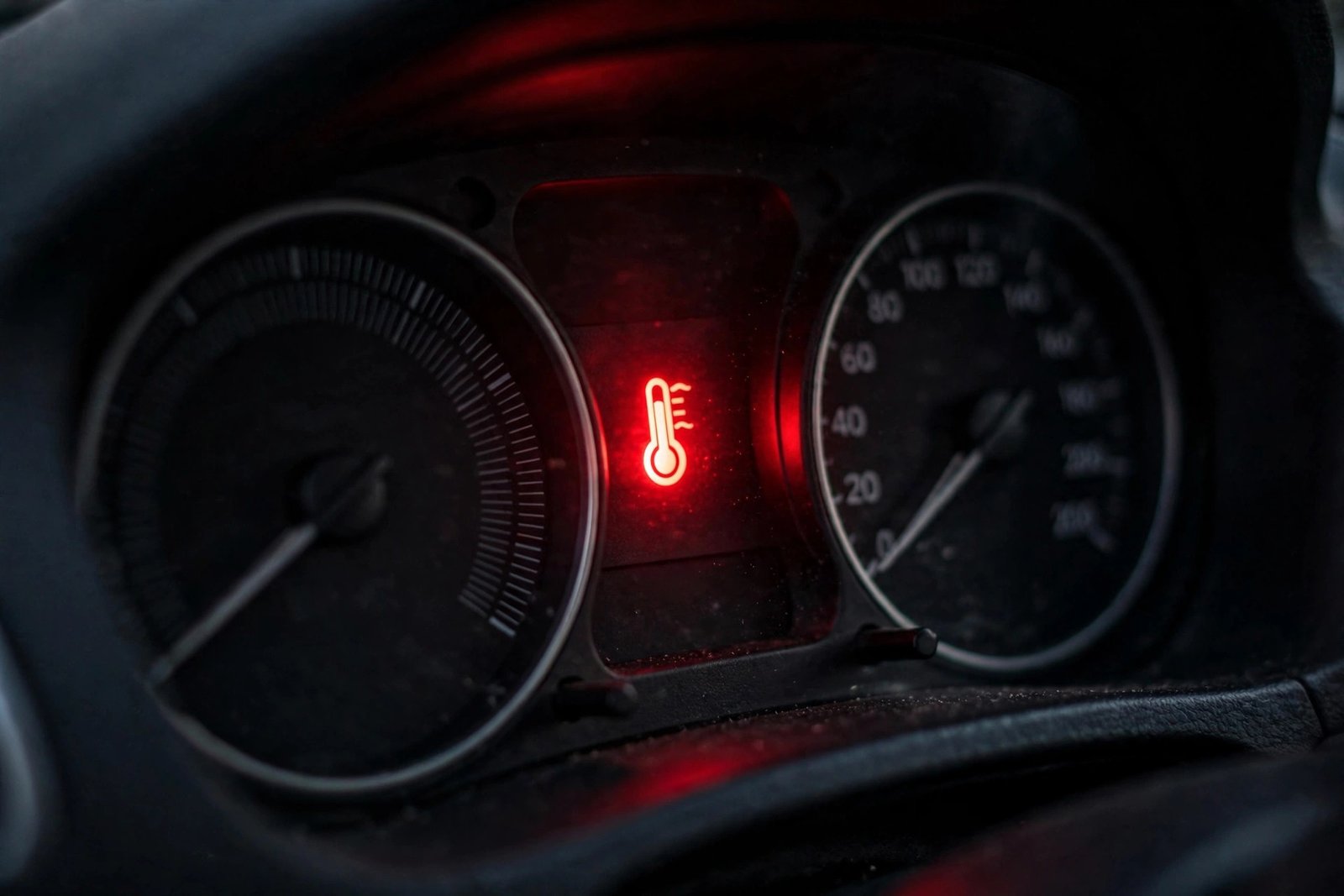
The red thermometer light means one thing: your engine is overheating right now. It shares the top of the dashboard urgency list with the oil pressure light — both can destroy an engine within minutes. The good news: if you respond correctly in the first 60 seconds, you usually save the engine. Respond wrong — especially by opening a hot cooling system — and you can hurt yourself badly.
In this guide, you’ll learn:
- Red vs. blue thermometer: the critical color distinction
- The exact 60-second response sequence
- Why you must NEVER open a hot radiator cap or coolant reservoir
- The most common causes, in order of likelihood
- When the answer is a tow truck
Safety first: the cooling system is pressurized, which raises the coolant’s boiling point. Opening the cap while hot releases that pressure instantly — superheated coolant flashes into steam and can erupt violently, causing severe burns. Never open the radiator cap or coolant reservoir until the engine has fully cooled (at least 30 minutes).
Red vs. Blue: The Color Decides Everything
| What you see | What it means | What to do |
|---|---|---|
| Red thermometer | Engine is overheating | Pull over, switch off, let it cool |
| Blue thermometer (some cars) | Engine is still cold — normal after startup | Drive gently; it goes out as the engine warms |
| Red light on a cold engine, gauge normal | Likely a faulty temperature sensor or wiring | Confirm with the gauge; get it scanned soon |
| Light flashes | Temperature has exceeded safe limits | Same as red: stop immediately |
car overheating but coolant is full
The 60-Second Response Sequence
- Hazards on. Pull over safely. Don’t try to reach the next exit — heat damage escalates fast.
- Turn the A/C off. Air conditioning adds engine load and reduces cooling capacity.
- Switch the engine OFF. Do not idle “to listen” — with a failed cooling fan, an idling engine with no airflow overheats further.
- Wait at least 30 minutes. Do not open the hood cap or reservoir. Steam burns are the #1 injury in overheating situations.
- Once stone-cold, check the coolant reservoir level (the translucent tank with MIN/MAX marks). If it’s empty or very low, you’ve got a leak — top up with the correct coolant mix (or water in a true emergency, then fix properly later) and head straight to a shop.
- Call for a tow if: the level was fine (the fault is deeper — thermostat, water pump, fan), you see steam, or the light returns after cooling.
The Most Likely Causes, in Order
1. Low coolant (leak somewhere)
The most common cause by far. Coolant doesn’t get “used up” — if it’s low, it leaked: hoses, radiator, water pump, heater core, or (worst case) internally past the head gasket.
2. Thermostat stuck closed
The thermostat is the valve that opens to let coolant flow. Stuck closed = no circulation = rapid overheating. Classic pattern: temperature climbs fast within minutes of driving.
3. Failed cooling fan
At speed, airflow cools the radiator. In traffic or at idle, the electric fan does that job. Fan failure = overheats in traffic, fine on the highway. Test: with the engine at temperature, the fan should kick on — if it never does, that’s your suspect.
4. Failing water pump
The pump circulates coolant. A failing pump whines, weeps coolant from its weep hole, or (on some cars) has a plastic impeller that cracks. Often replaced together with the timing belt.
5. Blocked or damaged radiator
Internal corrosion, external debris packed between radiator and condenser, or crushed fins reduce cooling. More common on older cars.
6. Blown head gasket
The serious one: combustion pressure leaks into the cooling system (or coolant into the oil). Signs: white exhaust smoke, sweet smell, milky residue under the oil cap, coolant vanishing with no visible leak. Always needs professional diagnosis — a pressure test and block test confirm it.
7. Faulty temperature sensor
If the gauge reads normal and the engine feels fine but the light is on, suspect the messenger, not the engine. A scan confirms.
When to Tow, Not Drive
- The red light came on and you don’t know why — one overheat event can warp a cylinder head.
- Steam from under the hood, or you hear boiling/gurgling.
- Coolant level was normal — the fault is mechanical (pump, fan, thermostat, gasket).
- The light returned after cooling down and topping up.
- The temperature gauge is pinned in the red zone.
FAQ
Can I just top up the coolant and keep driving?
Only to reach a shop — and only once the engine is cold. Coolant went somewhere; topping up without finding the leak just buys time until the next overheat. Repeated top-ups without repair often end in a blown head gasket.
How long should I wait before opening the coolant cap?
At least 30 minutes, longer in summer. Even then, use a thick cloth and open slowly to the first detent to release residual pressure.
My gauge reads normal but the light is on — what’s wrong?
Most likely the coolant temperature sensor or its wiring. The gauge and the warning light sometimes use different sensors. Get it scanned rather than assuming you’re fine.
Blue thermometer light — should I worry?
No. It means the engine hasn’t reached operating temperature yet. Drive gently until it goes out; avoid hard acceleration while it’s on.
car overheating but coolant is full
coolant leak under car sweet smell
Sources
- Engineer Fix — “What Does the Red Thermometer on a Car Mean?” (immediate action protocol; never open a hot cap) — https://engineerfix.com/what-does-the-red-thermometer-on-a-car-mean/
- WowOwow — “What Does the Temperature Light Mean on a Car?” (red vs. blue triage table; stop-now guidance) — https://wowowow.com/what-does-temperature-light-mean
- AA1Car — “What To Do If Your Temperature Warning Light Comes On” (cool-down procedure; leak inspection) — https://www.aa1car.com/library/temp_warning_light.htm