
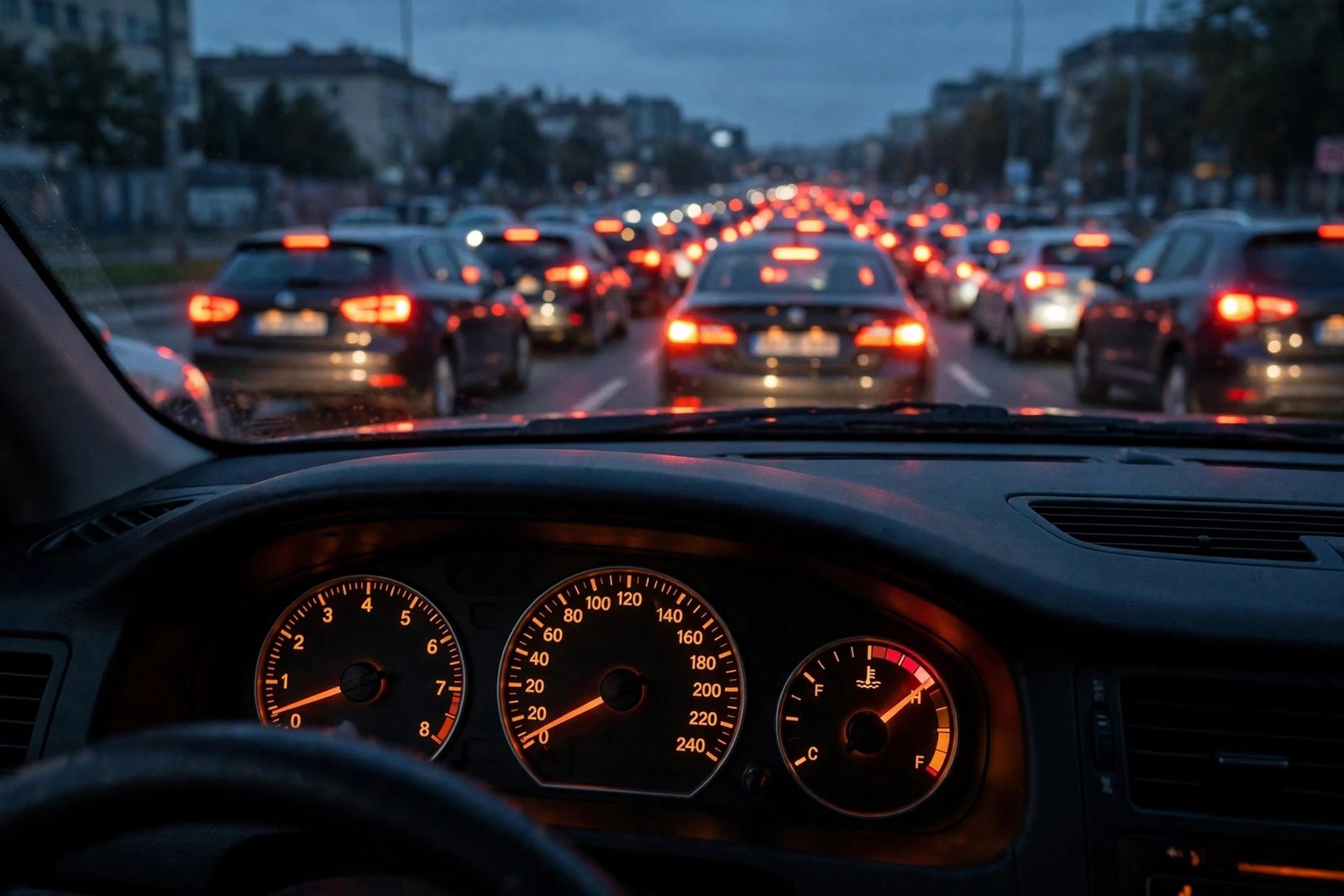
Your car sits in traffic, the temperature gauge creeps toward red — then you start moving and it drops back to normal. This pattern is one of the most solvable overheating problems there is, because it tells you almost exactly what’s wrong: your cooling system works fine with airflow, but fails without it. At highway speed, air rushing through the grille (ram air) cools the radiator for free. At idle, the radiator fan must do that job instead. So overheating-only-in-traffic almost always means the fan circuit is the suspect.
In this guide, you’ll learn:
- Why this exact pattern points at airflow, not coolant
- The most common causes, in order of likelihood
- The one test that confirms the diagnosis in minutes
- When it’s safe to drive to a shop (and when it isn’t)
Safety first: An overheating engine can suffer a blown head gasket or cracked head in minutes. If the gauge reaches the red zone, pull over safely, shut off the engine, and let it cool completely. Never open the radiator or reservoir cap on a hot engine.
The Opposite Pattern Has the Opposite Cause
Overheating that appears only at speed and clears up at idle is a different problem — restricted coolant flow or heat-transfer capacity, not airflow. See car overheats on highway only. Don’t mix the two; the fix for one won’t fix the other.
The 2-Minute Confirmation Test
With the engine at operating temperature and the car parked, turn the AC to max. On most cars, the computer forces the radiator fans on when the AC runs. Look through the grille (look, don’t touch — blades):
- Fans spin up → the fan motor works; the problem is likely the temperature sensor, relay, or control circuit that should have turned them on.
- Fans stay dead → the fan motor, its fuse, its relay, or its wiring has failed.
That single observation splits the diagnosis cleanly.
The Most Likely Causes, in Order
1. Radiator fan not running (most common)
The fan circuit has several failure points: a dead fan motor, a blown fuse, a failed relay, a bad coolant temperature sensor (the computer never gets the “turn the fan on” signal), or damaged wiring. The AC-max test above tells you which half of the circuit to investigate.
2. Low coolant level
Even slightly low coolant reduces the system’s heat capacity. It can behave fine at speed and overheat at idle. Check the reservoir when the engine is cold.
3. Thermostat sticking
A thermostat that opens late or partially lets the engine run hotter at idle, when there’s less margin. Less typical for this exact pattern, but possible.
4. Blocked radiator or condenser airflow
Leaves, plastic bags, packed bugs, and dirt between the condenser and radiator insulate the fins. At speed, sheer airflow overcomes it; at idle, the system can’t cope. Often visible through the grille.
5. Worn fan clutch (older trucks/SUVs with belt-driven fans)
A slipping fan clutch moves too little air at idle but “enough” gets forced through at speed. If the fan spins lazily by hand with the engine off (it should have some resistance), the clutch is suspect.
6. Water pump beginning to fail
A weak pump circulates enough at higher RPM but not at idle. Usually accompanied by other clues — coolant seepage, whining, or rising temperature under load too.
What You Can Do Right Now
- Turn the heater to max, fan to high. It sounds miserable, but the heater core is a second radiator — it pulls heat off the engine and can buy you the miles to a safe stop.
- Turn off the AC. The condenser adds heat in front of the radiator; switching it off reduces the cooling load.
- Keep moving if you safely can. Steady motion = free airflow. But don’t sit in a jam watching the needle climb — pull over before it hits red.
When to Drive vs. Tow
- Gauge rises in traffic but stays below red: Drive to a shop using the heater-max trick; get it diagnosed promptly.
- Gauge reaches red or steam appears: Pull over, shut off, tow. Continued driving risks head-gasket failure.
FAQ
Can I just keep driving if it cools down on the highway?
It’s tempting, but the underlying failure doesn’t fix itself — and one long red light can push it into the red zone. Get the fan circuit diagnosed.
Why does it get worse with the AC on?
The AC’s condenser sits in front of the radiator and dumps heat there. With no fan airflow, that extra heat is exactly what tips the system over.
Is it the thermostat or the fan?
For the traffic-only pattern, the fan circuit is far more likely. Thermostat problems usually overheat at all speeds or fluctuate — see temperature gauge going up and down.
How much does a fan repair cost?
It ranges from a cheap relay or fuse to a fan motor assembly. Get a written quote — diagnosing which part failed is the whole job, so don’t buy parts blindly.
Sources
- Automotive Gearz — “3 Reasons for Car Overheats in Traffic Not on Highway” (ram-air vs fan cooling; fan motor/fuse/relay/sensor diagnosis) — https://automotivegearz.com/car-overheats-in-traffic-not-on-highway/
- YourMotorCare — “Why Your Car Overheats When It’s Idling: 6 Major Causes” (fan, thermostat, coolant, pump, fan clutch, clogged radiator ranking) — https://yourmotorcare.com/why-your-car-overheats-when-its-idling/
- GreatWater360 Auto Care — “Why Your Car Overheats in Traffic” (reduced airflow at low speed; fan failure modes; diagnostic checklist) — https://www.greatwater360autocare.com/news/why-your-car-overheats-in-traffic
- Art’s Automotive — “What causes a car to overheat?” (idle-vs-driving pattern split; coolant flow vs airflow framing) — https://artsautomotive.com/art-icles/articles-for-the-curious/what-to-do-if-your-car-overheats/
- Car From Japan — “Common Reasons Why Is Your Car Overheating Then Going Back To Normal” (intermittent overheating; trapped air; weak cap) — https://carfromjapan.com/article/car-overheating-then-going-back-to-normal/