
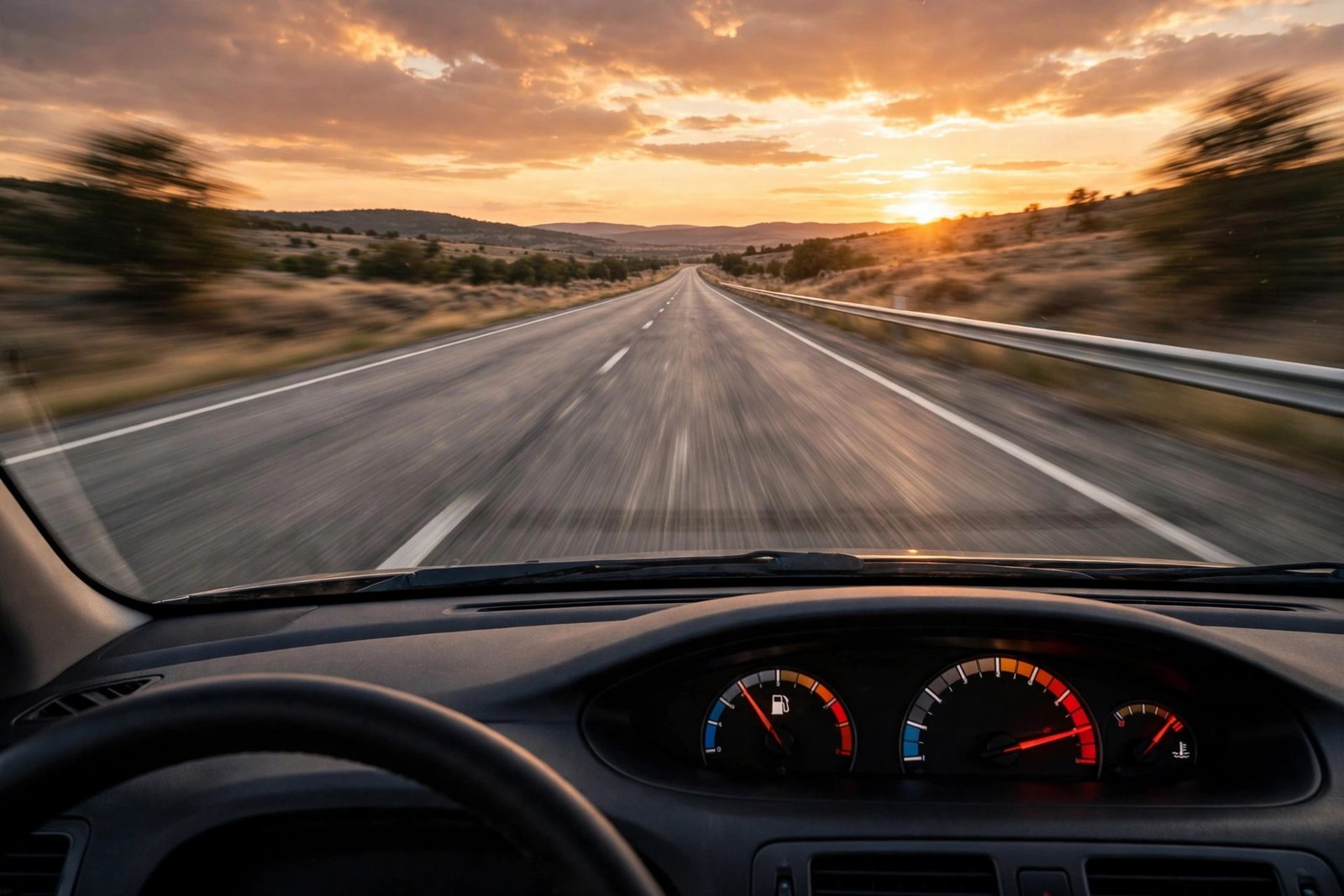
Your car is perfectly happy in town, but twenty minutes on the highway and the temperature gauge starts climbing — then drops when you slow down or stop. This is the opposite of a fan problem. At highway speed, airflow through the radiator is abundant; the fan is barely needed. If the engine still overheats, the cooling system can't move enough coolant or shed enough heat to keep up with the engine working hard. The diagnosis starts with flow and capacity, not airflow.
In this guide, you'll learn:
- Why highway overheating means something different from traffic overheating
- The most common causes, in order of likelihood
- Safe checks you can do yourself
- When to pull over vs. nurse it to a shop
Safety first: If the gauge reaches red or steam appears, pull over safely and shut off the engine. Never open a hot radiator or reservoir cap. Highway overheating that you "push through" is how head gaskets blow.
Don't Confuse the Two Patterns
| Pattern | Points to |
|---|---|
| Overheats in traffic, cools on highway | Airflow / fan problem — car overheats in traffic |
| Overheats on highway, fine at idle | Coolant flow or heat-transfer capacity — this article |
| Overheats everywhere | Low coolant, stuck-closed thermostat, major failure — car overheating even with full coolant |
The Most Likely Causes, in Order
1. Thermostat not opening fully (most common)
A thermostat that opens only partially flows enough coolant for idle and town driving, but becomes a bottleneck when the engine works hard at speed. The classic test: after a drive (engine hot), the upper radiator hose is very hot while the lower hose stays noticeably cooler — coolant isn't circulating freely.
2. Partially clogged radiator
Internal scale and corrosion restrict passages over the years. At idle the reduced capacity is enough; at highway load it isn't. External blockage (bugs, debris between condenser and radiator) contributes too — inspect through the grille.
3. Weak water pump
A pump with a corroded or slipping impeller moves enough coolant at low RPM but can't keep up under load. Clues: whining from the front of the engine, coolant seepage at the pump, or overheating that worsens on hills and with the AC on.
4. Low coolant level
Slightly low coolant may seem fine at idle but can't absorb the extra heat of sustained high-speed driving. Air in the system also collects at high points and disrupts flow. Check the reservoir cold.
5. Collapsing lower radiator hose
An old, soft lower hose can get sucked partially shut at higher RPM by pump suction — an easy visual check. It should feel firm, not mushy.
6. Head gasket beginning to fail
Combustion gases entering the cooling system reduce its efficiency and can push coolant out. Clues: bubbling in the reservoir, coolant loss with no visible leak, white exhaust vapor, or milky oil. If suspected, this needs professional testing — see coolant reservoir empty but no visible leak.
Safe Checks You Can Do Yourself
- Coolant level (cold engine): Reservoir between MIN and MAX.
- Hose temperature test: After a highway drive (careful — hot), compare upper and lower radiator hoses. A big temperature difference suggests the thermostat isn't opening fully or the radiator is restricted.
- Hose condition: Squeeze the lower radiator hose (cold engine) — soft and collapsible = replace it.
- Radiator visual: Look through the grille for packed debris, bent fins, or corrosion between the condenser and radiator.
- Listen: Whining from the water pump area or gurgling behind the dash (air in the system).
What to Do When It Overheats on the Highway
- Turn the heater to max, fan to high — it acts as a secondary radiator.
- Turn off the AC to reduce cooling load.
- Slow down gently and exit; don't keep pushing at 70 mph hoping it stabilizes.
- If the gauge hits red or steam appears: pull over, shut off, tow.
FAQ
Why does it cool down when I stop?
At idle the engine produces far less heat, so even a compromised cooling system can keep up. The margin disappears under sustained load.
Could it still be the fan?
Unlikely for this pattern — at highway speed, ram air does far more cooling than the fan. If it overheats only at speed, look at flow and capacity.
Is a radiator flush the fix for a clogged radiator?
A flush helps with mild scale but can't fix a heavily corroded or externally blocked radiator. Inspect first; replace if passages are badly restricted.
How soon should I get it checked?
Soon. Highway overheating stresses the head gasket with every episode — and head-gasket failure is one of the most expensive repairs a car can need.
Sources
- InstantCarFix — "Car Overheats While Driving But Not at Idle? 8 Common Causes" (flow vs capacity framing; thermostat, pump, radiator, coolant branches) — https://www.instantcarfix.com/services/car-overheating-while-driving-but-not-at-idle-diagnosis
- Gulf Euro Clinic — "Car Overheating Causes in Traffic vs Highway Driving" (highway-specific causes: coolant flow, fan, leaks/blockages) — https://gulfeuroclinic.com/car-overheating-causes-traffic-vs-highway-driving/
- Art's Automotive — "What causes a car to overheat?" (idle-vs-driving split; capacity loss over time) — https://artsautomotive.com/art-icles/articles-for-the-curious/what-to-do-if-your-car-overheats/
- GreatWater360 Auto Care — "Why Your Car Overheats in Traffic" (airflow vs flow distinction; fan diagnostic checklist) — https://www.greatwater360autocare.com/news/why-your-car-overheats-in-traffic
- Peoria Nissan — "What Does It Mean When Your Car Overheats?" (thermostat, fan, hose causes by pattern) — https://www.peorianissan.com/blog/2018/october/18/what-does-it-mean-when-your-car-overheats.htm