
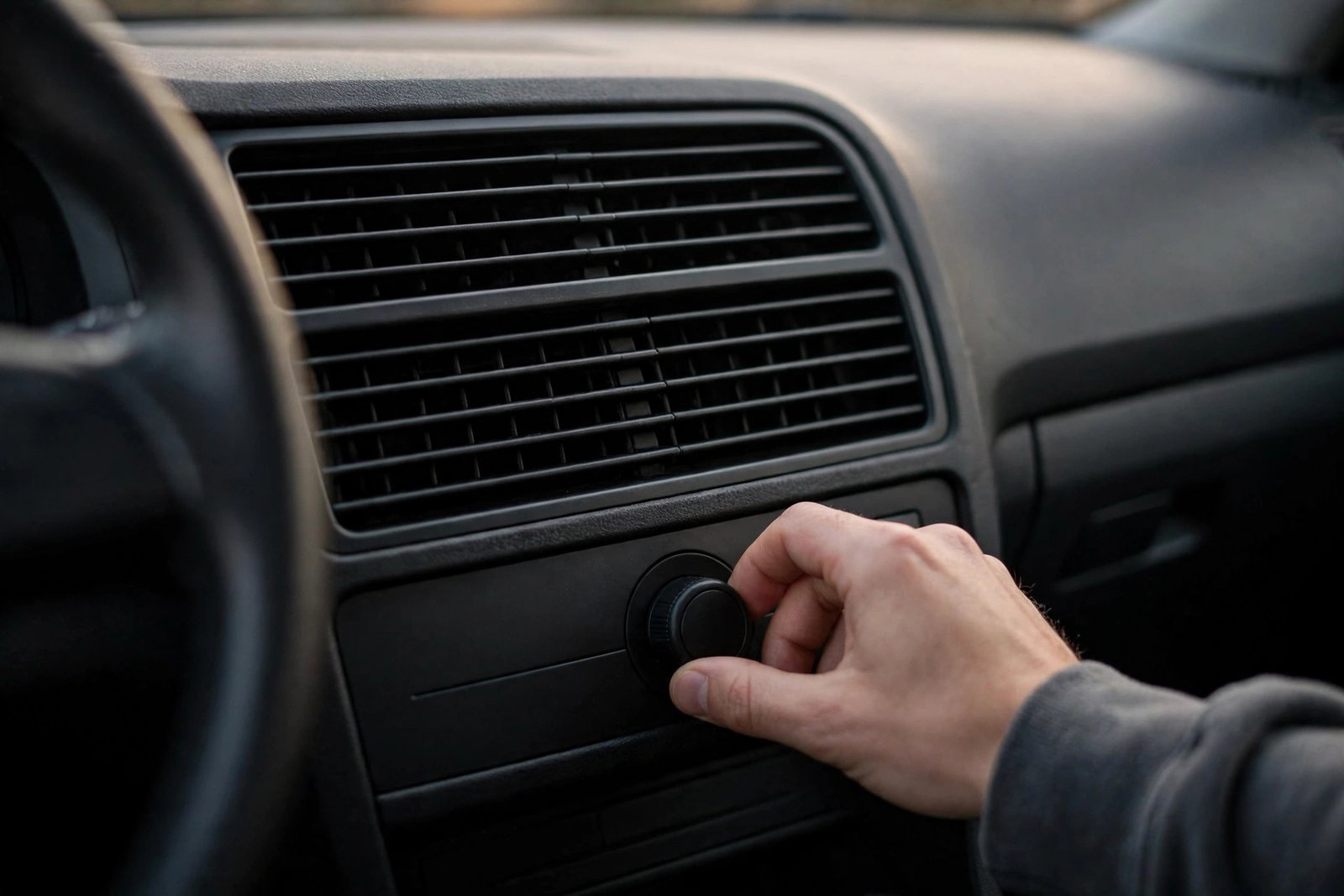
No air from the vents at any speed setting — AC or heat — means the cabin blower motor circuit has failed. This is a different part from the radiator fan under the hood. The blower lives behind the dash (usually under the glove box) and its speed is controlled by a resistor pack or control module. The diagnosis follows a clean decision tree: fuse → controls → resistor → motor.
In this guide, you'll learn:
- How to tell a blower failure from a "no cold air" problem
- The no-airflow decision tree, in order
- Safe checks you can do yourself
- When it's a DIY fix vs. a shop job
Safety first: Work with the ignition OFF when checking fuses or connectors. Blower motors draw significant current — if you smell burning plastic or see melted wiring at the connector, stop and have it inspected; electrical faults in the dash are a fire risk.
First: Is It "No Air" or "No Cold Air"?
- No air movement at all, any setting → blower circuit — this article.
- Air moves but isn't cold → refrigeration problem — car AC not cold enough.
- Air moves only on the highest setting → blower resistor — heater only works on high.
- Weak airflow but some air → clogged cabin filter first — see the airflow branch of car AC not cold enough.
The No-Airflow Decision Tree
Step 1: Check the fuse
Find the blower/HVAC fuse in the owner's manual (often under-dash fuse box). Pull it and look: a broken metal strip = blown. Replace with the same amperage — never higher. If the new fuse blows immediately, there's a short downstream (motor or wiring) — stop and get it diagnosed.
Step 2: Try every speed setting
- Works on high only → blower motor resistor pack has failed (high speed bypasses the resistor). See heater only works on high.
- Dead on all speeds → continue down the tree.
Step 3: Listen for the motor
Turn the fan to high and listen under the passenger-side dash:
- Humming or trying to spin → the motor is getting power but can't turn — seized bearings or debris in the fan cage. Sometimes a stuck motor can be confirmed by a gentle tap; replacement is the fix.
- Complete silence → no power reaching the motor — relay, switch, wiring, or the motor itself is open.
Step 4: Check the cabin air filter
A severely clogged filter won't usually stop all airflow, but combined with a weak motor it can feel like it. Inspect it — it's behind the glove box on most cars and takes minutes.
Step 5: Blower motor resistor / control module
On manual systems, the resistor pack (usually in the duct near the blower, cooled by airflow) burns out. On automatic climate control, an electronic blower control module does the job. Burnt connectors at the resistor are common — inspect for melting or discoloration.
Step 6: The motor itself
Blower motors wear out — bearings fail (squealing/grinding beforehand is the warning), brushes wear down. Replacement usually involves removing the glove box or a dash panel; on many cars it's a straightforward DIY, on some it's buried.
Safe Checks You Can Do Yourself
- Fuse inspection and replacement (same amperage, ignition OFF).
- Every-speed test — maps directly to resistor vs. motor.
- Listen test — humming vs. silence splits "no power" from "seized."
- Cabin filter inspection — hold it to light; replace if opaque.
- Connector look — with ignition OFF, peek at the blower and resistor connectors for melting or burning smell.
When to See a Mechanic
- New fuse blows immediately (short circuit — needs tracing)
- Burning smell or melted connectors (fire risk — don't keep replacing parts)
- Automatic climate control with no blower response (control module diagnosis)
- The motor is buried behind the dash on your model and you're not comfortable with trim removal
FAQ
Can I drive with no blower?
Yes, but with no defrost in cold or humid weather your windshield will fog — that's a genuine safety issue. Get it fixed promptly.
Why did it work yesterday and die today?
Blower motors often fail intermittently first — working after a bump, quitting on rough roads — as brushes wear or bearings seize. Intermittent operation is the warning; total failure follows.
Is it always the resistor?
No — "works on high only" is the resistor's signature. Dead on all speeds points to the fuse, motor, relay, switch, or wiring instead.
How much does a blower motor replacement cost?
Parts are typically modest; labor varies hugely by how buried the motor is. Get a written quote for your specific model rather than relying on general figures.
Sources
- Phoenix Auto Nashville — "What Are Causes Of Weak Air Flow From Car AC Vents" (cabin filter, blower motor, resistor symptom mapping) — https://phoenixautonashville.com/what-are-causes-of-weak-air-flow-from-my-car-ac-vents/
- JustAnswer — "Car AC Blowing Inconsistently?" (blower motor/resistor failure; duct and actuator branches) — https://www.justanswer.com/car/md4eu-cars-ac-blowing-air-stops-working-blows.html
- Smart AC Solutions — "AC Blows Fast Then Slow: Causes And Fixes" (blower motor vs refrigerant pattern split; pro-routing for refrigerant work) — https://smartacsolutions.com/car-ac-blows-fast-then-slow/
- U.S. EPA — Regulatory Requirements for MVAC System Servicing (Section 609 technician certification) — https://www.epa.gov/mvac/regulatory-requirements-mvac-system-servicing