
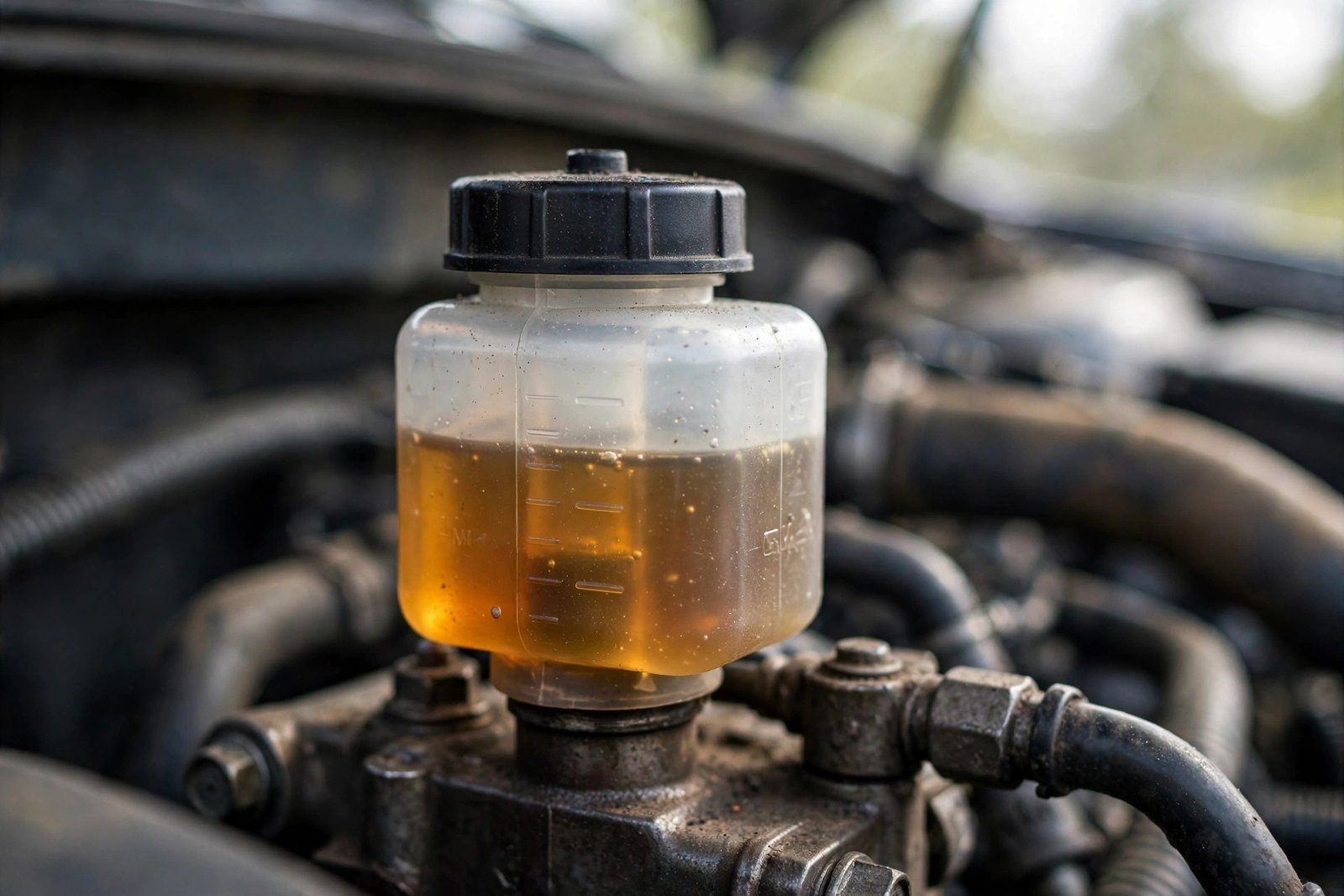
Your brakes are hydraulic: pressing the pedal pushes fluid, and fluid pushes the calipers. The brake fluid reservoir sits on top of the master cylinder at the back of the engine bay, and its level is a window into your brake system's health. Checking it is easy — but interpreting it is where most guides stop short.
Safety framing: this article is about checking and interpreting — a look-and-understand job. If the level is very low, drops suddenly, or the pedal feels spongy, that's a possible hydraulic leak: do not drive the car — have it towed to a certified mechanic. Brake hydraulics are diagnosis-only territory for DIY.
Step-by-Step: Checking Brake Fluid
- Park on level ground, engine off.
- Open the hood and find the reservoir — a small translucent plastic container at the rear of the engine bay, driver's side on most cars, mounted on the master cylinder near the firewall. The cap usually says "Brake Fluid" and often stamps the required type (DOT 3 / DOT 4).
- Read the level through the plastic. It should sit between MIN and MAX. Most cars never need the cap removed for a check. (Older pre-1980s cars with metal reservoirs need the cap lifted — wipe dirt away from the cap first so nothing falls in.)
- Note the color. Fresh brake fluid is clear to light amber/yellow. Dark brown or black = contaminated and due for replacement.
- Cap it and close the hood. Done — unless the level is low, which brings us to the important part.
The Critical Question: Why Is It Low?
A brake fluid reservoir that's slightly below MAX is usually normal — and this is the insight most guides miss:
- Gradual, slight drop = normal pad wear. As brake pads thin, the caliper pistons extend further and draw a little fluid from the reservoir to fill the extra space. If the level is a bit below MAX but well above MIN, this is expected.
- Sudden or large drop, or level below MIN = something is wrong. Either the pads are critically worn, or — more seriously — fluid is leaking from a line, hose, caliper, or the master cylinder itself.
Do not just top it up and move on. Topping up without finding the cause masks a leak. Worse: if the drop was from pad wear, topping to MAX means fluid can overflow when a technician retracts the caliper pistons during the next brake service.
If the Level Is Low
- Check the brake pads (or have them checked) — worn pads are the benign explanation.
- Look for leaks: wet spots at wheels, along brake lines under the car, or a damp master cylinder. Brake fluid is oily and often clear-to-amber.
- If the brake warning light is on or the pedal feels soft/spongy: do not drive. Tow it to a shop.
- If everything checks out and you must top up: use exactly the DOT type on the reservoir cap, from a fresh, sealed bottle — brake fluid absorbs moisture from the air (it's hygroscopic), which lowers its boiling point and degrades braking. Never reuse fluid from an opened bottle that's been sitting around, and never mix DOT types your manual doesn't approve.
Brake Fluid Facts Worth Knowing
- It's toxic and corrosive. Avoid skin/eye contact, wash hands after handling, and wipe spills off paint immediately — it damages finishes.
- It absorbs water over time, which is why manufacturers specify periodic brake fluid replacement (often every 2–3 years — check your manual). Old, moisture-laden fluid boils under hard braking, and boiling fluid = brake fade.
- The brake warning light (circle with "!" or the word BRAKE) often triggers on low reservoir level. Treat it as "inspect immediately," not "top up and ignore."
Common Mistakes
- Topping up a low reservoir without asking why. The level is a symptom; find the cause.
- Using old fluid from an opened bottle. Moisture-contaminated fluid is worse than slightly low fluid.
- Overfilling. An over-full reservoir can cause brake drag; keep it between the marks.
- Spilling on paint and not wiping it immediately.
- Assuming dark fluid is "fine because the level is okay." Dark = contaminated = due for a change, regardless of level.
When to See a Mechanic (Tow, Don't Drive)
- Fluid below MIN with no obvious explanation
- Any sign of a leak (wet lines, puddles, damp wheels)
- Spongy or sinking brake pedal
- Brake warning light on
- Dark/contaminated fluid needing a flush — brake fluid replacement needs proper bleeding equipment
FAQ
How often should I check brake fluid?
Every few months, or whenever you're under the hood for other checks. It's a 30-second look.
Can I mix DOT 3 and DOT 4?
DOT 4 can generally replace DOT 3 in systems spec'd for DOT 3 (higher boiling point), but never downgrade, and never mix in DOT 5 (silicone-based, incompatible). When in doubt: use exactly what's on the cap.
Why is my new car's brake fluid already slightly below MAX?
Normal pad wear from day one. Only worry about sudden drops or the level approaching MIN.
Does brake fluid go bad just sitting in the bottle?
An opened bottle absorbs moisture quickly — that's why you discard the remainder. A sealed, unopened bottle stored properly lasts much longer.
Sources
- EngineerFix — "How to Check Your Brake Fluid Level and Condition" (MIN/MAX reading; gradual drop = pad wear; below MIN = worn pads or leak; topping up before pad service causes overflow; DOT type on cap) — https://engineerfix.com/how-to-check-your-brake-fluid-level-and-condition/
- The Manual — "Learn How to Check Low Brake Fluid Yourself" (master cylinder location; translucent reservoir; toxic/corrosive handling; older metal reservoirs) — https://www.themanual.com/auto/how-to-check-your-cars-brake-fluid/
- Polaris Owner's Manual — "Master Cylinder / Brake Fluid" (never use a partial bottle — hygroscopic fluid absorbs moisture, lowering boiling point → brake fade/failure; do not overfill) — https://publications.polaris.com/owner/owners-manuals/9941702_R02/0000934691.XML.xml/$/0000746645
- Bullet Automotive — "6 Ways to Know If Your Brake Fluid Is Running Low" (spongy pedal = air/moisture; warning light = low fluid; leak = do not drive) — https://bullet-automotive.com/6-ways-to-know-if-your-brake-fluid-is-running-low/
- Mister-Auto UK — "How do I check the brake fluid level?" (flat surface, engine cool; reservoir on driver's side; below minimum = check pads or leaks, don't just fill) — https://www.mister-auto.co.uk/advice-maintenance/how-to-check-brake-fluid-level/