
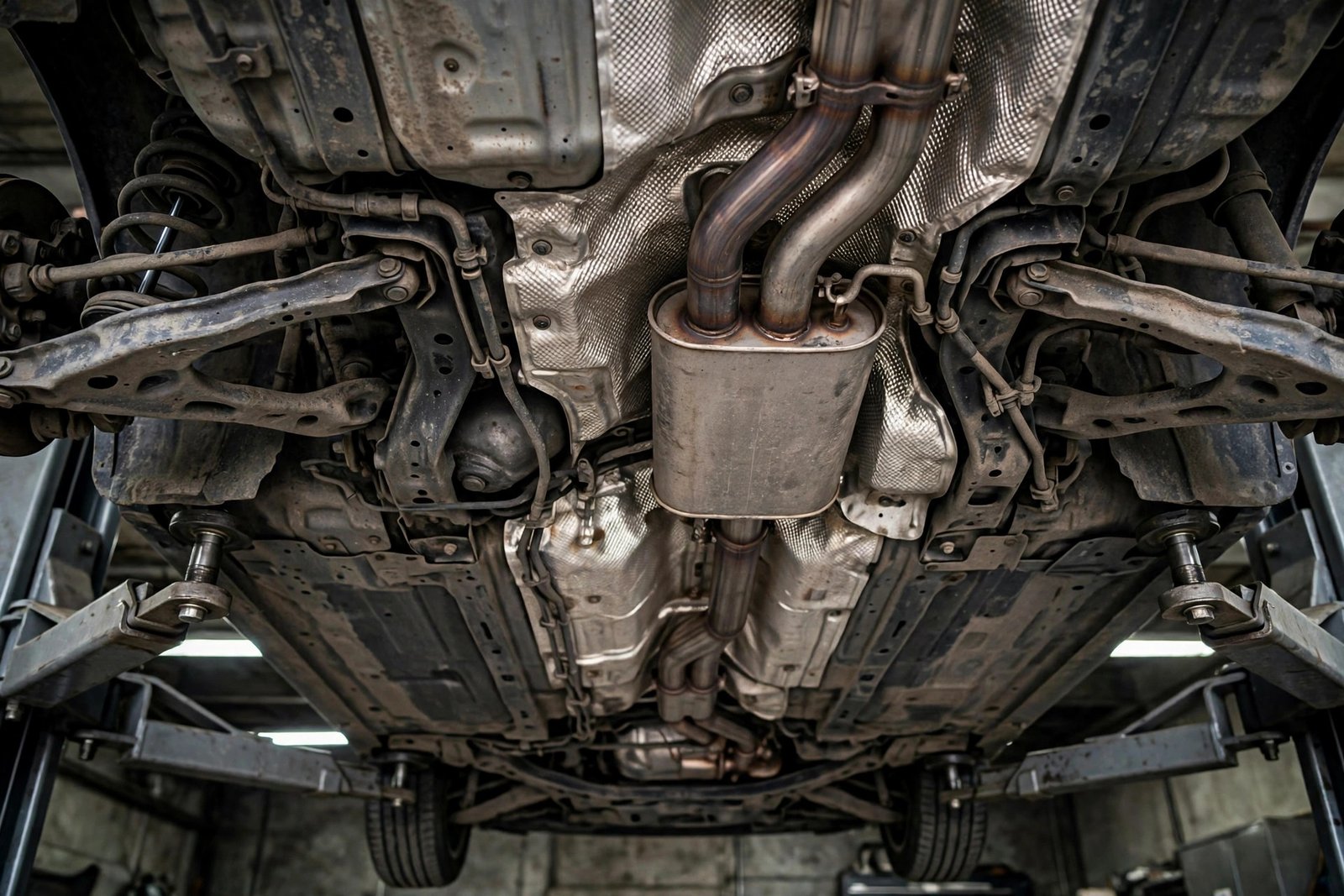
A rattle that appears when you press the gas and disappears when you lift off is the car telling you something only misbehaves under load. There are two completely different families here: engine pinging (a combustion problem — potentially damaging) and loose hardware (a vibration problem — usually just annoying). Telling them apart changes everything about what you do next.
In this guide, you’ll learn:
- The one rev test that splits pinging from loose parts
- The most common causes in each family, in order of likelihood
- Simple checks you can do in the driveway
- Which rattle is urgent and which can wait
Safety first: Never rev the engine hard in Park for extended periods, and never crawl under a car supported only by a jack. Exhaust parts stay hot long after shutdown — do all underbody checks stone cold. If the rattle comes with a flashing check engine light, that’s an active misfire: ease off and get it checked promptly.
The Split: Pinging vs Loose Hardware
The rev test: Parked, engine warmed up, blip the throttle gently in Park/Neutral.
- Rattle appears just from revving, with no load? → Loose hardware — heat shield, exhaust hanger, engine mount, undertray. The engine’s vibration alone shakes it.
- No rattle revving in Park — it only happens when actually accelerating under load (especially uphill)? → Engine pinging/detonation or a load-dependent drivetrain issue. Keep reading.
The sound itself is a clue: pinging is a metallic tinkling or marbles sound from the engine, like shaking a spray-paint can; loose hardware is a buzz, rattle, or clank from underneath or the engine bay edges.
If your rattle happens at idle rather than under acceleration, see rattling noise under the car at idle.
Family 1: Engine Pinging (Detonation)
Pinging — also called knocking or detonation — is abnormal combustion: pockets of the air-fuel mixture igniting on their own after the spark plug fires, creating pressure spikes that hammer the pistons. It’s most noticeable under load (hard acceleration, climbing hills) and it can damage pistons and head gaskets if ignored.
Causes, in order:
- Fuel octane too low for the engine — the most common and easiest fix. If your owner’s manual specifies premium and you’ve been running regular, or you just filled up somewhere new, try the correct octane.
- Carbon buildup — deposits on pistons and valves raise compression and create hot spots that trigger early ignition. More common on higher-mileage engines.
- Engine running hot or lean — cooling issues, vacuum leaks, or faulty sensors can push combustion temperatures into the ping zone.
- Ignition timing issues — less common on modern computer-controlled engines, but faulty knock sensors (the part that’s supposed to detect pinging and retard timing) let it continue unchecked.
Quick check: Did the pinging start right after a fill-up? Try a tank of the manufacturer-specified octane from a reputable station before anything else.
Family 2: Loose Hardware Under Load
Acceleration torques the engine on its mounts and shakes the whole exhaust line — revealing anything loose.
Causes, in order:
- Loose heat shield — the #1 suspect. Thin shields around the exhaust rust at their mounting points and buzz violently under load. Often sounds like a soda can full of screws.
- Worn engine/transmission mounts — let the engine rock excessively under torque; the movement itself rattles, and the engine can contact the firewall or subframe.
- Exhaust hangers, clamps, or a failing catalytic converter — a swinging pipe knocks; a converter with broken internals rattles (the “rocks in a can” sound, worse when hot).
- Loose undertray / splash guards — plastic panels with broken clips flap at speed and under vibration.
- Low transmission fluid or torque converter issues — a faint rattle that grows with acceleration and is tied to gear/shift behavior points at the transmission rather than the exhaust. Check for leaks (reddish spots) and shifting abnormalities.
Simple Checks You Can Do Yourself
- The rev test above — the single most informative 10 seconds.
- The octane question: What fuel did you last put in, and what does the manual specify? New pinging after a fill-up = fuel first.
- The cold tap test (engine OFF, stone cold): Tap heat shields and the catalytic converter shell gently — a loose shield buzzes; a failing converter reproduces the internal rattle.
- Oil level check: Low oil lets the valvetrain rattle — a quick dipstick check rules out the simplest engine-bay cause.
- Listen for location: Engine-bay tinkling under load = pinging family. Underbody buzz/clank = hardware family. Rear-of-car whine that grows = fuel pump or differential, not this guide.
When to See a Mechanic — Soon vs Now
Soon: Heat-shield-type buzz with no other symptoms; mild pinging that resolves with correct octane fuel.
This week: Persistent pinging on the correct fuel (needs diagnosis — knock sensor, carbon, cooling); “rocks in a can” converter rattle; rattle with a steady check engine light.
Now: Pinging that’s loud and getting worse (detonation damages pistons); rattle + flashing check engine light (active misfire); rattle + loss of power + burning smell (possible converter blockage); anything visibly hanging or dragging underneath — see metallic scraping noise under the car.
FAQ
Is engine pinging the same as rod knock?
No — and the distinction matters. Pinging (detonation) is a combustion-timing problem, often fixable with fuel or a sensor. Rod knock is a deep mechanical hammering from worn engine bearings — far more serious. Pinging tinkles under load; rod knock thuds with engine speed even at idle.
Will premium gas fix my rattle?
Only if the rattle is pinging and your engine needs the higher octane. If the rattle is a loose heat shield, no fuel on earth will quiet it — that’s why the rev test comes first.
Why does it only rattle going uphill?
Uphill = maximum engine load = maximum pinging conditions and maximum engine-torque movement. Uphill-only rattles strongly suggest one of the two families here rather than a constant mechanical fault.
Can I ignore a heat-shield rattle?
The rattle itself is harmless noise — but confirm that’s what it is first. A “heat shield rattle” that’s actually pinging or a failing converter is not harmless. The rev test and the sound location are how you confirm.
Sources
- engineerfix.com — “What Causes a Rattling Noise When Accelerating?” (detonation/pinging mechanism; octane; carbon; timing) — https://engineerfix.com/what-causes-a-rattling-noise-when-accelerating/
- engineerfix.com — “Why Does My Car Rattle When I Accelerate?” (heat shields; hangers; catalytic converter; undertrays under load) — https://engineerfix.com/why-does-my-car-rattle-when-i-accelerate-4/
- rxmechanic.com — “What Causes Rattling Noise When Accelerating?” (low oil; transmission fluid; valve train; timing chain) — https://rxmechanic.com/rattling-noise-when-accelerating/
- carzinity.com — “Rattling Noise When Accelerating: Causes & Solutions” (heat shield; engine mounts; transmission lubrication; exhaust components) — https://carzinity.com/rattling-noise-when-accelerating/
- motorverso.com — “Car Makes Rattling Noise When Accelerating: Causes (How To Fix)” (suspension, driveshaft, heat shield, transmission fluid) — https://www.motorverso.com/rattling-noise-when-accelerating/