
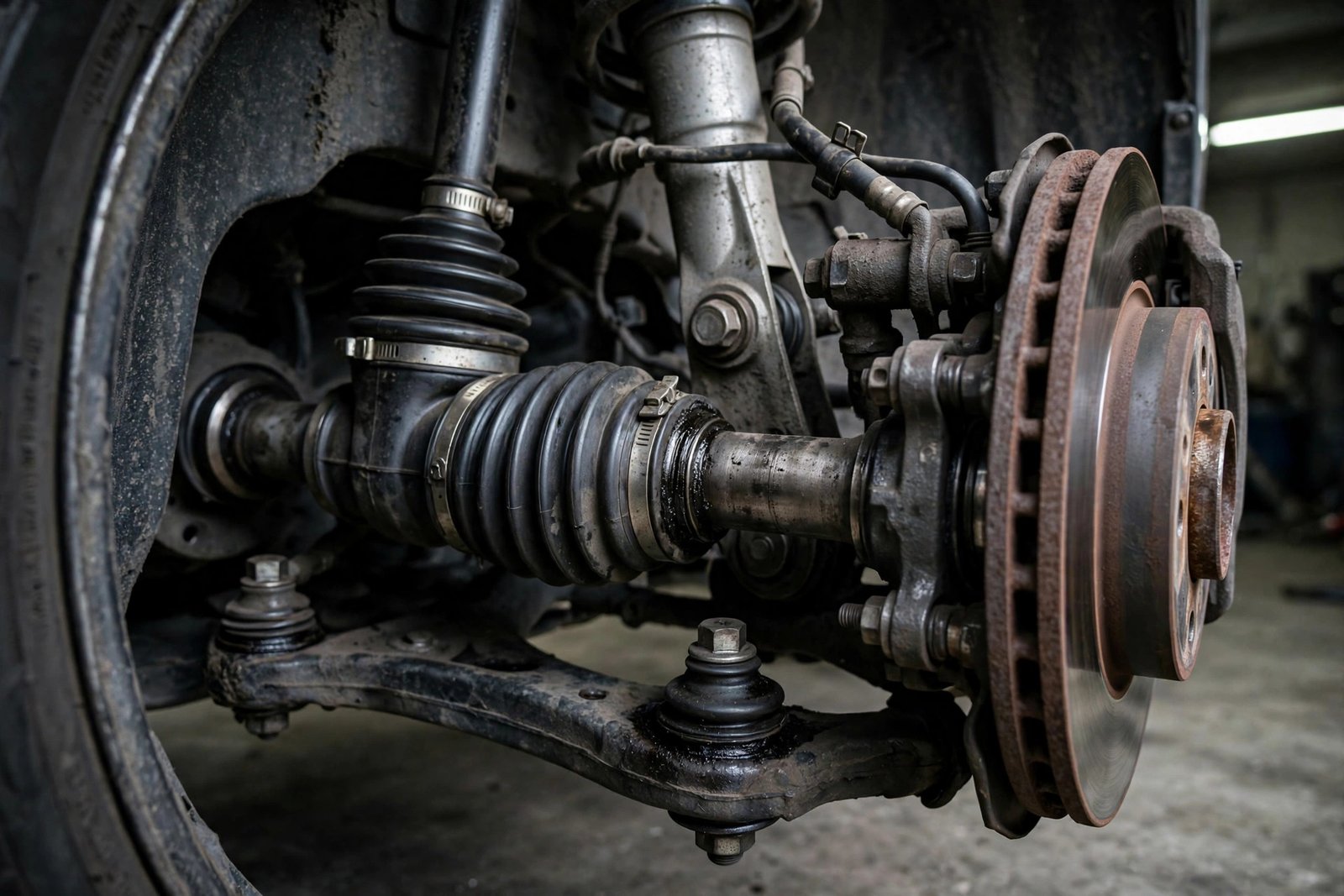
Of all the noises a car makes when turning, clicking is the most specific: a rhythmic click-click-click that speeds up with the wheels and gets worse at full steering lock is the textbook signature of a worn CV (constant velocity) joint. This guide confirms the signature with two tests — and explains why the fix can't wait indefinitely.
In this guide, you'll learn:
- The CV-joint click signature (and how it differs from pops, knocks, and grinds)
- Two confirmation tests you can do in a parking lot
- Why CV joints fail (the torn-boot story)
- Why this topic is diagnosis-only — and the failure timeline
Safety first — read this: A CV joint that fails completely stops transmitting power to that wheel — the car won't move, and if it lets go at speed you lose drive suddenly. This article is diagnosis-only: confirm the pattern and take it to a certified mechanic. Axle/CV replacement is not a driveway job for most drivers — it involves the hub, suspension, and proper torque on critical fasteners.
The Click Signature: Three Hallmarks
It's a CV joint if all three are true:
- Rhythmic — click-click-click at a steady rate, not a single pop or knock.
- Tracks wheel speed — faster when the wheels turn faster, slower when they slow. (Engine RPM doesn't matter.)
- Worst at full steering lock under power — pulling out of a parking space or making a U-turn, foot on the gas.
If your noise is a single heavy knock, see knocking noise when turning. A single sharp pop at turn initiation: popping noise when turning. A harsh continuous grind: grinding noise when turning (late-stage wear — more urgent).
Why CV Joints Click: The Torn-Boot Story
The outer CV joint — the one near the wheel — lets the front wheels receive engine power while steering at sharp angles. Inside a flexible rubber boot, precision ball bearings roll in machined tracks, bathed in special grease.
The failure always starts the same way: the boot tears (age, road debris). Grease flings out; water, grit, and road salt get in. The bearings and tracks wear rapidly, developing play. At sharp steering angles under load, the worn parts bind and snap back with each revolution — click. The signature is so consistent that experienced mechanics diagnose it by ear.
The Two Confirmation Tests
Test 1 — The full-lock circle: In an empty lot, turn the wheel to full lock and drive slow circles, first one direction then the other, with light throttle. Rhythmic clicking from one side = that side's outer CV joint. (Noise usually comes from the joint on the outside of the turn — the one at the sharper angle under load — but confirm by listening, not by rule.)
Test 2 — The grease check: Shine a flashlight at the inside of each front wheel and the rubber boots behind them. Dark grease splattered around = torn boot = the joint has been running contaminated. A torn boot with clicking means the joint is already damaged — rebooting alone won't save it at this stage.
What a Worn CV Joint Means for You
- It won't heal. Once clicking starts, the internal damage is done — the joint only gets louder.
- The timeline is "weeks to months," not years — but it can accelerate without warning, especially under hard acceleration or full-lock turns.
- Complete failure = no drive to that wheel. The car stops moving; if the joint separates at speed, it can damage surrounding parts.
- The repair is a CV axle replacement (the whole axle assembly is the standard fix on most cars) — a routine shop job, not an engine-out affair. Get a quote; don't guess at prices online since they vary widely by vehicle.
Simple Checks You Can Do Yourself
- The full-lock circle test above — the single best confirmation.
- The grease check — torn boot evidence.
- Note the conditions: Which direction? Under power or coasting? Getting louder over weeks? Write it down for the mechanic.
- Check the other side too: CV boots age together. If one side's boot is torn, have the shop inspect the other side while it's on the lift.
When to See a Mechanic — Soon vs Now
This week (don't wait months): Confirmed rhythmic clicking at full lock. It's drivable to a shop, but every full-lock turn under power wears it further.
Now: Clicking that's become loud enough to hear with windows up; clicking joined by vibration; any clunking or grinding replacing the click (the joint is in late-stage failure); grease visibly slinging onto the wheel.
FAQ
Can I drive with a clicking CV joint?
Short term, gently, to a shop — yes. Avoid full-lock turns under power and hard acceleration, which stress it most. Don't plan a road trip on it.
Does a torn boot always mean replacing the axle?
If it's already clicking, yes — the joint is damaged. A torn boot caught before any noise (during an inspection) can sometimes be rebooted, which is much cheaper. That's why the grease check matters.
Front-wheel drive only?
Outer CV joints are on the driven, steered wheels — front on FWD cars, all four on AWD. RWD cars have CV-style joints at the rear but they don't steer, so the full-lock click signature is a FWD/AWD phenomenon.
Clicking when turning vs clicking when starting the engine?
Completely different: clicking at startup with no crank is electrical (starter/battery). Clicking that tracks wheel speed in turns is mechanical (CV). Different guides, different parts.
Sources
- engineerfix.com — "Why Does My Car Make a Clicking Noise When Turning?" (outer CV joint failure mechanism; boot tear; bind-and-release) — https://engineerfix.com/why-does-my-car-make-a-clicking-noise-when-turning/
- slashgear.com — "What Does It Mean If Your Car Is Making A Clicking Sound When You Turn?" (CV joint wear progression; urgency) — https://www.slashgear.com/1476840/car-clicking-when-turning-explained/
- valleyautoelectric.com — "What's That Clicking Sound When I Turn My Steering Wheel?" (CV joints; grease leak; suspension components) — https://valleyautoelectric.com/blog/what-s-that-clicking-sound-when-i-turn-my-steering-wheel
- cartalk.pandahub.com — "Why Is My Car Making Clicking Noise: Causes And Fixes" (clicking-when-turning section; grease splatter tip) — https://cartalk.pandahub.com/car-maintenance/car-making-clicking-noise