
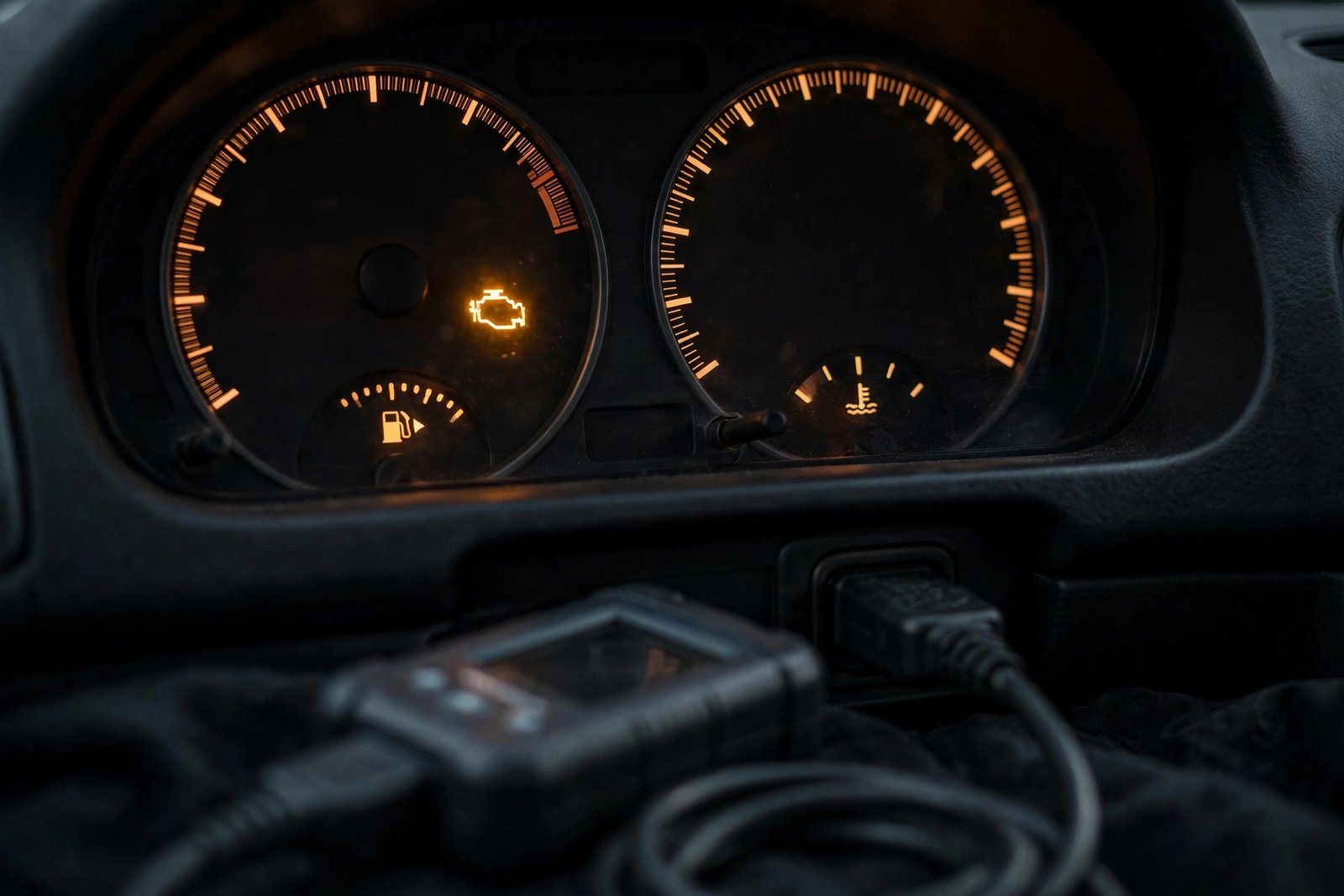
Your check engine light was on yesterday, off this morning, and back again after lunch. Here's the key insight: the light going off does not mean the problem is gone. The computer turns the light off when the fault stops repeating — but it keeps the code stored, and the underlying condition is usually still developing. This guide explains the intermittent pattern and what to do about it.
In this guide, you'll learn:
- Why the light turns itself off (drive cycles, not repairs)
- The difference between "light off" and "problem gone"
- The most common intermittent causes, in order
- How to catch the culprit with stored and pending codes
- When an intermittent light becomes urgent
Why the Light Comes and Goes
Your car's computer runs self-tests (monitors) on emissions and engine systems during normal driving. When a test fails, it stores a code and turns the light on. If the fault doesn't repeat for enough subsequent drive cycles, the computer turns the light off — but the code stays in memory as a history code.
So the pattern is:
- Fault happens → light on. The computer saw the failure.
- Fault stops repeating → light off after several clean cycles. Nothing was fixed.
- Fault returns under the right conditions → light on again. The condition that triggers it (cold start, hard acceleration, highway cruise) came back.
Think of it like a smoke alarm with a dying battery that chirps only on cold nights — the silence between chirps doesn't mean the battery healed.
Urgency Triage
| Pattern | Meaning | Response |
|---|---|---|
| Comes and goes, car runs fine | Intermittent fault; developing problem | Get the stored codes read — don't wait for it to stay on |
| Flashes briefly then stops | Brief active misfire — may have been real | Scan for pending/history codes soon |
| Off now, but came on under load (hills, acceleration) | Load-dependent fault (ignition, fuel, converter) | Diagnose — these worsen with time |
| Was intermittent, now stays on | The fault became permanent | Book a diagnosis promptly |
The Most Likely Intermittent Causes, in Order
1. Loose or marginal gas cap / EVAP small leak
The classic intermittent trigger. The seal is almost good — it passes the pressure test some days and fails others. Tighten or replace the cap first; it's the cheapest hypothesis.
2. Intermittent misfire (spark plugs, ignition coils)
Misfires that happen only under specific conditions — cold starts, hard acceleration, highway cruising — set the light, then clear when conditions change. Repeated misfires quietly damage the catalytic converter even while the light is off.
3. Failing O2 sensor (drifting, not dead)
A sensor that's starting to fail gives bad readings only sometimes. Fuel economy may dip slightly before anything feels wrong.
4. Dirty MAF sensor
Contamination causes erratic airflow readings under certain conditions (humidity, temperature). Often fixable with proper MAF cleaner — but confirm with data first.
5. Loose wiring or corroded connectors
Vibration, heat cycles, and moisture make electrical connections intermittent by nature. These are the hardest to find and the reason "the light was off when I brought it in" is such a common shop story.
6. Early catalytic converter efficiency loss
The converter works well enough most of the time but dips below the efficiency threshold under load — setting and clearing the code in waves.
How to Catch It: Stored, Pending, and History Codes
This is the part most drivers miss: a scan is useful even when the light is off. Ask for (or read yourself):
- Stored/history codes — what the computer saw, even days ago.
- Pending codes — faults detected but not yet repeated enough to light the dash. These are the early-warning system.
- Freeze-frame data — the exact conditions (RPM, speed, temperature, load) when the fault occurred. This is how you reproduce it.
Many auto parts stores scan free, but basic free scans sometimes miss pending codes and freeze-frame — a shop-level scanner catches everything.
What to Do
- Note the pattern. When does it come on — cold start? After refueling? Under hard acceleration? On the highway? Patterns are diagnostic gold.
- Get scanned even with the light off. History and pending codes are the whole point of this article.
- Don't clear codes as a test unless you're deliberately checking whether the fault returns — and understand you'll erase the freeze-frame evidence.
- Fix by evidence, not by guess. Intermittent faults punish parts-swapping more than any other kind.
When It Becomes Urgent
- The light starts flashing — active misfire, possible converter damage.
- The intermittent pattern becomes permanent — the fault won.
- New symptoms appear: shaking, power loss, hard starting, stalling, smells.
- Fuel economy drops noticeably — the engine is compensating for something.
FAQ
If the light is off, can I pass an emissions inspection?
Maybe not — inspectors check the computer's readiness monitors and stored codes, not just the dash. A recently cleared or intermittent fault often shows up as "not ready."
Should I disconnect the battery to reset it?
That clears codes and the freeze-frame evidence your mechanic needs. Only do it if you understand you're erasing the diagnosis trail.
How long until an intermittent light becomes permanent?
No fixed timeline — weeks to months is typical. The trend is always one direction: intermittent faults become permanent faults.
My mechanic said "no codes found" — now what?
Ask specifically about pending and history codes, not just active ones. If the battery was recently disconnected, codes may have been wiped — drive normally for a week and rescan.
check engine light on but car runs fine
Sources
- Mechanic Base — "Why Did the Check Engine Light Suddenly Turn Off By Itself?" (gas cap, refueling with engine running, air-fuel imbalance) — https://mechanicbase.com/warning-lights/check-engine-light-turned-off/
- Dale's Auto Care — "What to Do When the Check Engine Light Comes On" (history codes retained after light goes out) — http://dalesautocare.com/what-to-do-when-the-check-engine-light-comes-on/
- Hal's Auto Care — "Check Engine Light Turns On and Off" (intermittent causes; risks of ignoring) — https://www.halsautocare.com/check-engine-light-turns-on-and-off