
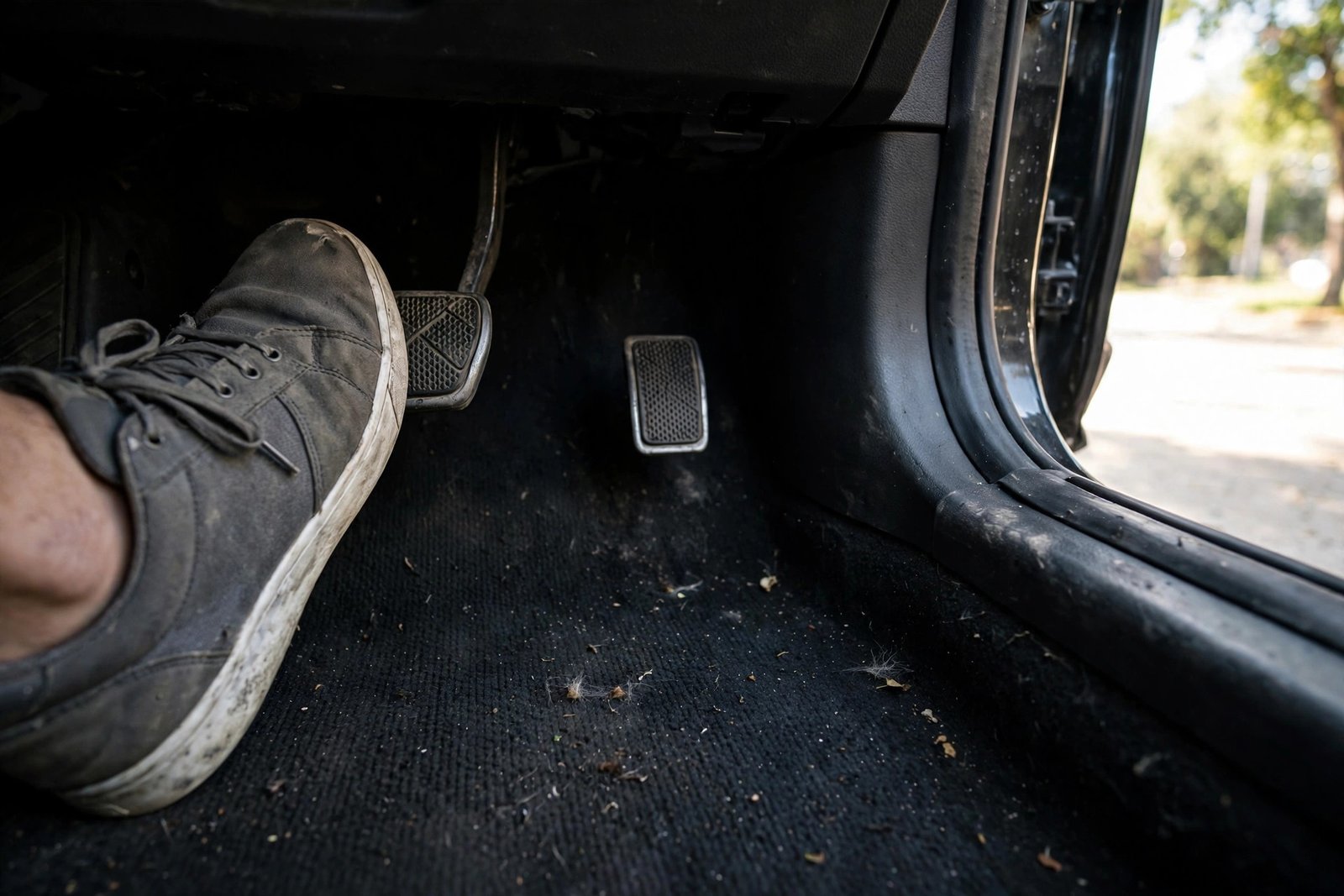
A brake pedal that works fine on Monday and drops to the floor on Tuesday is one of the most frightening symptoms a car can produce — and one of the most misunderstood. “Intermittent” does not mean “mild.” It means a hydraulic fault that comes and goes with temperature, pressure, or the position of a failing seal. Every occurrence is the system telling you it cannot be trusted.
The core message: a pedal that sinks intermittently is a tow-to-the-mechanic situation, not a wait-and-see one. The fault that lets the pedal sink once can let it sink completely the next time — possibly in an emergency stop.
Safety first: If your brake pedal has sunk to the floor even once — even if it feels fine now — do not keep driving. Intermittent hydraulic failure is a known prelude to total failure. Minimize driving, use the parking brake gently as a backup only in a true emergency (never at speed), and have the car towed to a certified mechanic.
In this guide, you’ll learn:
- Normal vs. dangerous: the one distinction that matters
- The most common causes, in order of likelihood
- Why “it went back to normal” is not reassurance
- The simple parked test that points at the master cylinder
- What to tell your mechanic
Normal vs. Dangerous — Read This First
There is exactly one benign explanation, and it’s small:
- Slight pedal-height change at a stoplight (normal): in some cars, when the air conditioning cycles off, engine vacuum rises and the brake booster adds a touch more assist — felt as a small, temporary dip in pedal height while holding the brakes. It’s slight, it’s repeatable, and the brakes still work perfectly. Some manufacturers document this as a normal characteristic.
Everything else — the pedal traveling much farther than usual, needing a pump to recover, or going to the floor — is not normal. If your pedal ever needed pumping to get braking back, that’s a hydraulic fault, full stop.
The Most Likely Causes, in Order
1. Master cylinder internal bypass (most common)
The master cylinder’s internal seals hold the pressure that stops your car. When a seal weakens, fluid slips past it internally — pressure bleeds away and the pedal sinks. The insidious part: there’s no external leak and the fluid level looks normal, because the fluid isn’t leaving the system — it’s just not being pressurized. It starts intermittent (the seal holds sometimes) and gets worse over time. It never gets better.
2. External leak or air in the lines
A weeping line, hose, caliper seal, or wheel cylinder lets fluid out and air in. Air compresses; fluid doesn’t — so pedal travel gets wasted squeezing bubbles. If the pedal needs pumping to recover, air is the classic explanation. low brake fluid symptoms
3. Boiling brake fluid (vapor lock)
Brake fluid absorbs moisture over time, which lowers its boiling point. After heavy braking, the water content can boil into vapor pockets — compressible gas where solid hydraulic fluid should be. The signature: the pedal sinks after hard or repeated braking, then feels normal again once everything cools. Old fluid is the root cause here.
4. ABS hydraulic module internal fault
Inside the ABS unit, solenoid valves and seals control pressure to each wheel. An internal valve leak lets pressure bleed past even with no external loss — producing a slow, intermittent sink, sometimes only at a stoplight. This one can survive a master-cylinder replacement, which is why mechanics test for it specifically.
5. Booster or vacuum issues (rare for sinking)
A failing booster usually makes the pedal hard, not sinking. But vacuum faults can produce odd pedal behavior that mimics sinking — which is why the parked test below matters: it isolates the hydraulics from the booster.
The Parked Test: Pointing at the Master Cylinder
This is an observation test, not a repair — it just gives your mechanic a head start:
- Park on level ground, engine off.
- Pump the brake pedal several times until it goes hard (this exhausts the booster’s vacuum reserve).
- Press and hold the pedal firmly for 30 seconds.
- If the pedal slowly sinks while you hold it — with no external leak visible — the master cylinder’s internal seals are the prime suspect.
- If it stays rock-hard — the fault is more likely elsewhere (ABS module, air, or a heat-dependent fault).
Either way, the car goes to a certified mechanic. This test just tells them where to look first.
Why “It Went Back to Normal” Means Nothing
Intermittent hydraulic faults are dynamic: they depend on seal position, fluid temperature, and pressure. A seal that bypasses when hot can seal again when cold. Vapor that forms under heat condenses when cool. “Fine now” is the fault resting, not the fault healed. Every documented case pattern — forums, shops, manufacturer bulletins — shows the same arc: intermittent, then frequent, then total. The only safe response to the first occurrence is inspection.
How This Differs From a Spongy Pedal
A spongy pedal is consistently soft — every press feels mushy. An intermittent sinking pedal is fine, then suddenly isn’t. The spongy pedal usually means air in the lines or low fluid; the intermittent sink usually means a seal or valve failing dynamically. They’re different faults with different fixes — but the same rule: certified mechanic, promptly. spongy or sinking brake pedal
What to Tell Your Mechanic
“Brake pedal sinks to the floor sometimes” plus: how often it happens, what you were doing when it happened (heavy braking? at a stoplight? cold start?), whether pumping recovered it, what the fluid level shows, the result of the parked test, and whether the brake warning light came on. A shop pressure-tests the hydraulics, checks for external leaks, and tests the master cylinder and ABS module — your timeline tells them which fault pattern to chase.
FAQ
Is it safe to drive if the pedal feels fine right now?
No — that’s the trap of intermittent failure. The seal, valve, or vapor condition that failed once will fail again, and you can’t predict when. Tow it.
Could it just be air in the lines?
Air causes a consistently spongy pedal, not an intermittent floor-drop. Intermittent sinking points more at seal bypass, vapor lock, or an ABS valve fault — all of which need professional diagnosis.
Why does it happen more after heavy braking?
Heat is the trigger for two causes: boiling moisture in old fluid (vapor lock) and thermally-expanded seals bypassing. If your sink follows hard braking and clears when cool, tell your mechanic that pattern — and ask about the fluid’s age.
Can I just top up the fluid and keep driving?
Topping up helps only if the reservoir is actually low — and intermittent sinking usually happens with a full reservoir (internal bypass loses no fluid). If the level is fine and the pedal still sinks, topping up does nothing. Get it towed.